Discovering a €4.19M AI Opportunity in Construction Project Management
How Intelvision is helping a leading German construction consultancy project a ~28% recovery of annual engineering payroll — without adding a single new person
- ~28% of annual engineering payroll projected to be recovered
- 5–6 wk. projected payback period postdeployment
- 947% modelled ROI on €440K Capex investment
The client
A leading German construction project management consultancy operating in the Tier 2 Mittelstand segment, steering complex commercial builds. Their mission: act as a fully independent project partner, take complete ownership of every problem, and represent the client’s interests with absolute integrity.
They are good at what they do. The constraint isn’t capability. The constraint is the compliance framework they are legally required to operate inside.
The client came for better reporting. The real problem was much bigger
German construction project management is governed by AHO Heft 9 — a legally mandated compliance framework interlocked with VOB contract law and HOAI fee scales. Adherence isn’t optional. Every project requires sequential documentation, phase-gate approvals, financial auditing, and legal verification across more than 300 process steps.
The framework is rigorous by design. That rigor is also its structural flaw. The client’s highly skilled Project Steering engineers — people hired to manage complex builds — are currently spending 30–40% of their billable capacity on:
- Manually extracting data across three disconnected systems to compile monthly compliance matrix reports
- Auditing 50–200-page contractor invoices line by line using a desk calculator
- Cross-referencing contract clauses to resolve fee boundary disputes with contractors
- Chasing contractors for missing documents and manually cataloguing thousands of files for handover packages
What the Diagnostic Found
More than 300 process steps were consuming time, attention, and management capacity
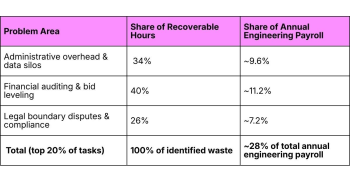
We broke the AHO Heft 9 value stream into 300 granular process steps and measured Processing Time (PT) and Waiting Time (WT) against each one. Across the full project lifecycle, the framework currently consumes approximately 2,550 manual processing hours per project. We identified the top 20% of tasks responsible for 80% of that burden.
Beyond the payroll cost, the diagnostic modelled three further risk areas:
- Missed revenue ceiling: The client is estimated to be forfeiting approximately 44% of additional addressable revenue because it cannot scale output without inflating payroll
- Error risk: Manual bid leveling and payment application auditing carry genuine overpayment risk on multi-million euro contractor invoices
- Working capital drag: Reporting delays push invoice issuance back, creating cash flow latency that currently requires short-term credit to bridge
Approximately 28% of the client’s total annual engineering payroll is currently consumed by administrative tasks that could be automated capital that is fully available for redeployment into billable, revenue-generating work.
The Current State: A Day in the Life
To make this concrete, here is what a single routine request looks like today on a large commercial build. The client (John) needs two things by end of day: the monthly compliance matrix report and a ruling on a significant variation claim from a contractor.
- Tuesday 08:30 — Sarah (Project Steering Engineer) opens John’s email. To compile the matrix report, she logs into three separate software systems and spends four hours manually copying data between screens into a master Excel file.
- Tuesday 13:30 — Sarah starts auditing the contractor’s 50-page variation claim. She manually cross-references hundreds of line items against the baseline Bill of Quantities using a calculator. Four hours later, she finds a discrepancy. She drafts a rejection note and emails the package to Klaus (Project Leader) for sign-off.
- Tuesday 17:30 — Klaus is on site at another project. The email sits unread.
- Wednesday 10:00 — Klaus opens the email. The variation claim requires him to determine the firm’s legal position under contract law. He spends three hours cross-referencing contract clauses and searching his own email archive for a similar ruling from two years prior. He drafts a formal rejection and signs the package.
- Wednesday 14:30 — John receives the documents. He requested them Tuesday morning.
Current cycle time: 30.5 hours | Active engineering time: 11.5 hours | Wait time: 19 hours
For a task that is, at its core, data retrieval and mathematical verification.
The Proposed Solution: Three Targeted Technical Interventions
Rather than a high-risk infrastructure overhaul, the proposed MVP targets exclusively the 60 highest-yielding process steps. Three technical engines, deployed in sequence.
Engine 1 — Data Liquidity (MCP)
Read-only API connections to the client’s existing project management, cost control, and scheduling systems. The engine polls live data, normalises it into a unified structure, and automatically compiles compliance matrix reports and phase-gate documentation packages. No migration. No new core infrastructure. Sits on top of what already exists.
Engine 2 — Deterministic Financial Auditing (OCR + Logic)
Contractors drop their PDF invoices and bids into the platform. OCR extracts every line item. The engine runs a deterministic comparison against the approved baseline — flagging discrepancies, outliers, and mathematical errors instantly. Engineers review exceptions, not entire documents.
Engine 3 — Cognitive Compliance Shield (Localised RAG AI)
A secure, locally hosted AI vector database trained on the relevant contract law, fee scale regulations, and the client’s own historical claim resolutions. When a contractor submits a variation claim, the system queries the database, determines the applicable service classification, and generates a legally cited draft response for the Project Leader to review and sign.
Critical safeguard: No AI output is ever legally committed without human sign-off. RoleBased Access Control ensures engineers can process and verify, but only authorised Project Leaders hold signatory authority. The human remains in the loop at every consequential decision point.
The Future State: The Same Day, Redesigned
- Tuesday 08:15 — Sarah clicks Generate Monthly Matrix Report. The Data Liquidity Engine fires API calls to all connected systems and returns a client-ready report in under two minutes.
- Tuesday 08:20 — Sarah drags the contractor’s 50-page PDF into the platform. The OCR engine reads every line item and flags the discrepancy in 30 seconds. The compliance engine simultaneously drafts a legally cited rejection letter. Sarah adjusts the tone and submits to Klaus for sign-off.
- Tuesday 09:30 — Klaus gets a platform notification. He reviews the AI’s legal citations, sees Sarah’s verification stamp, and approves. The signed package routes automatically to John.
- Tuesday 09:35 — John receives his documents — 95 minutes after his request.
Projected cycle time: 1.5 hours | Projected active engineering time: ~15 minutes
The Projected Investment and Return
The MVP is scoped as a 44-week phased CapEx investment, sequenced so each phase is designed to fund the next.
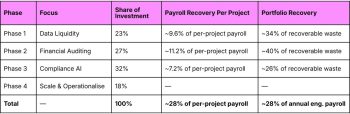
Projected payback period: approximately 5–6 weeks post-deployment.
The modelled ROI sits at approximately 947% — a figure that reflects two realities specific to professional services firms. First, the investment is small relative to the pre-existing revenue engine it is being applied to. Second, once the software is built, the marginal cost of compiling the 100th report versus the 1,000th is effectively zero.
Important caveat: The return is only realized if the client actively redeploys the recovered capacity into new, billable market share. The platform removes the administrative ceiling. The commercial team fills the space.
What This Is Projected to Mean for the People Inside the Business
- Project Steering Engineers are projected to shift from acting as manual data clerks to doing the strategic construction management they were trained and hired for
- Project Leaders are projected to stop spending 3-hour blocks on baseline legal research and become executive reviewers of AI-generated, legally cited drafts
- Project Manager capacity is projected to increase by approximately 67% in concurrent project throughput — same person, same stress level, significantly more output
- The firm is projected to absorb substantially more concurrent projects with zero headcount increase, with EBITDA margin expansion from the current ~18.9% to a projected ~42.6%
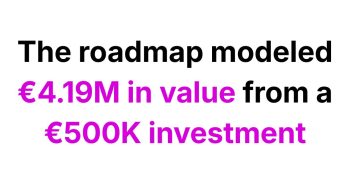
The audit became a broader operating model transformation
The most important projected outcome isn’t a percentage. It’s a structural change to the business model.
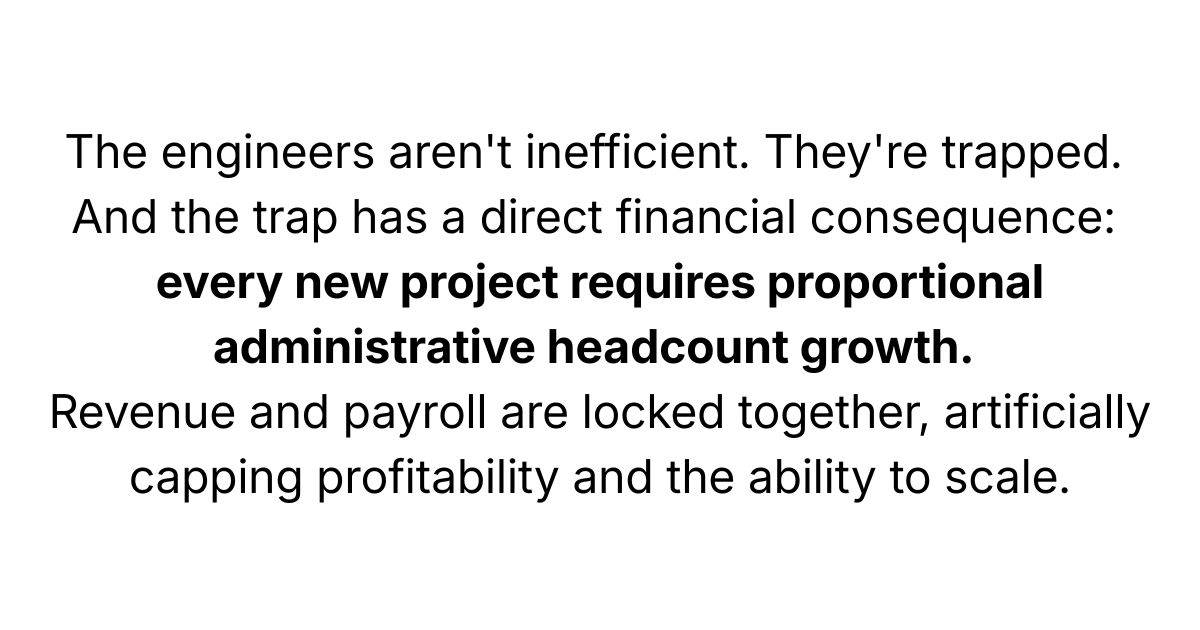
Currently: every unit of new revenue the client acquires requires a proportional increase in administrative payroll to manage the compliance paperwork behind it. Growth has a ceiling built into its own cost structure.
With the platform live: the marginal cost of taking on a new project is no longer administrative headcount. It becomes engineering time spent on actual construction management. Revenue and payroll are decoupled.
That isn’t an efficiency improvement. That’s a different business model — and it’s what this engagement is being built to deliver.