Rebuilding Delivery System in B2B SaaS
How Intelvision rebuilt a European B2B software company’s entire product delivery system — from the inside
- >90% of user stories are disconnected from any business capability
- ~10% of annual revenue exposure lost to poor quality costs
- 3+ yrs of embedded partnership before the audit was initiated
The product was moving, but the business value was getting harder to see
A European B2B software product company with a complex, integration-heavy product and a longterm commercial roadmap. Intelvision had been working with this client for more than three years, with our engineers embedded directly in ongoing product development. Work was moving. Tickets were being completed. Features were being discussed. We were the ones who saw the problem first.
The Problem Nobody Had Named Yet
The client didn’t come to us asking for a transformation. There was no crisis moment, no failed launch, no boardroom ultimatum. From the outside, the project looked active.
But from the inside — after three years of deep involvement — we could see that development activity had quietly decoupled from business outcomes. The team was building things. It was increasingly difficult to explain what those things were worth.
That gap, left unaddressed, compounds. And it was already compounding.
We initiated a structured audit. The client hadn’t asked for it. We did it because we believed we had a responsibility to.
What the Audit Revealed
The Majority of User Stories Were Floating Free
The most striking finding: more than 90% of existing user stories were not clearly linked to any business capability, product goal, or roadmap priority.
The team wasn’t idle. The backlog was full. But the work existed largely as isolated tasks — tickets assigned, completed, and closed without a clear thread connecting them to the product’s commercial direction.
When user stories are disconnected from business capabilities, leadership faces a persistent and corrosive problem: they can see that the team is busy, but cannot answer the questions that actually matter.
- Which business capability did we advance this sprint?
- Which customer problem did we solve?
- What value did we create last month?
- Is this feature worth the investment?
- Where does this ticket fit in the roadmap?
These aren’t reporting questions. They’re the questions that drive sound product investment decisions. Without answers, those decisions default to instinct.
Product Ideas Were Leaking Out of the Pipeline
The client had real commercial insight. Their leadership team spoke regularly to customers, identified market gaps, and generated a consistent flow of product ideas worth exploring.
Those ideas weren’t being captured, structured, or progressed systematically. There was no defined path from a conversation in a sales call to a validated opportunity, from a validated opportunity to a refined requirement, and from a refined requirement to a development-ready user story.
Ideas entered the system informally and often lost their original business context by the time they reached a developer’s queue. The gap between strategic intent and technical execution was structural, not a matter of individual effort.
Quality Issues Were Carrying a Hidden Business Cost
The product had recurring quality problems: bugs, rework, incomplete implementations. The visible cost was development inefficiency: time spent fixing things that should have been right.
The larger cost was less visible: delayed releases, slower go-to-market, leadership time diverted into checking and correcting delivery, and missed sales cycles where a prospect needed a capability the team was still reworking.
We modelled the financial exposure across three dimensions, expressed as a share of total modelled monthly revenue exposure:
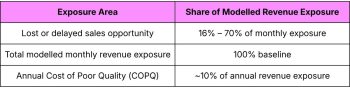
These figures represent modelled exposure, not guaranteed losses. But they changed the nature of the conversation from “how much development work is being done?” to “how much business value is being created or destroyed?”
System Visibility Design & Tasks in Progress
- The product relied on multiple technical components and integrations. When something failed, diagnosing it was slow. The client had limited structured visibility into system availability, integration failures, operational bottlenecks, and root causes of incidents.
Leadership operated reactively, learning about problems after they had already impacted users or sales conversations.
- The team consistently had more items started than finished. In software delivery, that’s not a sign of ambition — it’s a signal that flow is broken. Incomplete work accumulates context-switching costs, obscures genuine progress, and makes it harder for anyone to point to a finished capability and say: that shipped, and it works
We stopped treating tickets as tasks and rebuilt delivery around product value
The goal wasn’t to improve developer output in isolation. It was to connect product strategy, roadmap planning, project management, and technical execution into a single, coherent delivery system. We rebuilt the client’s delivery model across three levels simultaneously.
Strategic Level: Clarifying What Mattered Most
We worked with leadership to articulate product direction, map business capabilities, and establish commercial priorities. This gave the roadmap a backbone — a set of clearly defined outcomes that development work could be anchored to.
Tactical Level — Translating Strategy into Buildable Units
We translated strategic priorities into epics, features, and release plans — each one explicitly connected to a business capability. Investment decisions at this level were evaluated against expected business value, not just development cost.
The question shifted from “how long will this take?” to “what does this unlock, and is it worth unlocking now?”
Delivery Level — Rebuilding Execution Around Shipped Outcomes
We restructured the sprint-to-release cycle around completion, not activity. Each user story was required to trace upward to a feature, a capability, and a business goal. Work that couldn’t make that connection was either restructured or removed.
What Changed
1. Development became legible to the business
Before the transformation, more than 90% of user stories were disconnected from any clear business purpose. After the transformation, every backlog item could be traced to:
- A business capability
- A roadmap priority
- A customer need
- A commercial outcome
Leadership could now look at any sprint and understand what was being built, why it mattered, and what value had shipped.
2. Jira became a product delivery system, not a task board
Jira was restructured into a full product delivery hierarchy:
- Ideas
- Opportunities
- Business capabilities
- Features
- User stories
- Sprints
- Releases
This made delivery traceable from strategic intent to production release. Nothing floated free, and every item had a defined place in the product system.
3. Investment decisions became evaluable before work started
The client could compare the cost of building a feature against its expected business value before committing engineering capacity.
Each initiative could now be assessed by:
- Revenue opportunity
- Customer impact
- Delivery effort
- Technical complexity
- Roadmap importance
This shifted prioritization from opinion-based backlog management to a more disciplined investment conversation.
4. The delivery model became structured and measurable
We introduced a proactive full-stack audit and a defined idea-to-release pipeline. Product ideas now moved through a clear sequence:
- Idea capture
- Refinement
- Development
- Testing
- Product owner review
- Release
The transformation was measured through three operating metrics: First-Time Yield, System Availability and Visibility, and Work in Progress. This made the before-and-after comparison concrete and auditable.
5. Leadership gained proactive visibility and control over financial exposure
With the new operating model, leadership could see which ideas were being evaluated, which features were in refinement, which capabilities were in development, and which releases were planned.
Financial exposure also became manageable through:
- Reduced rework
- Better quality control
- Clearer delivery visibility
- Stronger linkage between delivery activity and revenue opportunities
The headline shift: development stopped being a collection of disconnected tickets and became a business-readable product delivery system.