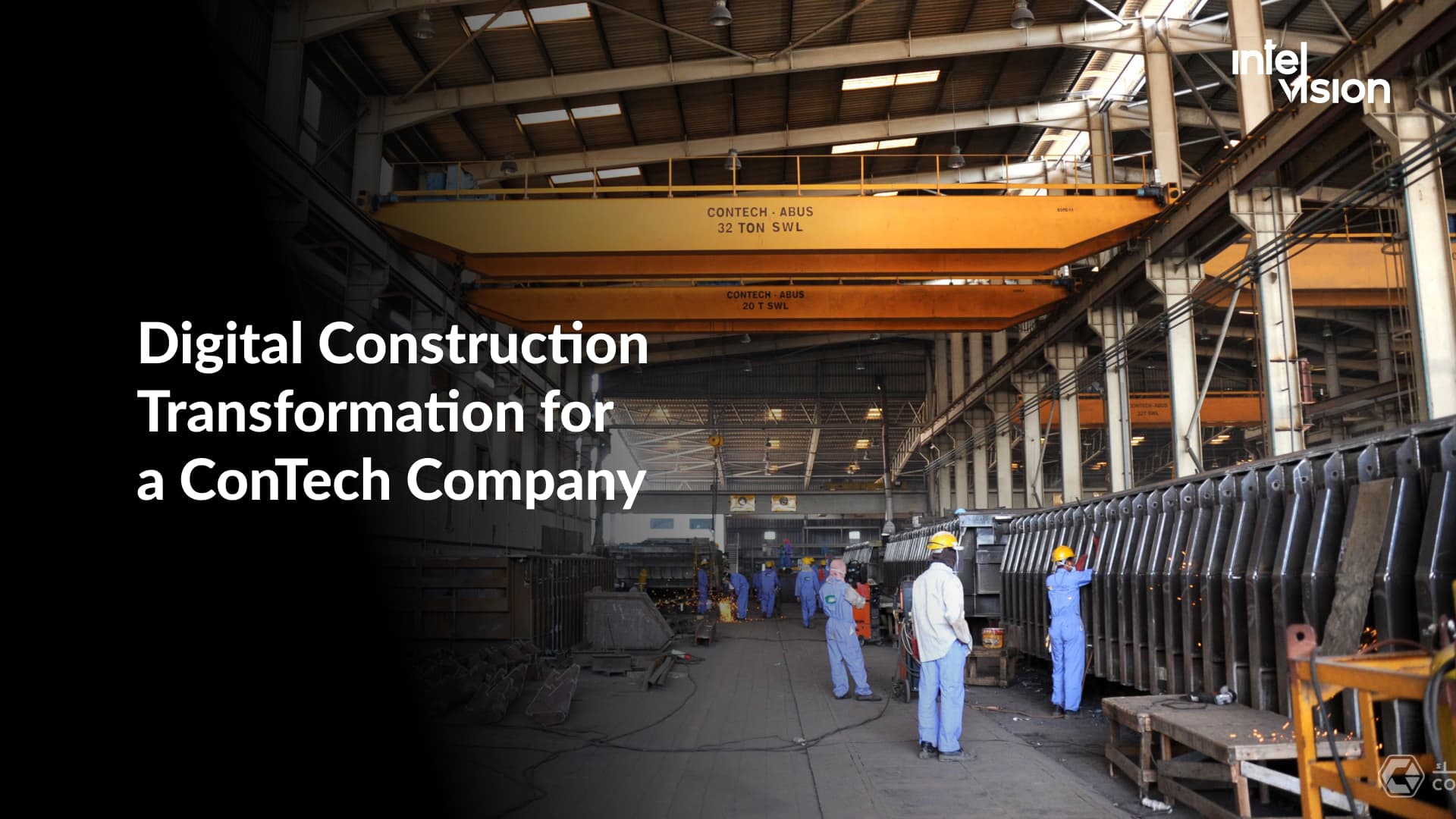
Digital Construction Transformation for ConTech Companies: The DACH Guide for 2026
What's new: New market data, re-checked startups (all three still operating), EU product rules, a ConTech playbook, R&D tax changes and an FAQ; an unsourced investment figure was removed.
Summarize with AI
Read summarized version with AI
- DACH construction is growing slowly (1% real in Germany in 2026), so ConTech products win on measurable savings, integration and compliance rather than novelty.
- Demand signals are strong in specific places: housing permits up 12.1%, rising public orders and a serial renovation market dena estimates could reach €500 billion by 2045.
- Growing segments include AI for documents, ESG and decarbonization data, CDEs and BIM collaboration, focused access and operations tools, field apps and renovation software.
- Vendors now carry EU duties of their own: Data Act access rights, Cyber Resilience Act vulnerability reporting from September 2026 and AI Act rules for worker-monitoring features.
- Own one painful workflow, design for interoperability and the field, keep engineering cost flexible during long sales cycles and check R&D tax incentives early.
From climate-conscious buildings to AI that reads contracts and invoices, construction and property technology is changing how Germany, Austria and Switzerland build, manage and invest in real estate. For a ConTech or PropTech company, that sounds like a growing market. In practice, 2026 is a year in which DACH buyers are careful, budgets are tight and regulation is adding duties for software vendors as well as for builders.
This guide is written for founders, CTOs and product leads of ConTech and PropTech companies that sell into the DACH region. It covers what the market numbers say this year, what is driving adoption, which segments are gaining traction, how the three countries differ, what holds vendors back and a practical playbook for building a product that construction and real estate firms actually adopt.
What digital construction transformation means for a ConTech company in 2026
For a contractor or developer, digital transformation means replacing paper, email and disconnected tools with structured data that flows from design to site to operation. For a ConTech company, it means something more specific: your product either becomes part of that data flow, or it becomes one more silo that the client will eventually replace.
That shift changes what wins deals. A good demo and an enthusiastic innovation manager are no longer enough. DACH buyers now ask three questions first: what does it save us in money or hours, does it connect to what we already use, and is it compliant? The rest of this guide is organized around those questions.
Market momentum: what the 2026 numbers say
The DACH construction market is large, but not booming. The German figures, which set the tone for the region, show a mixed picture:
- Thin growth, squeezed margins. The German construction industry federation (HDB) expects only 1% real revenue growth in 2026, down from 2.5% forecast in January. About three quarters of its members say they cannot pass higher energy, diesel and material costs on to clients.
- A filling pipeline. Permits for 169,400 dwellings were issued from January to August 2026, up 12.1% on the previous year, and 760,700 approved dwellings are still waiting to be built.
- Public money is starting to move. New orders in public construction rose 22.7% in nominal terms in May 2026 compared with a year earlier, according to the HDB, although the federation says construction activity still lags behind the stimulus expected from the federal special fund for infrastructure.
- A new renovation market. Serial renovation has generated about €2 billion in turnover so far, and the German Energy Agency (dena) estimates the market could reach €500 billion by 2045.
- Room to grow in AI. Only 10.79% of EU construction enterprises used AI in 2025, compared with 24.82% in real estate, according to Eurostat. In a RICS survey, a quarter of firms planned to increase AI spending, 28% had no plans to and 22% were unsure.
The first version of this article quoted a total for DACH PropTech investment. We have removed it because we could not trace it to a source we could verify. Reliable, comparable funding data for DACH ConTech is scarce; demand signals like the ones above are a better guide for product decisions than headline investment totals.
What's driving adoption in the DACH region
- Energy and carbon rules. The recast Energy Performance of Buildings Directive had to be transposed by 29 May 2026. It makes energy performance certificates digital, requires building automation in non-residential buildings and requires life-cycle carbon disclosure for new buildings over 1,000 m² from January 2028 and for all new buildings from January 2030. National energy laws such as Germany's GEG sit on top.
- Investor and lender pressure on ESG data. EU corporate sustainability reporting has been postponed for many companies and its standards simplified, as the European Commission sets out, but investors still ask for carbon and energy data across portfolios.
- Talent shortages. 28% of European construction firms say a lack of staff limits output, Oxford Economics reports. The same shortage hits property operations, which pushes demand for automation.
- Public client requirements. In Germany, BIM has been the standard method for federal trunk roads since 2025 and is being introduced for federal buildings through a step model up to 2027.
- Rising tenant expectations around digital service and transparency.
- Growing acceptance of SaaS in conservative construction and real estate firms, provided data is hosted in the EU.
Segments gaining traction
These segments line up with the demand and regulatory signals above. Compared with our 2025 list, AI-driven document work has moved up and some earlier bets have cooled:
- AI for documents and workflows. Extracting data from contracts, invoices and technical reports, and drafting responses for project and asset managers. Berlin-based Architrave, for example, now combines its data room and asset management platform with AI tools for classification and deep data extraction from contracts, ESG reports and due diligence documents.
- ESG and decarbonization data platforms. BuildingMinds describes itself as an AI-powered data platform for real estate decarbonization, with CapEx and carbon pathway modeling and reporting for GRESB, SFDR, the EU Taxonomy and CRREM.
- Common data environments and BIM collaboration. Platforms that hold plans, documents, IFC models and issues in one project space, such as Visoplan, whose development we support.
- Access and building operations. Sensorberg, which we named in 2025 among notable German startups, now focuses on keyless digital access for self-storage, coworking and commercial real estate, with offline operation and audit logs. That kind of focus on one clear use case is a pattern worth noting.
- Field and inspection apps that replace paper on site and generate compliance documentation automatically.
- Industrialized construction and serial renovation software: scan-to-BIM, configurators and production planning that connect a building survey to a factory order.
We have dropped two items from our 2025 outlook: blockchain-based leasing and document flows, and tenant apps growing into "lifestyle platforms". Neither shows up in the regulatory or demand signals above, so treat them as long shots rather than priorities for this year.
Country-by-country highlights
Germany
- The largest market, with public infrastructure, housing and serial renovation as the main demand pools.
- BIM is the standard on federal roads; federal buildings follow up to 2027. Vendors selling to public clients need IFC and BCF support, not just proprietary formats.
- A national framework agreement for serial renovation, tendered EU-wide in September 2026 by GdW, HDB and dena, creates demand for survey, configuration and logistics software.
- Germany's R&D tax allowance became more generous: for eligible expenses from 1 January 2026, the maximum assessment basis rises to €12 million a year and the flat rate for in-house work to €100 per hour. ConTech companies with a German tax seat that run genuine R&D projects should check eligibility with the certifying body (BSFZ).
- All three startups we named in 2025 (BuildingMinds, Sensorberg and Architrave) are still operating, each with a sharper focus than before; Sensorberg and Architrave are based in Berlin.
Austria
- Digital Findet Stadt, the Austrian innovation platform for the construction and real estate industry, runs training, AI consulting and innovation labs, including a certification for AI managers in construction and real estate starting in November 2026.
- Circular construction and building on existing stock were both topics of the platform's events in autumn 2026, which matches the renovation-led demand seen in Germany.
Switzerland
- Bauen digital Schweiz (buildingSMART Switzerland) is preparing a recommendation on data dictionaries to give the industry a common data language and has invited the industry to help build an object catalog for information delivery during construction.
- The Swiss contractors' association Baumeisterverband reported in October 2026 on an AI tool that bundles the rules for sustainable building, a sign that AI for regulatory knowledge is reaching mainstream contractors.
- For vendors, the Swiss focus on shared data standards means interoperability is a buying criterion, not an extra.
Challenges holding back ConTech and PropTech companies
The challenges we listed in 2025 are still the main ones, and each now has a clearer answer:
- Long sales cycles with conservative buyers. Shorten them with a paid pilot that has a baseline and agreed KPIs, rather than free proofs of concept that never end.
- Fragmented regulation. Building law sits with the 16 German states, the nine Austrian states and the 26 Swiss cantons. Design configurable rules and local-language content from the start.
- Integration with legacy systems. ERP, accounting, CAFM and building management systems are rarely modern. Budget integration work in every deal, and offer open APIs and exports.
- Resistance from non-technical users. Most adoption problems are product problems in disguise. Our guide to overcoming tech adoption barriers in construction covers what buyers will expect from you.
- New EU product duties. The Data Act has applied since 12 September 2025 and gives users access to data from connected products. The Cyber Resilience Act requires manufacturers of products with digital elements to report actively exploited vulnerabilities from 11 September 2026, with main obligations from 11 December 2027. Under the AI Act, features that allocate tasks or monitor and evaluate workers fall into the employment category of Annex III, whose high-risk obligations apply from 2 December 2027 under the current timeline.
A transformation playbook for ConTech companies
- Own one painful workflow. Pick a process where clients lose measurable time or money, such as invoice checking, defect management or handover documentation, and become the best at it before expanding. Show the saving in the client's terms; our guide to the cost and ROI of construction tech describes how buyers calculate it.
- Design for interoperability. Support IFC and BCF where models are involved, offer an API and full data export, and map your data to the client's identifiers for projects, cost codes and assets.
- Build for the field. Offline capture, short workflows, photos and plans as input, German and other site languages.
- Make compliance a product feature. EU hosting, a data processing agreement, a vulnerability handling process for the Cyber Resilience Act, data access for the Data Act and an honest classification of any AI feature under the AI Act.
- Use AI where results can be checked. Keep calculations deterministic where money is counted, show sources for generated text and require human sign-off for contractual output. That is how we designed the AI roadmap for a German construction project management consultancy, which modeled €4.19M in value and about 947% ROI on an investment of about €500k.
- Plan engineering capacity for a long market. DACH sales cycles are slow, so burn rate matters. Keep product ownership and architecture in-house and add capacity flexibly. Our work with Visoplan scaled a dedicated team from one to five people, with published results of 50% lower development costs and 40% faster time to market. For ING+, a German infrastructure management platform that uses automation and AI, two senior full-stack developers and a QA specialist were onboarded in 18 days and proposed a phased migration from Blazor to Angular; the published results include a 40% reduction in development costs.
- Decide what to build and what to buy. Authentication, document viewers, payments and many integrations are commodities. Build what makes you different. Our article on building vs buying software for PropTech startups goes through the trade-offs.
- Fund R&D smartly. Check R&D tax incentives early. The published case of a German property management platform we supported notes a 30% development cost optimization from competitive rates, and that R&D tax incentives reduced development costs by a further 20 to 30%.
How AI-assisted development changes the ConTech build
AI coding tools are now standard: the 2025 DORA report found that 90% of technology professionals use AI at work and more than 80% believe it has increased their productivity. The same report found a positive relationship between AI adoption and delivery throughput, but a continuing negative relationship with delivery stability.
For ConTech companies, this cuts both ways. Integrations, admin tools and prototypes are cheaper to build, which lowers the cost of meeting each client's integration needs. At the same time, competitors can copy features faster, so differentiation moves to domain depth, data quality and trust. And because construction clients punish unstable releases, the gains only count if testing, code review and release discipline keep up with the faster pace of change.
Common mistakes ConTech companies make in DACH
- Selling innovation instead of savings. Buyers with 1% growth do not buy innovation; they buy hours and euros back.
- Closed data. A product that cannot export or connect will be replaced when the client standardizes.
- Underestimating localization. German-language UX, local standards and support hours are table stakes.
- Endless free pilots. Paid pilots with a decision date get decisions.
- Treating security as paperwork. With CRA reporting live from September 2026, a vulnerability process is part of the product.
- Scaling the team before the use case. Prove one workflow, then grow capacity.
What to expect next
- AI copilots for project and asset managers, grounded in each client's own documents and contracts, with human review built in.
- Construction and PropTech hybrids that treat building and operation as one data flow, from BIM and handover data to operation and carbon reporting.
- Software for industrialized renovation, driven by frameworks such as serial renovation in Germany.
- More consolidation, as larger vendors and established construction and real estate groups buy focused products that already have customers. This is our expectation, not a forecast from a published source.
- Interoperability as a buying criterion, pushed by Swiss data dictionaries, German public BIM requirements and the EU Data Act.
Final thoughts
DACH is not an easy market for ConTech and PropTech companies, but it rewards those who solve one expensive problem well, connect to everything around it and take compliance seriously. Companies that focus on sustainability data, automation and simple onboarding, and that keep their engineering cost under control during long sales cycles, are the ones that will shape the next decade of digital construction in the region.
If you are building a ConTech or PropTech product and need senior engineers who know construction and real estate software, see how we support construction tech and PropTech companies.
Sources
- HDB: BAUINDUSTRIE senkt Umsatzprognose 2026 (25 August 2026)
- HDB: Baugenehmigungen im Aufwind, aber der Neubau braucht Planungssicherheit (16 October 2026)
- HDB: Der Bau kommt nur langsam aus dem Tritt (24 July 2026)
- HDB: Serielles Sanieren soll Standard werden (1 September 2026)
- Eurostat: Use of artificial intelligence in enterprises
- RICS: Optimism high for AI in construction, but skills shortages and integration challenges slow adoption (September 2025)
- European Commission: Energy Performance of Buildings Directive
- European Commission: Corporate sustainability reporting
- Oxford Economics: Labour shortages remain an entrenched challenge (October 2025)
- BIM Deutschland: BIM for federal trunk roads
- Architrave
- BuildingMinds
- Sensorberg
- BSFZ: Forschungszulage and the Investitionssofortprogramm
- Digital Findet Stadt
- Bauen digital Schweiz / buildingSMART Switzerland
- Schweizerischer Baumeisterverband
- European Commission: Data Act
- European Commission: Cyber Resilience Act
- EU AI Act Annex III: High-risk AI systems
- EU AI Act implementation timeline
- Google Cloud: Announcing the 2025 DORA report
Read Intelvision often? Add us as a preferred source in Google Search.
Add to preferred sources