Energy consulting, Germany
Energy Modernisation Advisor
A German energy-efficiency consulting company needed to stabilise its development team, reduce delivery friction, and build the process foundation for sustainable product growth.
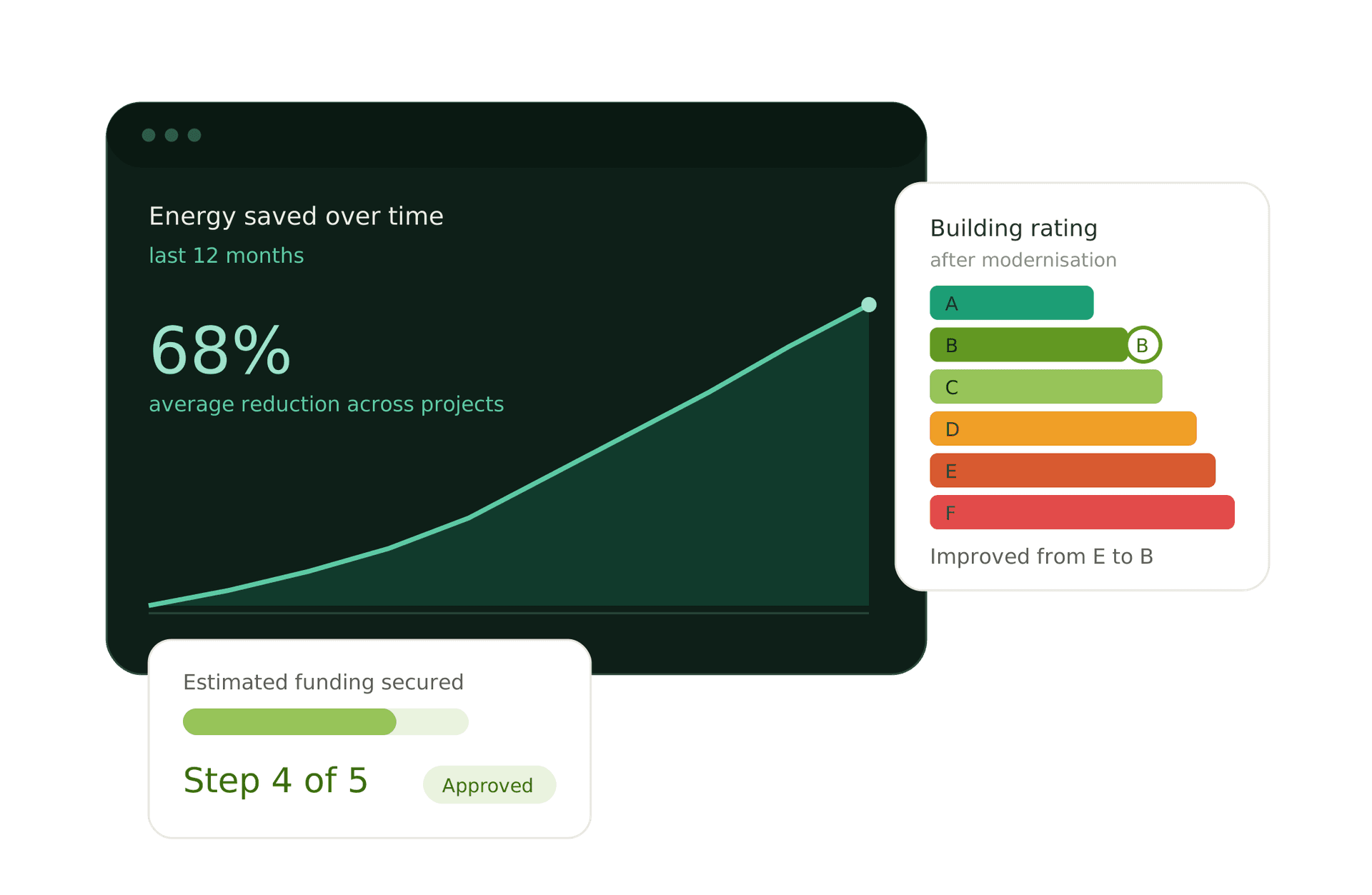
The engagement
- Key result
- 15+structural issues resolved
- Time to engage
- under 2 weeks
- Team involved
- 1 business analyst, 1 dedicated project manager, development team
- Duration
- 8+ months
- Scope
- Process audit, PM restructuring, tooling migration, delivery optimisation
- Tech stack
- Backend
- .NET
AI- AI Automation
Cloud & infrastructure- Azure
CMS- WordPress
Product tools- Jira
- Confluence
About the company
The client helps homeowners and businesses access German government funding for building renovation and energy modernisation. It connects property owners, construction trades, and funding institutions such as BAFA and KfW, managing consulting, applications, and project coordination end to end.
- Energy consulting
- Germany
- 20+ in-house specialists
- Building renovation
Project Overview
The client was scaling its digital product but operating without the process infrastructure to support it. The founding CEO was simultaneously holding the CEO, Product Manager, and Project Manager roles. The team was capable and motivated, but working under conditions that created bottlenecks, miscommunication, and delivery inconsistency at every level. Intelvision was brought in to audit the full operation, identify the structural gaps, and lead the remediation process.

Challenges
Single point of failure at the top
The CEO was responsible for product vision, sprint planning, task prioritisation, stakeholder communication, and day-to-day project decisions all at once. Every decision had to pass through one person. When that person was unavailable, progress stalled. The team had no fallback and no authority to move independently.
Meeting overload draining capacity
Monday sessions ran for entire mornings without a clear agenda or defined outcomes. Daily standups included up to sixteen participants, the majority of whom had no relevant input to give or receive. One team member was losing roughly thirty percent of their available weekly hours to unproductive meetings alone. Deep work time was being systematically destroyed.
No shared source of truth
Feedback, decisions, and task updates were scattered across four separate tools. Developers regularly missed comments left in design files. Requirements were communicated verbally and never written down. There was no consistent record of what had been agreed, who had approved it, or what the current priority was.
Knowledge locked in individuals
There were no handover processes before team members went on leave. When someone was absent, the remaining team absorbed the pressure without structure or documentation to rely on. Knowledge lived in people’s heads, not in systems.
Estimation accuracy too low to plan around
When working with unfamiliar technologies, developers could not reliably estimate how long tasks would take. Deadlines slipped repeatedly. Sprint planning was built on guesses, and re-prioritisation became a constant reactive exercise rather than a structured decision.
Solution
Intelvision conducted a structured audit across four dimensions: organisational processes, communication and collaboration, resource capacity, and individual team wellbeing. From that audit, a remediation plan was built and executed in close collaboration with the client team.
The engagement included a dedicated Project Manager hired to relieve the CEO of operational overhead, a restructured meeting framework that reduced wasted time across the board, a single agreed source of truth for tasks, decisions, and feedback, and a knowledge transfer framework tested and validated through a real team absence.
The partnership covered:
Dedicated business analysis
a structured review of every pain point, translated into a prioritised remediation roadmap.
Process redesign
sprint cadence, retrospectives, Definition of Done, and backlog management rebuilt from the ground up.
Tooling migration and governance
centralised task management, agreed channel rules, and documented requirements as the new standard.
Ongoing advisory
continued support as the team works through the remaining items on the roadmap.
How we solved the challenges
Relieving the CEO bottleneck
A dedicated Project Manager was placed to take over sprint planning, task coordination, and team communication. The CEO now focuses on product strategy and vision. Decision-making is distributed and no longer dependent on a single person being available.
Rebuilding meeting culture
Monday sessions were restructured and spread across the week. Daily standups were reduced to the core product team only, capped at thirty minutes. Participants attend because they are relevant, not by default. The team recovered meaningful deep work time.
Creating a single source of truth
One tool per purpose. Task comments in the project management system. Design and copy feedback in the design tool. Daily communication in the team chat. Written requirements in every task. Verbal-only handoffs eliminated.
Protecting knowledge continuity
A handover framework was documented and tested successfully during a real team absence. Processes are now in the knowledge base, not in people’s memory. Coverage no longer depends on one person knowing everything.
Building estimation reliability
Time tracking is active and historical data is accumulating. Estimation accuracy now reaches 85–93% depending on the sprint and the tasks. It varies rather than holding at one number, but the data foundation is in place to keep it consistent.
Project features
- Structured process audit across processes, communication, resource capacity, and team wellbeing
- Prioritised remediation roadmap built from every identified pain point
- CEO bottleneck removed, with a dedicated Project Manager taking over sprint planning, task coordination, and team communication
- Meeting culture rebuilt, with stand-ups limited to the core product team
- Rebuilt Scrum process: sprint cadence, retrospectives, Definition of Done, and backlog management
- Single source of truth, with written requirements in every task
- Knowledge handover framework, documented and validated during a real team absence
- Time tracking and estimation baseline built on historical sprint data
- Infrastructure migrated and stabilised on Azure, with development ongoing
Results
- 15+
- structural issues resolved
- 8+ months
- continuous process partnership
- 4
- tools streamlined, one per purpose
- 30 min
- daily stand-up limit
- 85–93%
- estimation accuracy achieved
Strike Team
Senior engineering leaders find the real constraint in a fixed-fee engineering diagnostic, then stay to fix it. Project rescue, fractional CTO, architecture and business cases.
About the Strike TeamMore case studies
All 44 case studies
A small efficiency request became a €4.19M board-ready roadmap
A German construction consultancy asked to save time on manual work. We mapped 300+ process steps and turned the request into a board-ready roadmap worth a modelled €4.19M.
- Team
- Wayne Arendse, Delivery & Transformation Lead; Yurii Kotula, CEO & Engineering Leader

An efficiency and infrastructure request became a roadmap, redistributed roles and trackable delivery
The founder of a German energy-efficiency consultancy held three roles at once. A free audit led to a dedicated project manager, shorter standups and one place for all work.
- Team
- Wayne Arendse, Delivery & Transformation Lead; Yurii Kotula, CEO & Engineering Leader

One month to a unified codebase, and direction for a team flying blind
A German licensing platform was moving from WordPress to Next.js. In about a month more than five repositories became one, and we named the missing planning layer that kept the team waiting.
- Team
- Wayne Arendse, Delivery & Transformation Lead; Yurii Kotula, CEO & Engineering Leader
Let’s talk
We usually start with advice. You get a direct answer on whether we can help and what should happen first.

Talk to an expert
Yurii Kotula
CEO and Engineering Leader
Your first call is with Yurii. Send the form, or pick a time in his calendar.
Book a call with Yurii