Licence EdTech Platform
A German EdTech scale-up running a digital licensing platform modernised its platform architecture to deliver faster product development and serve a growing base of learners across the DACH region.
- Time to hire: 16 days on average
- Core team: 2 full-stack developers, 1 back-end developer
- Duration: ongoing
About the company


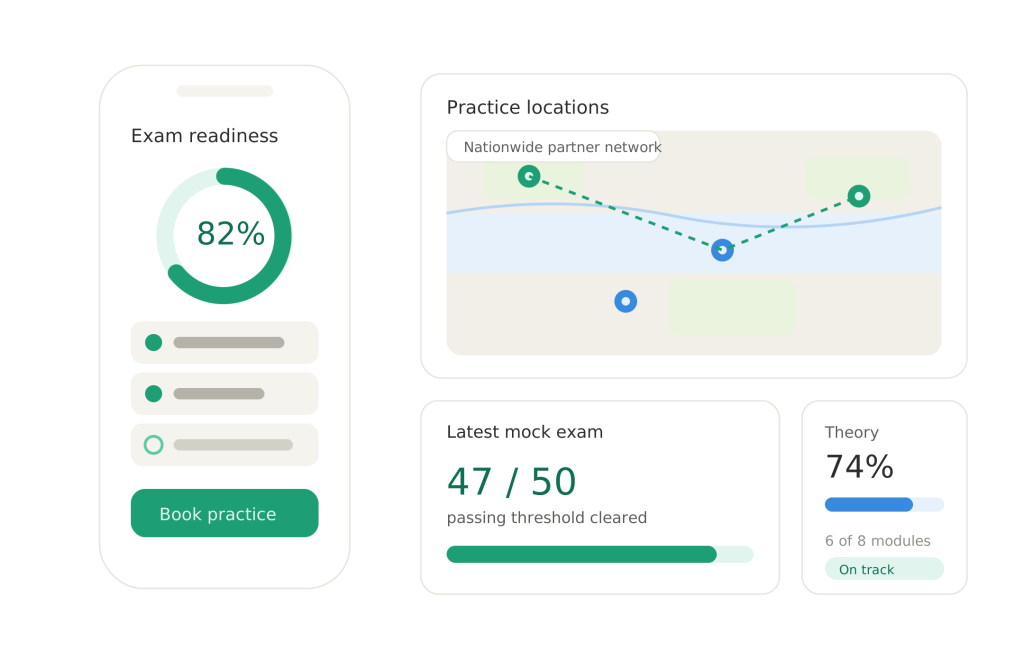
The client is a German EdTech scale-up that makes getting a recreational licence simple and digital. Its iOS and Android app brings theory courses, exam simulations, and exam registration into one place, while a nationwide partner network covers in-person practical training.
Project Overview
The client had built a working product, but as the company grew, the technical foundation began to limit its speed.
As the platform grew, its mobile app, API, admin panel, worker, and exam scraper evolved as separate repositories. The company also planned a gradual move from WordPress to Next.js without disrupting thousands of active learners.
To move faster without building an internal engineering team from scratch, the client chose Intelvision’s Tech Talent as a Service model. Within days, it had a shortlist of pre-vetted engineers who could start contributing from week one.
Intelvision provided 3 developers covering the full technical scope of the platform: core infrastructure and mobile, frontend modernisation and payments, and the customer communication layer.

Challenges
Scaling development without building a full in-house team
The client was growing fast, and so was the product backlog. It needed to expand engineering capacity without a lengthy hiring process or the overhead of building and managing a larger in-house team, bringing in developers who could integrate quickly, work independently, and contribute at the level of a trusted internal engineer.
Fragmented codebase and no unified architecture
The platform had grown into at least five separate repositories: a mobile frontend compiled to iOS and Android, a Node.js backend, a Next.js admin panel with its own backend, a background job worker, and a government exam scraper.
Shared logic was duplicated across projects. There were no shared packages and no monorepo structure, so every new feature required touching multiple disconnected codebases, slowing delivery and increasing the risk of inconsistency.
Platform modernisation on a live product
Migrating from WordPress and WooCommerce to Next.js while keeping the current product running for active learners was a genuine technical challenge. The team decided to start with the most complex part, the checkout page with full payment integration, before moving on to the rest of the platform a deliberate risk-management choice: if the hardest piece could be delivered correctly, the remainder of the migration was worth completing.
Solution
Intelvision matched the client with three engineers whose tech profiles aligned with the platform’s existing stack and the work ahead.
Each developer took ownership of a distinct part of the product and integrated directly into the client’s workflow, including stand-ups, the Kanban board, and communication via Slack.
Together, they covered 3 key areas: shared infrastructure and the core codebase, the checkout and admin panel, and the customer communication layer used by support agents.
This split let the client move several workstreams forward in parallel, from technical consolidation and payment migration to AI-assisted support and GDPR compliance.
Infrastructure and core platform. The first developer merged fragmented repositories into one Turborepo monorepo in about a month, removing code duplication. He then built a bulk notification flow for sending exam invitations to multiple users at once.
Frontend modernisation and payment integration. The second developer moved the checkout from WordPress/WooCommerce to Next.js with Mollie payments in about 4 weeks. He also fixed hanging PDF invoice generation in the admin panel with background jobs.
Customer communication and GDPR compliance. The third developer works on the Ruby on Rails support layer. He added speech-to-text with AI-drafted replies for agents to review, and automatic GDPR-compliant deletion of personal attachments after one year.
Tech stack
Project features
- Turborepo monorepo consolidating 5+ separate repositories with shared internal package architecture
- Checkout migration from WordPress/WooCommerce to Next.js with full Mollie payment integration (coupons, legal popups, multiple payment methods)
- Bulk exam notification system from the admin panel
- Speech-to-text with AI processing: voice messages transcribed and processed, with draft replies pre-loaded for the agent
- GDPR-compliant private attachment lifecycle management: automatic detection and deletion of personal documents after the one-year retention period
- BullMQ background job worker for async processing: PDF invoice generation, payment refunds, video transcoding
- Government exam portal scraper, parsing availability data from an official registration portal with no public API
- Admin panel improvements: background PDF invoices with progress polling, coupon/promotion filters, detail pages, job monitoring dashboard
- AI-assisted code review via Copilot integration on the client side, applied across all pull requests