
Discuss your challenge

Technical debt becomes a sequenced transformation path

Legacy pressure, modernization, due-diligence findings, or a platform that cannot carry the roadmap. We map the real risk, design the target architecture, and sequence the migration so production keeps shipping while the foundation changes underneath it.

< 4 hrsDesigned recovery time, from no tested restore

The foundation is setting your ceiling

Every release is stressful. Something always breaks.

  • Every change touches everything

    Small features require edits across the system. Estimates balloon because nobody can bound the blast radius.

  • Rewrite pressure vs. migration fear

    Half the team wants to rebuild from scratch, the other half knows big-bang rewrites kill companies. Meanwhile, nothing moves.

  • Scaling limits are known but unowned

    Everyone can name the bottleneck. Nobody owns the plan to remove it without stopping delivery.

  • Due diligence found what you feared

    An acquisition, an audit, or an enterprise customer surfaced architecture risks that now have a deadline attached.

  • One engineer knows how it works

    Critical knowledge lives in one head. Every vacation is a risk event, and every architecture discussion routes through one calendar.

No big-bang rewrites. Production keeps shipping.

The rewrite fantasy fails because it pauses value delivery and bets everything on a future cutover. The neglect path fails slower but just as surely. The disciplined route is a sequenced transformation: map the actual risk, design a target worth reaching, and migrate in phases that each pay for themselves, while the roadmap keeps moving.

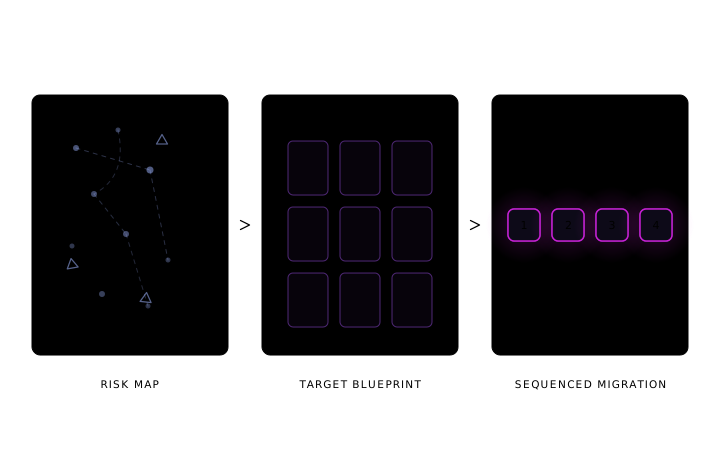
Risk map. Target blueprint. Sequenced migration.

The transformation triptych: where the risk actually is, where the architecture needs to be, and the order that gets you there safely.

Three panels: a cold risk map with warning ticks, a clean violet target blueprint grid, and a sequenced migration of four numbered phases along an arrow with phase one highlighted in pink.
Risk map → target blueprint → sequenced migration

Assess, design, sequence — the same order the engagement runs. Each phase retires risk and pays for itself while production keeps shipping.

Assess

Where is the real risk?

A codebase and architecture assessment that ranks risk by business impact, not by engineering annoyance.

  • Architecture risk map
  • Dependency and coupling analysis
  • Scalability and reliability limits
  • Knowledge concentration
  • Security and compliance exposure

Design

What should the target be?

Target architecture recommendations recorded as decisions with rationale, not diagrams for show.

  • Target architecture blueprint
  • Architecture decision records
  • Technology and platform choices
  • Data and integration design
  • Quality gates for the migration

Sequence

What order keeps delivery alive?

A migration roadmap in self-funding phases, each reducing risk and returning capacity.

  • Phased migration plan
  • Risk mitigation layers
  • Rollback and safety strategy
  • Delivery continuity plan
  • Effort and cost estimates per phase

How it works

  1. Audit

    Codebase, architecture, data, integrations, delivery pipeline. Ranked findings with business impact attached.

    Weeks 1-3

  2. Target and sequence

    The blueprint and the phased roadmap, pressure-tested with your senior engineers so it is theirs, not ours.

    Weeks 3-6

  3. Execute the first phase

    Optional but usual: we lead the highest-risk phase hands-on, installing the quality gates and patterns the rest of the migration will follow.

    Weeks 6-12+

  4. Transfer

    Documentation, decision records, and a team that can carry the remaining phases without us.

    Final phase

What changes

  • Debt becomes a plan

    A ranked, costed, sequenced path replaces the vague dread of "we need to fix the architecture."

  • Delivery never stops

    Each phase ships alongside the roadmap. No feature freeze, no cutover cliff.

  • Risk drops early

    Phases are ordered by risk retired per euro spent. The scariest exposure goes first.

  • The knowledge spreads

    Decision records and pairing turn one-engineer knowledge into team capability.

Who Delivers This

Portrait of Yurii Kotula

Yurii Kotula

CEO & Engineering Leader

10+ years in engineering leadership. CEO of Intelvision, a software engineering company that has delivered 100+ software products for startups and scale-ups.

Yurii built the Strike Team model around one standard: senior ownership, strong architecture, and predictable execution. He ensures every engagement aligns technical decisions with real business outcomes, not just velocity, but impact.

Portrait of Wayne Arendse

Wayne Arendse

Strike Team Lead

20+ years in technology delivery and transformation. PMP and Lean Six Sigma Master Black Belt.

Wayne has scaled global engineering organizations (7 to 85 across 35 countries), built delivery systems with measurable performance metrics, and reduced cost of poor quality by up to 80%. He brings structure, accountability, and operational clarity to projects that have gone off the rails, and turns chaos into controlled delivery.

About Intelvision

Case studies

All case studies

Frequently asked

What is architecture transformation?

Architecture transformation turns technical debt and legacy pressure into a sequenced migration path: map the real risk, design the target architecture, and migrate in phases while production keeps shipping.

Should we rewrite our legacy system or refactor it?

Almost never rewrite. Big-bang rewrites pause value delivery and bet everything on a future cutover. The disciplined route is a phased transformation where each phase retires risk and pays for itself.

How do you modernize a legacy application without stopping delivery?

By sequencing the migration into self-funding phases that ship alongside the roadmap — no feature freeze, no cutover cliff, with rollback and safety strategy built into every phase.

What does an architecture review include?

A codebase and architecture assessment ranked by business impact: dependency and coupling analysis, scalability and reliability limits, knowledge concentration, and security and compliance exposure.

How do you prioritize which technical debt to fix first?

By risk retired per euro spent. The scariest exposure goes first — not the debt that annoys engineers most.

Due diligence flagged our architecture. What now?

This is a common trigger. We turn due-diligence findings into a ranked, costed, sequenced remediation plan with deadlines the board and the acquirer can track.

How long does an architecture transformation take?

The audit takes weeks 1–3, target design and sequencing weeks 3–6, and the first (highest-risk) migration phase typically runs weeks 6–12+. Remaining phases transfer to your team.

Can you migrate a monolith to microservices?

Yes, when it is justified. Target architecture choices are recorded as decisions with rationale — including when a modular monolith beats microservices for your stage.

What if critical knowledge lives in one engineer's head?

That is an architecture risk we explicitly map. Decision records and pairing during migration turn one-engineer knowledge into team capability.

What do we own after the engagement?

The target blueprint, architecture decision records, quality gates, and a team able to carry the remaining phases without us.

Turn the foundation from liability into an asset

We usually start with advice. You get a direct answer on whether we can help and what should happen first.

Talk to an expert

Yurii Kotula

CEO and Engineering Leader

Your first call is with Yurii. Send the form, or pick a time in his calendar.

Book a call with Yurii
5.0 from 14 verified reviews on Clutch

Phone is optional. Everything else is required.

We use your details to answer your enquiry. See our Privacy Policy.