Find where your software is losing money, and what to fund next
We analyze your product, delivery system, market context, and technical foundation to uncover hidden revenue, savings, and growth opportunities, then turn them into a business case your board can act on.
“Our roadmap is basically a wish list. Nobody can say what it’s worth.”
Your roadmap is full, but not financially clear
Features, requests, and ideas exist, but leadership cannot easily compare what each one is worth, what it costs, or what it unlocks commercially.
Delivery activity is not tied to business value
The team is completing work, but too much of it is disconnected from product capabilities, customer outcomes, operational efficiency, or revenue impact.
Manual processes are hiding major efficiency gains
Workflows may be consuming days or weeks of effort that could be reduced through automation, AI, better data flow, or smarter system design.
Technical constraints are limiting growth
The product works today, but architecture, integrations, data quality, scalability, or delivery limitations may quietly block what the business wants to do next.
Leadership needs a stronger case to fund the next move
You know an investment is needed, but without a quantified business case, the board or leadership team will not approve it.
Value hides in one of three places
Product value usually hides in the strategy, the operations, or the technology. Most analyses look at only one. We diagnose all three together, because the usual failure mode is that strategy says one thing, delivery does another thing, and engineering gets blamed for the gap.
Our framework: Strategy. Operations. Technology.
What measurable business outcome must change?
Strategy, operations and technology held in the same frame
One diagnosis across all three — the constraint is rarely where the noise is. We keep strategy, operations, and technology in one frame until the real blocker shows itself.
Strategy
Are you investing in the right opportunities?
What the product is supposed to achieve, which market and customer problems matter most, which capabilities are worth funding.
Business goals
Market needs
Customer problems
Product capabilities
Revenue opportunities
Efficiency opportunities
Roadmap priorities
Investment logic
Operations
Can your company turn ideas into measurable outcomes?
How ideas move from leadership discussion into real delivery, and where value is lost in unclear ownership, poor estimation, slow handoffs, and reporting that shows activity but not value.
Opportunity capture
Idea evaluation
Requirements refinement
Estimation quality
Delivery tracking
Waiting time, rework, and handoff loss
Technology
Can the technical foundation support the opportunity?
Not a technical wishlist. Can this opportunity be delivered, what will it cost, what could it unlock, and what risks need to be managed?
Architecture constraints
Technical debt
System availability
Integration complexity
Data readiness
Automation potential
AI suitability
Release maturity
Implementation risk
How it works
1
Business and product discovery
Understand what the company is trying to achieve, why the product exists, where leadership sees opportunity, and where value may be leaking. Not a mission statement exercise.
2
Pain point and constraint mapping
We speak with leadership, product, operations, project management, technical leads, and delivery teams to map where value is lost: unclear priorities, rework, poor quality, slow delivery, weak visibility, technical constraints, manual work, missed opportunities.
3
Market and opportunity research
Market, customer needs, industry workflows, competitor movement, regulatory constraints, external forces. This is where small requests often become bigger business cases.
4
Strategy, Operations, Technology analysis
Strategy: what should be built and why. Operations: how ideas become structured delivery. Technology: what must be true technically.
5
Business case development
The financial logic: current cost, potential upside, estimated investment, risks, dependencies, recommended sequence. From "this seems like something we should do" to "this is worth funding, and here is why."
6
Board-ready roadmap
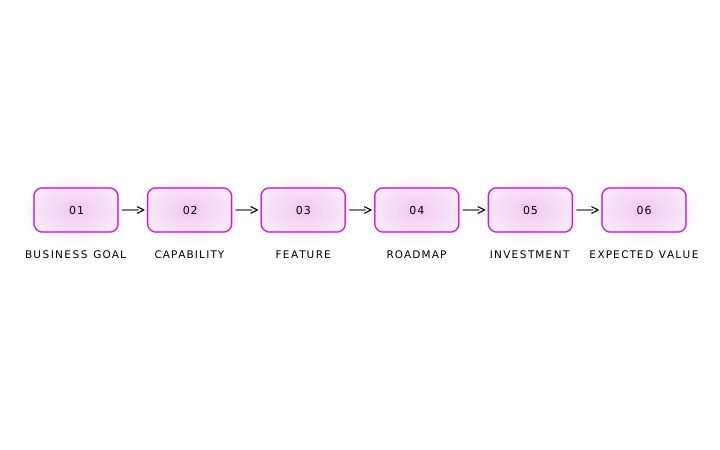
Business goal, capability, feature, roadmap, investment, expected value, connected in one defensible plan for what to do next and what to fund first.
Business goal → capability → feature → roadmap → investment → expected value
the value chain
Every step of the analysis walks this chain, in order. If a link cannot be defended with numbers, it does not reach the board.
What you receive
A clear case for where to invest next.
Opportunity diagnosis
Financial impact model
Cost of the current state plus potential value: revenue upside, savings, reduced rework, efficiency gains, scalability, risk reduction.
Capability map
ROI-backed roadmap
Implementation recommendation
Delivery transformation, technical modernization, automation, AI implementation, project rescue, premium engineering support, or internal execution.
Board-ready business case
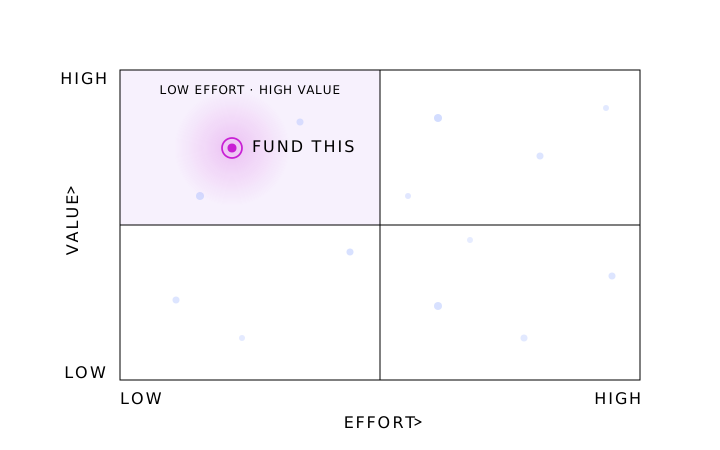
Effort × value — one quadrant is worth funding first
effort × value
Every opportunity we surface lands on this matrix. The business case names the quadrant worth funding first, prices it, and sequences the rest behind it.
Who Delivers This
Yurii Kotula
CEO & Engineering Leader
10+ years in engineering leadership. CEO of Intelvision, a software engineering company that has delivered 100+ software products for startups and scale-ups.
Yurii built the Strike Team model around one standard: senior ownership, strong architecture, and predictable execution. He ensures every engagement aligns technical decisions with real business outcomes, not just velocity, but impact.
Wayne Arendse
Strike Team Lead
20+ years in technology delivery and transformation. PMP and Lean Six Sigma Master Black Belt.
Wayne has scaled global engineering organizations (7 to 85 across 35 countries), built delivery systems with measurable performance metrics, and reduced cost of poor quality by up to 80%. He brings structure, accountability, and operational clarity to projects that have gone off the rails, and turns chaos into controlled delivery.
Modelled expected annual loss, quantified and phased out: €508K–€1.05M
Designed recovery time, from no tested restore: < 4 hrs
Frequently asked
What is a business case development service for software?
It is a structured analysis of your product, delivery system, market, and technical foundation that quantifies where software is losing money and what to fund next — delivered as a board-ready business case.
How do you build a business case for a software investment?
We follow one chain: business goal → capability → feature → roadmap → investment → expected value. If a link cannot be defended with numbers, it does not reach the board.
How do I justify an engineering budget to the board?
Boards fund numbers, not opinions. We model the cost of the current state — rework, delays, manual work, lost revenue — against the value of fixing it, so the ask becomes an ROI decision instead of a cost discussion.
How do you calculate the ROI of a custom software project?
We quantify current-state costs, potential upside (revenue, savings, efficiency, risk reduction), required investment, and dependencies — then sequence the roadmap so early phases fund later ones.
What deliverables do we receive?
Opportunity diagnosis, financial impact model, capability map, ROI-backed roadmap, implementation recommendation, and a board-ready business case.
How is this different from a consulting audit or strategy deck?
Most analyses look at strategy, operations, or technology in isolation. We diagnose all three together — because the usual failure mode is strategy saying one thing, delivery doing another, and engineering blamed for the gap.
Can a business case cover AI and automation opportunities?
Yes. We assess automation potential, AI suitability, and data readiness as part of the technology analysis. One engagement turned a small efficiency request into a €4.19M self-funding AI roadmap.
How long does business case development take?
Typically a few weeks: discovery, constraint mapping, market research, strategy-operations-technology analysis, then the financial model and board-ready roadmap.
What if the analysis shows the investment is not worth it?
That is a valid outcome. The business case ranks every opportunity on an effort × value matrix — you fund the quadrant that pays first and skip what does not.
Who is this service for?
Founders, CEOs, CTOs, and product leaders who know an investment is needed but cannot yet defend it with numbers — or who suspect their roadmap is not financially clear.