Engineering Diagnostic
An efficiency and infrastructure request became a roadmap, redistributed roles and trackable delivery
- 3 → 1
- three delivery roles moved off one founder onto a dedicated PM
- 30%
- a part-time contributor's week lost to unstructured meetings
- 16
- people per daily standup, later cut to the product team

Case file
- Industry
- Energy-efficiency consulting
- Region
- Germany
- Service
- Engineering Diagnostic
- Team
- Wayne ArendseDelivery & Transformation LeadYurii KotulaCEO & Engineering Leader
- Systems
- WordPress
- .NET
- Azure
- AI automation
- Jira and Confluence for delivery
- product domain covers German funding programmes (BAFA, KfW)
Client context
The client is a German consultancy of around 20 people. It helps homeowners and businesses plan energy-efficient renovations and secure state funding, and its product runs mainly on WordPress with a newer .NET, Azure and AI scope layered on top.
The engagement opened with a free process and technical audit. The client had not asked for a rescue. The delivery data surfaced the problem.
Business problem
The company wanted higher operational efficiency and modern infrastructure. Delivery was unpredictable, and one person carried too much of it. The founder held CEO, Product Manager and Project Manager at once, so every decision routed through a single point.
The texture was in the working week. Monday meetings consumed entire mornings. Daily standups ran with 16 people, most of them irrelevant to any given attendee. One part-time contributor lost 30% of her limited weekly hours to unstructured meetings. Priorities were re-argued constantly under an "everything is priority #1" pattern.
The stakes
- 30% of a key part-time contributor's limited weekly hours consumed by unstructured meetings.
- Daily stand-ups run with 16 participants, most without relevant input, pulling the team off focused work each day.
- Entire Monday mornings consumed by meetings every week, taken straight out of the team's focused-work time.
What was broken
- Three management roles (CEO, Product Manager, Project Manager) held by one person, a single decision point for the whole team.
- Feedback split across four tools (Figma, Teams, Google Sheets, Asana), with developers missing Figma comments.
- No unit testing, no automated pipeline, no dedicated QA.
- No handover before absences, forcing single-person coverage on the remaining team.
Diagnostic approach
The audit ran on three levels at once, because the bottleneck was organisational and operational as much as it was technical.
Strategy
What is the delivery capacity for?
The company's value depends on shipping product and process improvements steadily. That capacity was absorbed by one overloaded owner and constant re-prioritisation. Three moves: free founder capacity from day-to-day coordination back to product direction; establish a single prioritisation model instead of verbal re-argument; separate committed work from planned work, so roadmap entries stop reading as promises.
Operations
Where does the time actually go?
Meetings and unclear ownership consumed focus time, and work and decisions were scattered across tools. Three moves: cut standups to the product team only; centralise task tracking and decisions in one source of truth; introduce handover before absences to remove single-person coverage risk.
Technology
Can the system carry the load safely?
Infrastructure needed modernisation for the .NET, Azure and AI scope, with no testing safety net in place. Three moves: support an Azure migration alongside the existing WordPress product; introduce a Definition of Done that includes testing; build automation to remove repetitive manual internal work.
What changed
A dedicated delivery owner now runs coordination.
An embedded Project Manager took over sprint planning, coordination and review. The founder confirmed he moved off day-to-day project management and back onto product strategy. Standups were cut to the product team, and priority sessions replaced constant verbal re-prioritisation.
Work runs from a single source of truth.
Task tracking moved into Jira, with requirements written up rather than passed verbally. Feedback channels were fixed: Jira for tasks, Figma for design and copy, Teams for daily communication. Retrospectives now run every two weeks with tracked action items, and a handover framework documented in Confluence was tested during a real team absence.
An AI and automation capability was added.
An Intelvision engineering team started automating repetitive internal processes and supporting the Azure migration. It worked through a new technology area and an at-times unclear scope while delivery kept moving.
Decisions
Diagnose before staffing.
The engagement opened with a free process and technical audit rather than an immediate hire. Adding people to an undiagnosed bottleneck would have scaled the confusion, not the output.
A dedicated PM, not more developers.
The constraint was coordination and decision-making, not engineering hours. The first role added removed the single-owner bottleneck instead of adding capacity below it.
Time tracking as calibration, not surveillance.
The team carried past trauma from punitive time tracking. It was introduced explicitly for estimation calibration, with a stated commitment that the data would not feed performance review. Retro 4 confirmed developers reacted positively.
Results
| Measure | Before | After |
|---|---|---|
| Decision ownership | One person holding CEO, PM and Project Manager | Dedicated PM owns delivery; founder on product strategy |
| Standup participation | 16 people, mostly irrelevant | Product team only, 15–30 minutes |
| Feedback channels | Split across four tools, comments missed | One source of truth per purpose: Jira, Figma, Teams |
| Absence coverage | No handover, single-person coverage on the team | Handover framework in Confluence, tested during a real absence |
Strike Team
Senior engineering leaders find the real constraint in a fixed-fee engineering diagnostic, then stay to fix it. Project rescue, fractional CTO, architecture and business cases.
About the Strike TeamMore case studies
All 41 case studies
A small efficiency request became a €4.19M board-ready roadmap
A German construction consultancy asked to save time on manual work. We mapped 300+ process steps and turned the request into a board-ready roadmap worth a modelled €4.19M.
- Team
- Wayne Arendse, Delivery & Transformation Lead; Yurii Kotula, CEO & Engineering Leader
Energy Modernisation Advisor
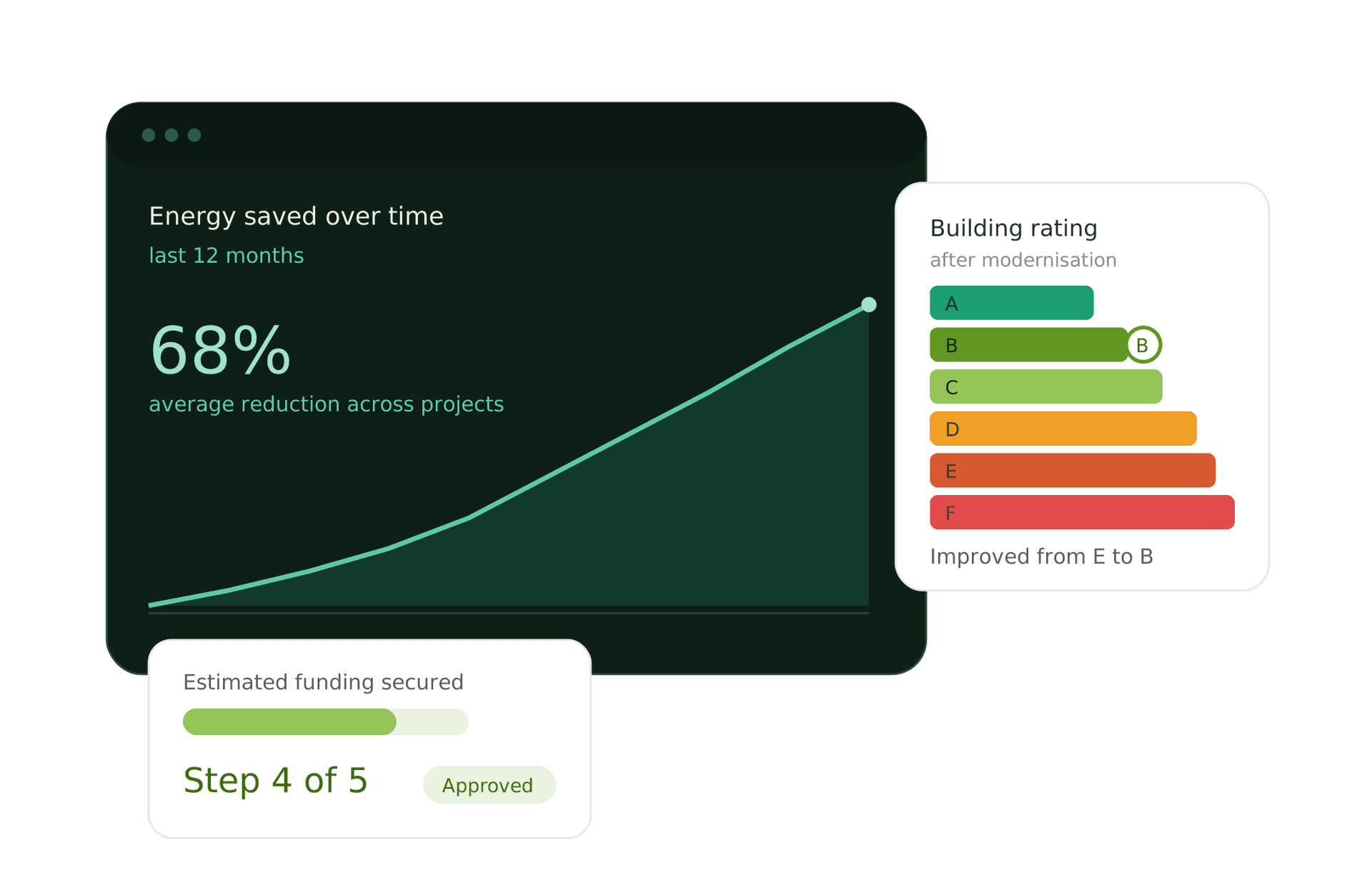
A German energy-efficiency consultancy needed a steadier way to ship its product. Over eight months we resolved 15+ structural issues and raised estimation accuracy to 85 to 93%.
- Team
- 1 business analyst, 1 dedicated project manager, development team
- Time to start
- under 2 weeks
- Duration
- 8+ months

One month to a unified codebase, and direction for a team flying blind
A German licensing platform was moving from WordPress to Next.js. In about a month more than five repositories became one, and we named the missing planning layer that kept the team waiting.
- Team
- Wayne Arendse, Delivery & Transformation Lead; Yurii Kotula, CEO & Engineering Leader
Let’s talk
We usually start with advice. You get a direct answer on whether we can help and what should happen first.
Talk to an expert
Yurii Kotula
CEO and Engineering Leader
Your first call is with Yurii. Send the form, or pick a time in his calendar.
Book a call with Yurii