Engineering Diagnostic
Rebuilding an unmanaged delivery model, and recovering ~43% of annual delivery cost
- ~43%
- of annual delivery cost recoverable, drawn from the client's own data
- ~60% higher
- true all-in delivery cost versus the visible spend
- ~9%
- of monthly cost banked from the first fix

Case file
- Industry
- Early-stage AI SaaS
- Region
- Switzerland
- Service
- Engineering Diagnostic
- Team
- Wayne ArendseDelivery & Transformation LeadYurii KotulaCEO & Engineering Leader
- Systems
- Product platform
- a Teams bot and AI modules
- CI/CD
- single-tenant architecture
- enterprise frame of SOC 2 Type II / ISO 27001 and Swiss data residency
Client context
The client is an early-stage Swiss software company. It is pivoting from a consulting-services business into an enterprise AI product, and has committed to enterprise-grade security: Swiss-default data residency, encryption, least-privilege access, and no training on customer data.
The client is moving decisively into that market which screens vendors on multi-tenancy, security certification, and delivery predictability. With its enterprise commitments set, the question worth answering was how ready delivery already was to back them at scale. The engagement put that in numbers, drawn from the client's own delivery data rather than assumption.
Business problem
Delivery ran on individual contributors with no delivery owner. One role was expected to cover leadership, architecture, code review, meetings, and hands-on development at the same time. Coordination, prioritisation, and technical trade-offs were handled informally rather than through a delivery and technical governance structure.
The texture showed in the day-to-day. Around half of all merge requests shipped with no peer review, and releases went out ungated, at will. Kanban ran without a formalised cadence and there was no committed release plan. In one session, 27,000 lines of AI-generated code entered the codebase, unreviewable at that scale. Three client-side stakeholders coordinated sign-off by hand, and client executives spent roughly 240 hours a month keeping delivery moving.
The stakes
- Total modelled exposure across six categories approached a full year of delivery cost.
- Roughly 39% of all-in delivery cost was high-confidence avoidable waste, drawn from the client's own delivery data.
- Client-side executives spent ~240 hours/month keeping delivery moving instead of running the business.
- 32.5% of delivered work was rework, re-done at full delivery cost.
What was broken
- One role covered leadership, architecture, code review, meetings, and hands-on development at once.
- ~50% of merge requests shipped with no peer review, and releases shipped ungated.
- 27,000 lines of AI-generated code entered the codebase in a single session, unreviewed.
- The product ran on a single hardcoded tenant.
- The Teams bot and the AI modules had never been reviewed, on either side.
- No committed release plan existed; post-release defect rate and sprint velocity were not tracked.
Diagnostic approach
The gap sat across the business at once, a strategic pivot, an operating model, and a codebase, so the diagnostic ran on three levels together.
Strategy
What is the delivery gap worth?
The pivot to an enterprise product depends on delivery credibility the current model cannot yet show, so the diagnostic put the gap in money before anything else. It mapped the consulting-to-product pivot to the delivery capabilities enterprise buyers screen for, established the true all-in cost of delivery rather than the visible team spend alone, and separated confirmed waste from modelled exposure.
Operations
Where does the time actually go?
Delivery ran on individuals with no cadence and no owner, so the coordination cost landed on client executives. It traced ~240 client-executive hours/month spent keeping delivery moving, measured rework at 32.5% of delivered work, and found Kanban run without a formalised cadence and no committed release plan.
Technology
Can the system ship safely?
Code shipped without review or gates, and the architecture could not onboard a second enterprise customer. It found ~50% of merge requests shipping with no peer review, a single hardcoded tenant blocking multi-tenant onboarding, and the Teams bot and AI modules unreviewed, with no stable DEV/Demo environment.
What changed
The true cost of delivery is now a figure, not an impression.
The engagement replaced a visible monthly spend with an all-in cost roughly 60% higher, built from the client's own data and a Swiss IT/PM benchmark. Of that, around 39% is confirmed avoidable waste. The decision now rests on numbers.
A three-role operating model, proposed with ownership drawn.
The proposed model splits today's single overloaded role into a Client Executive Sponsor for sign-off, a Technical PM for operations, and a Tech Lead for architecture and quality. Each carries a defined access level and decision boundary. It is designed to remove the single point of failure the diagnostic found.
A measurement baseline that already banked one saving.
Six delivery metrics now carry baselines and targets, tracked sprint over sprint. The first fix the measurement surfaced, a redundant pre-daily removed and the team daily trimmed to 20 minutes, saves around 9% of monthly delivery cost, at zero incremental cost.
Decisions
Confirmed waste leads, not the biggest number.
The case could have opened on the full modelled exposure. It opens instead on the ~39% of cost that comes from the client's own data, so the figure carrying the decision is the one that cannot be argued down.
Split the overloaded role rather than hire a CTO.
A full-time CTO was costed at a six-figure annual salary and rejected. It over-corrects on cost and stage, takes 60–90+ days to hire, and still does not run daily delivery. Three defined roles fix the actual failure, which is ownership, not seniority.
Fix the operating model before multi-tenancy or certification.
SOC 2, ISO 27001, and a multi-tenant rebuild are real blockers, but scoping them first spends money before delivery can be trusted to execute. The path gates them behind a working cadence and full review coverage.
Prove the measurement before asking for the full engagement.
The meeting saving was banked from a retrospective, not projected. It shows the tracking works before any larger commitment is made.
Results
| Measure | Before | After |
|---|---|---|
| Delivery cost visibility | Delivery seen only as the visible monthly spend | True all-in cost established ~60% higher, ~39% of it avoidable waste |
| Meeting overhead | Redundant pre-daily plus an unbounded team daily | ~9% of monthly cost recovered, realized |
| Code-review coverage | ~50% of merge requests reviewed | Target 100%, tracked sprint over sprint |
| Release planning | No committed release plan | Published release plan, met per release, under the proposed model |
Strike Team
Senior engineering leaders find the real constraint in a fixed-fee engineering diagnostic, then stay to fix it. Project rescue, fractional CTO, architecture and business cases.
About the Strike TeamMore case studies
All 41 case studies
A small efficiency request became a €4.19M board-ready roadmap
A German construction consultancy asked to save time on manual work. We mapped 300+ process steps and turned the request into a board-ready roadmap worth a modelled €4.19M.
- Team
- Wayne Arendse, Delivery & Transformation Lead; Yurii Kotula, CEO & Engineering Leader

An efficiency and infrastructure request became a roadmap, redistributed roles and trackable delivery
The founder of a German energy-efficiency consultancy held three roles at once. A free audit led to a dedicated project manager, shorter standups and one place for all work.
- Team
- Wayne Arendse, Delivery & Transformation Lead; Yurii Kotula, CEO & Engineering Leader
Energy Modernisation Advisor
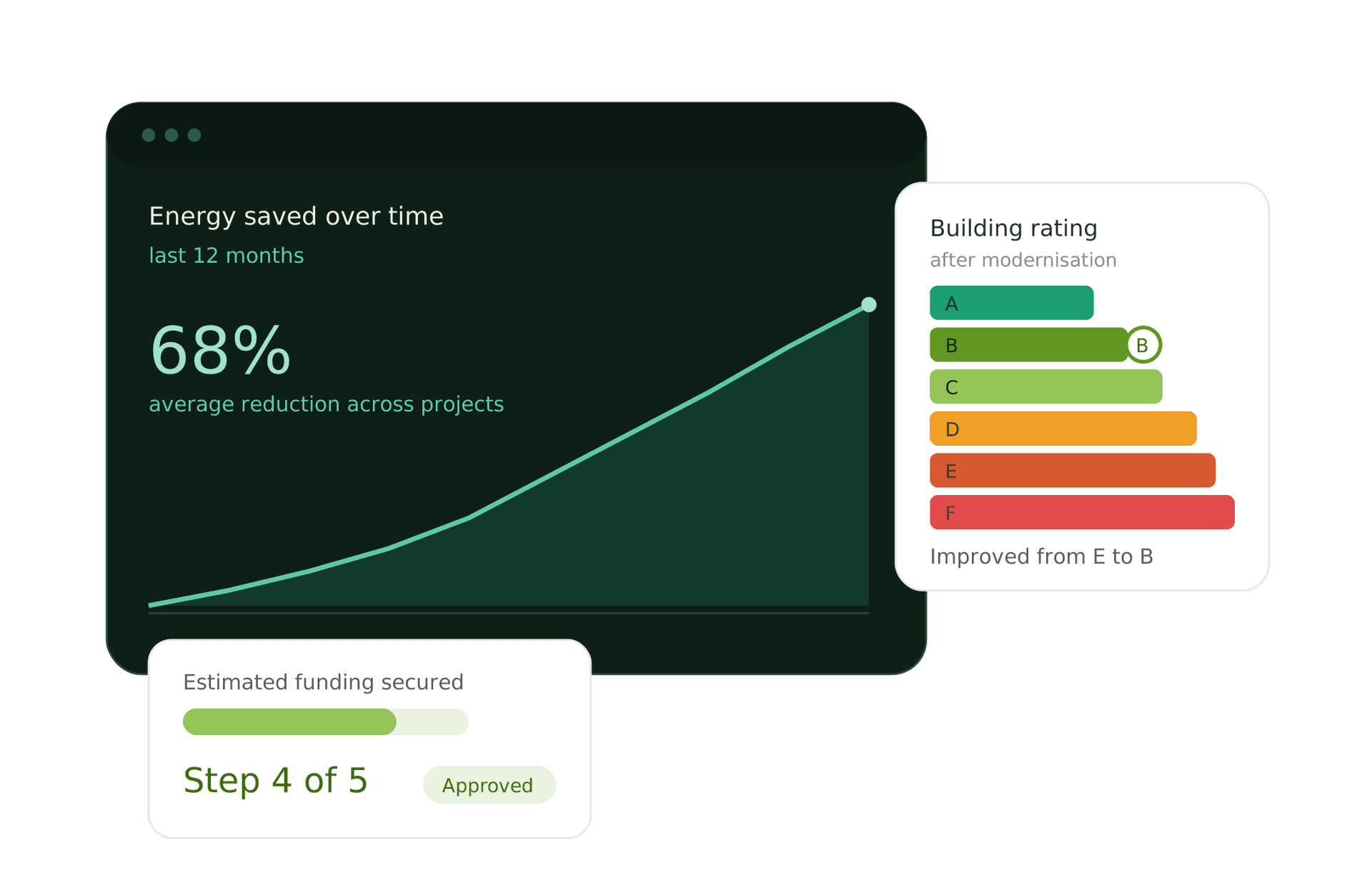
A German energy-efficiency consultancy needed a steadier way to ship its product. Over eight months we resolved 15+ structural issues and raised estimation accuracy to 85 to 93%.
- Team
- 1 business analyst, 1 dedicated project manager, development team
- Time to start
- under 2 weeks
- Duration
- 8+ months
Let’s talk
We usually start with advice. You get a direct answer on whether we can help and what should happen first.

Talk to an expert
Yurii Kotula
CEO and Engineering Leader
Your first call is with Yurii. Send the form, or pick a time in his calendar.
Book a call with Yurii