Engineering Operating System
Providing a lean single-family office with an operating system to scale and cut manual work by 64%
- 64%
- manual workload removed
- 34 / 34
- processes documented & digitised
- six-fig.
- annual licence eliminated

Case file
- Industry
- Single-family office (SFO)
- Region
- Germany
- Service
- Engineering Operating System / Business Case Development
- Team
- Wayne ArendseDelivery & Transformation LeadYurii KotulaCEO & Engineering Leader
- Systems
- React (Vite)
- Django 6.0/DRF
- PostgreSQL 16
- Neo4j
- DuckDB
- Redis
- Dagster
- n8n
- WireGuard VPN
- local LLM (Qwen3)
- Whisper.cpp
Client context
A lean German single-family office managing 12 operating companies across three industries — real estate development, professional services, and manufacturing. The office was built for control rather than scale: the founding family concentrated decision-making, and operational capacity was deliberately constrained to stay agile.
A change in business conditions required the office to grow without hiring proportionally. The expansion plan assumed a staffing constraint; the operational model did not.
Business problem
All 12 companies ran on a patchwork of spreadsheets, email threads, ad-hoc documents, and a legacy ERP licence the office could neither extend nor replace affordably. A single-family office running 12 companies cannot afford to let its knowledge live in inboxes.
The principal spent a disproportionate share of their week reconstructing state — pulling together reports, chasing updates, re-interpreting decisions made months earlier — rather than directing capital. Manual reconciliation consumed roughly 64% of operational hours that should have been spent on investment decisions and portfolio governance.
The stakes
- Business continuity — a single key-person departure would leave the portfolio ungovernable
- Operational resilience — any disruption to the ERP or spreadsheet chain could halt reporting
- Capacity to expand — the principal could not take on new companies under the current model
- Decision quality — real-time data was unavailable; decisions were made on reconstructed state
What was broken
- No single source of truth across 12 companies
- Knowledge locked in people, not systems
- Six-figure annual licence for ERP software that covered less than 40% of operational need
- Zero process documentation — 34 critical processes existed only in people's heads
- Manual reconciliation consuming 64% of operational hours
- No capability to onboard new portfolio companies without proportional headcount increase
Diagnostic approach
The diagnostic ran across three levels simultaneously. The family office had an operations problem, a technology problem, and a knowledge problem — in that order.
Strategy
What is the work structured around?
Modelled the portfolio structure and mapped the governance design against the expansion plan.
- Ownership model mapped
- Portfolio governance defined
- Expansion constraints documented
Operations
How does work move through the office?
Traced every operational workflow from trigger to resolution. Nothing was assumed to be working.
- All 34 processes traced end-to-end
- Bottlenecks and key-person dependencies identified
- Handoff and escalation paths documented
Technology
What does the system need to do?
Evaluated the incumbent ERP against actual operational need, not vendor capability claims.
- ERP dependency assessed and costed
- Replacement architecture specified
- Integration surface mapped
What changed
Portfolio Command Centre
A single operational view across all 12 companies: KPIs, cash positions, milestone status, and risk flags in one place. The principal's week now starts with a dashboard, not a reconstruction exercise.
Process Library
All 34 critical processes documented, structured, and linked to the systems that execute them. New staff can be onboarded in days, not months.
Document Intelligence
Contracts, reports, and correspondence indexed and searchable. A local LLM (Qwen3) runs extraction and classification without data leaving the network perimeter. Whisper.cpp handles voice notes and meeting recordings.
Relationship Graph
A Neo4j-backed relationship map connecting entities, decisions, and obligations across the portfolio. Counterparty history, open commitments, and relationship context visible without opening an inbox.
Reporting Pipeline
Automated reporting flows built on Dagster and n8n replace the manual reconciliation cycle. Reports that previously took a day to assemble now generate in minutes.
Infrastructure
WireGuard VPN with zero external cloud dependencies for sensitive data. PostgreSQL 16 as the primary operational store, DuckDB for analytical queries, Redis for real-time state.
Decisions
Local LLM over cloud AI
Sensitive counterparty and financial data cannot leave the network perimeter. Qwen3 runs entirely on-premises. Capability is slightly lower than frontier models; data sovereignty is non-negotiable.
Graph database for relationships
Counterparty and entity relationships are too complex for a relational model at this scale. Neo4j captures the real structure; joins would have hidden it.
Replace the ERP, not extend it
The incumbent licence covered less than 40% of operational need at a six-figure annual cost. Custom engineering cost less over a five-year horizon and eliminated the vendor dependency.
React (Vite) frontend
The office needed a fast, maintainable interface team members could use without training. A standard web stack with a stable component library. No abstraction layers between the UI and the operational data.
Results
| Measure | Before | After |
|---|---|---|
| Manual reconciliation time | 64% of operational hours | ~0% — fully automated |
| Process documentation | 0 of 34 | 34 of 34 |
| ERP licence cost | Six-figure annual spend | Eliminated |
| Time to assemble weekly portfolio report | ~1 working day | <5 minutes |
| Key-person dependency | Critical — 3 people held all operational context | Distributed across documented systems |
| Capacity to add a portfolio company | Not viable without new hire | Viable within existing headcount |
Strike Team
Senior engineering leaders find the real constraint in a fixed-fee engineering diagnostic, then stay to fix it. Project rescue, fractional CTO, architecture and business cases.
About the Strike TeamMore case studies
All 41 case studies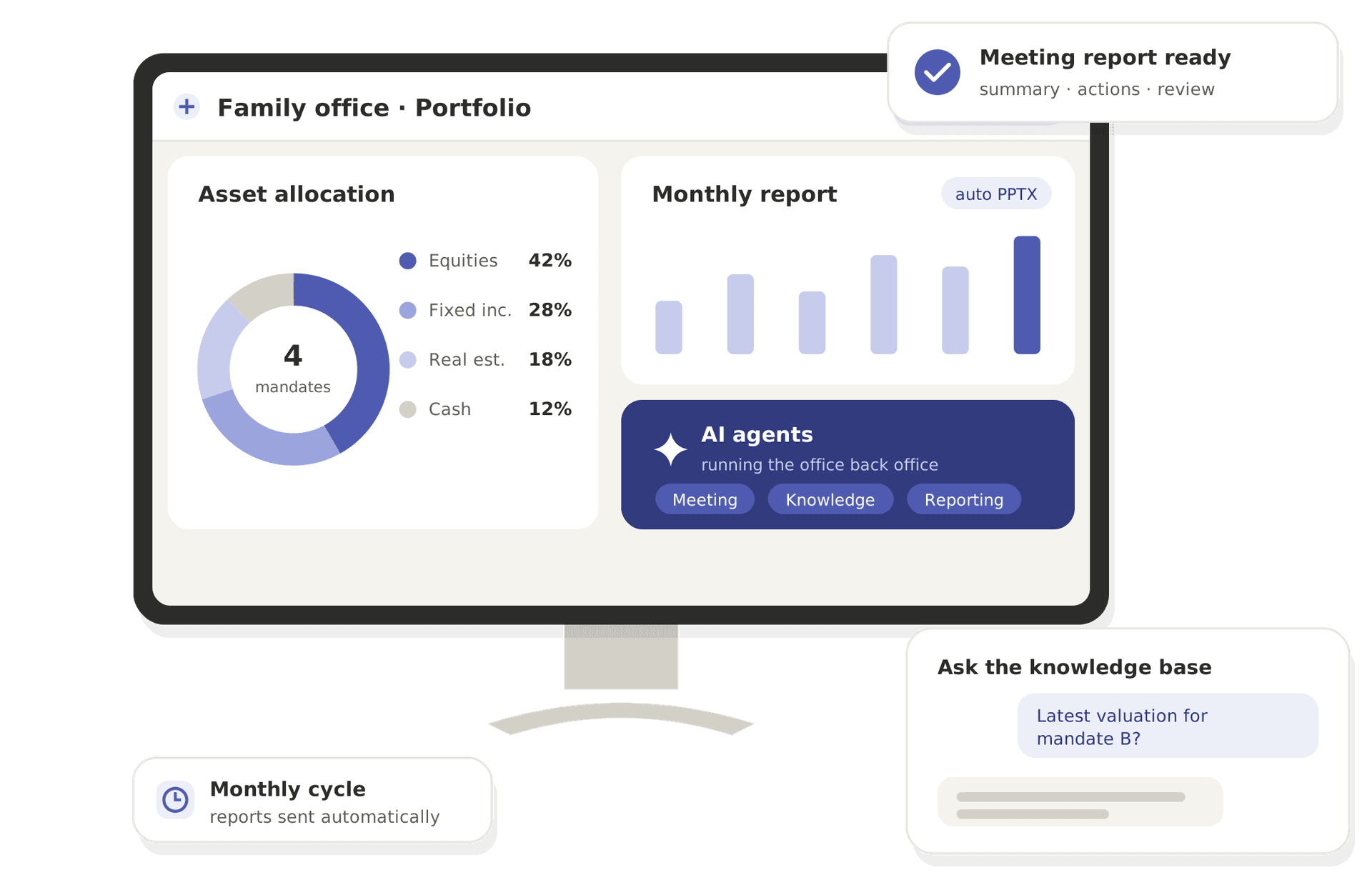
No-code AI agents for a lean investment office
A German single-family office wanted routine work off its small senior team. We built no-code AI agents that free up about 3 to 4 hours a day for the principal.
- Team
- 2 AI developers, 1 business analyst, consulting lead
- Time to start
- under 2 weeks
- Duration
- 3+ months

A small efficiency request became a €4.19M board-ready roadmap
A German construction consultancy asked to save time on manual work. We mapped 300+ process steps and turned the request into a board-ready roadmap worth a modelled €4.19M.
- Team
- Wayne Arendse, Delivery & Transformation Lead; Yurii Kotula, CEO & Engineering Leader

An efficiency and infrastructure request became a roadmap, redistributed roles and trackable delivery
The founder of a German energy-efficiency consultancy held three roles at once. A free audit led to a dedicated project manager, shorter standups and one place for all work.
- Team
- Wayne Arendse, Delivery & Transformation Lead; Yurii Kotula, CEO & Engineering Leader
Let’s talk
We usually start with advice. You get a direct answer on whether we can help and what should happen first.
Talk to an expert
Yurii Kotula
CEO and Engineering Leader
Your first call is with Yurii. Send the form, or pick a time in his calendar.
Book a call with Yurii