
How Can an Outsourced Development Team Solve Your Tech Problems?
What's new: New talent-shortage and rate data, a problem-to-model table, cost estimation, AI-assisted delivery, contract and GDPR points, a checklist and an FAQ. Unverifiable brand anecdotes removed.
Summarize with AI
Read summarized version with AI
- An outsourced team fixes capacity and skill problems: hiring gaps, missing niche skills, a roadmap with no team, MVP deadlines and after-release support.
- It does not fix unclear product ownership or a broken delivery process; diagnose those first, or extra developers only add cost.
- Pick the model (staff augmentation, dedicated team, project delivery, rescue) before the provider, and budget on total cost, including your own product owner's time.
- AI tools are now standard: ask providers how they review AI-generated code, which tools may see your data, and who owns the output.
- Put IP assignment, an NDA, a GDPR Article 28 processing agreement, replacement terms and an exit plan in the contract before work starts.
IT outsourcing means handing part or all of your software development, testing, support or infrastructure work to a specialized company. Most companies already do it in some form: a design agency here, a contractor there, a cloud provider running the servers. The question a CTO or founder actually faces is narrower: which of my current tech problems would an outsourced development team fix, and which would it make worse?
This guide answers that question for 2026. It covers the problems an outsourced team solves well, the ones it does not, what it costs, how AI-assisted development changes the arrangement, what to put in the contract, and how to run the team so it delivers. It is written from the vendor side of the table, so it also says plainly where outsourcing is the wrong answer.
What an outsourced development team is in 2026
An outsourced development team is a group of engineers, and usually QA, analysis and delivery management, employed by another company and working on your product. You pay the provider; the provider employs, pays, equips and replaces the people. How much of the delivery the provider owns depends on the model you choose, and that choice matters more than the provider's country or hourly rate.
In practice there are four models. Most "outsourcing worked" or "outsourcing failed" stories are really stories about picking the wrong one.
| Model | What you get | Who owns delivery | Best for |
|---|---|---|---|
| Staff augmentation | Individual engineers inside your team, tools and ceremonies | You (your tech lead and process) | Filling specific skill or capacity gaps in a team that already works |
| Dedicated team | A cross-functional team (engineers, QA, BA or PM) carrying a product area | Shared: you own the product, the team owns day-to-day delivery | A roadmap with no team to deliver it, or a new product line |
| Project-based delivery | A defined scope delivered by the provider, often fixed price or milestone based | The provider, against an agreed specification | Well-defined builds: an MVP, a migration, an integration |
| Rescue or takeover | Senior engineers and delivery leads who diagnose and fix a troubled project | The provider leads until delivery is stable, then hands back | Projects that are slipping, stuck or leaving a previous vendor |
Two things have changed since this article was first published in 2022. First, the line between "outsourced" and "in-house" has blurred: remote work made it normal for an external engineer to sit in the same Slack channels, standups and repositories as employees. Second, AI coding assistants are now part of almost every team's workflow, which changes what you should ask a provider about quality and review (more on that below).
Which tech problems an outsourced team solves, and which it does not
An outsourced team is a capacity and capability tool. It works when the problem is "we know what to build and cannot build it fast enough or well enough". It struggles when the problem is "we do not agree on what to build".
| Tech problem | Typical symptom | Does outsourcing help? | Model that fits |
|---|---|---|---|
| Hiring gap | A senior role open for months, roadmap slipping | Yes, often within weeks | Staff augmentation |
| Missing niche skill | No one in-house knows the cloud platform, data pipeline or mobile stack you need | Yes | Part-time or full-time specialist |
| A roadmap with no team | New product line approved, nobody free to build it | Yes | Dedicated team |
| A hard deadline for an MVP | Funding milestone or customer launch in three to six months | Yes, if scope is kept tight | Dedicated team or project-based |
| Legacy system blocking growth | Every change breaks something; one person understands the code | Yes, with senior architecture leadership | Project-based modernization, or a rescue team first |
| After-release support | Bugs, updates and small features eat the product team's time | Yes | Dedicated or part-time support team |
| A project that is slipping | Every milestone turns into "two more weeks" | Only if the provider diagnoses before adding people | Rescue or takeover |
| Unclear product strategy | Priorities change weekly, nobody owns the backlog | No. Adding developers adds cost, not clarity | Fix ownership first, then add capacity |
The last row deserves emphasis. If your backlog has no owner, an outsourced team will not create one. It will sit idle, or it will build the wrong thing quickly. The same is true for a broken release process or a team that cannot agree on architecture: more hands make the chaos bigger. In those cases the first step is a diagnosis of the delivery system, not a larger team. That is the situation our project rescue work is built for.
Other problems companies bring to outsourced teams include security hardening, backup and recovery gaps, regulatory work such as GDPR or financial-sector rules, cloud cost and configuration problems, and integrations between systems that grew separately. All of these suit an external team when the scope is clear and someone on your side can make decisions quickly.
Why companies hire outsourced development teams now
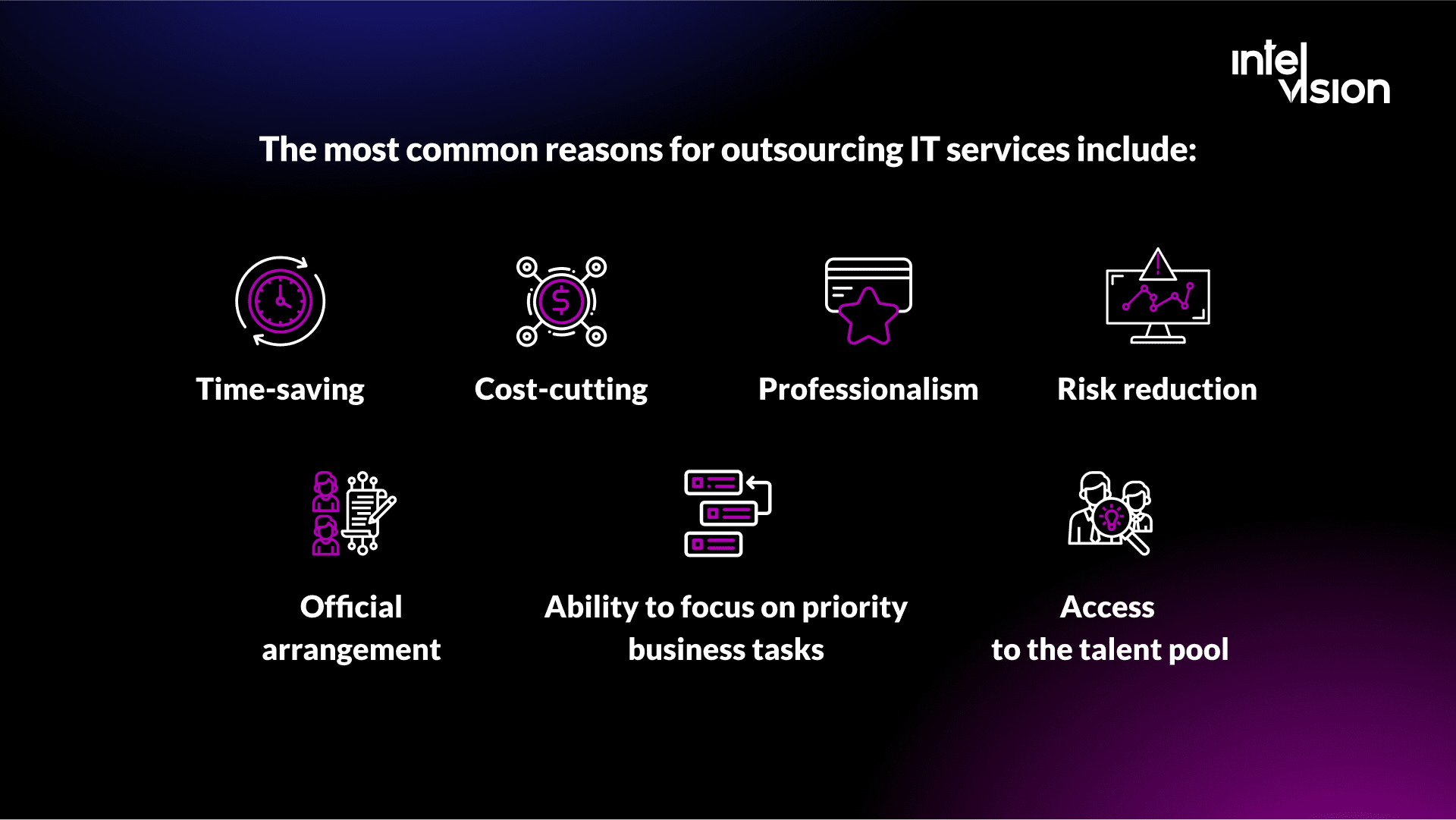
The reasons have not changed much since 2022, but their weight has. In Deloitte's 2024 Global Outsourcing Survey of more than 500 executives, skilled talent and agility sit alongside cost reduction as the key drivers. The market keeps growing: Statista projects worldwide IT outsourcing revenue of about US$618 billion in 2026, rising at roughly 5.9% a year to 2031.
Access to talent you cannot hire locally
This is the strongest reason in Europe. According to Eurostat, 57.5% of EU enterprises that recruited or tried to recruit ICT specialists in 2023 had difficulty filling those vacancies. In Germany the share was 72.4%, in Czechia 70.5% and in Austria 67.3%. Outsourcing lets you hire from a wider pool without territorial limits, and providers can supply rare roles (a DevOps architect, a senior machine learning engineer, an enterprise architect) for the months you need them rather than as a permanent hire.
Time to start
Recruiting, notice periods and onboarding for a senior in-house hire often take a quarter or more. A provider with an existing bench and network can usually show candidates within days and have someone working within a few weeks. The speed only holds if your onboarding is ready: repository access, a clear first ticket and a person who answers questions.
Cost, measured honestly
Outsourcing removes recruiting fees, equipment, office space, benefits administration and the cost of a bad hire. It does not remove the cost of your own product ownership, review time and coordination. Older articles, including the first version of this one, claimed outsourcing would cut "at least 70%" of labor costs. That figure compares rates, not total cost, and it ignores the management time an external team needs. A realistic saving depends on where you are hiring from and where the team sits; the next section shows how to estimate it.
Focus on the work only you can do
Delegating defined engineering work lets founders and product leaders spend time on customers, partners and strategy. This is still a sound reason, with one caveat: you can delegate building, but not deciding. Product direction stays with you.
Lower delivery risk when you choose carefully
A provider that has staffed similar projects brings proven roles, processes and replacements. A newly formed in-house team brings none of that on day one. The flip side is vendor risk: if the provider holds all the knowledge, leaving becomes expensive. Plan for that from the start (see the contract section below).
Flexible scaling
A good outsourcing agreement lets you scale the team up when the roadmap grows and down when it does not, without layoffs. Check the notice period for scaling down; it is where the real flexibility lives.
What an outsourced development team costs in 2026
Rates vary by country, seniority and model, and published ranges differ between sources, so treat any single number as a reference point. One 2025 vendor rate guide gives these senior hourly ranges:
| Region (senior engineer) | Typical hourly range | Source |
|---|---|---|
| United States and United Kingdom | $80 to $150 | Innowise, 2025 rates |
| Poland | $50 to $65 | Innowise, 2025 rates |
| Czech Republic | $55 to $70 | Innowise, 2025 rates |
| Romania | $40 to $55 | Innowise, 2025 rates |
| Bulgaria | $35 to $50 | Innowise, 2025 rates |
Rates can also fall. Accelerance reported that Eastern European rates fell 9% year over year in October 2024, as buyers pushed for discounts in a competitive market. For comparison, Intelvision publishes its own pricing: a monthly rate of €6,500 to €9,000 per developer depending on seniority, which is the equivalent of €32 to €50 an hour, with no upfront fees (see our pricing page).
How to estimate the cost of an outsourced team
Use total cost, not the rate card. A simple model:
- Team cost: number of people × monthly rate × months. A four-person team at €6,500 to €9,000 each costs €26,000 to €36,000 a month at the published Intelvision rates.
- Your internal time: a product owner at roughly half time, plus a tech lead's review time. This is the cost most budgets forget.
- Ramp-up: expect the first two to four weeks to be slower while the team learns the domain and the codebase.
- Tooling and access: licenses, cloud environments, security reviews.
- Exit and handover: documentation and knowledge transfer at the end. Agree in advance who pays for it.
Compare that total against the fully loaded cost of hiring the same people in-house, including recruiting fees, the months the role sits empty and the cost of delay to your roadmap. The months of delay are often the biggest number in the comparison.
How to choose the right outsourcing model for your problem
Pick the model before you pick the provider. Four questions decide it:
- Do you have a working delivery process? If yes, staff augmentation adds capacity to it. If not, adding people to it will not help; you need a team that brings its own process, or a diagnosis first.
- Who will own the backlog? If you have a product owner with time, a dedicated team works well. If nobody can own it, a project-based scope with a clear specification is safer.
- How stable is the scope? A fixed scope suits a fixed price. An evolving product suits a monthly team. Fixed price on a moving scope produces change-request disputes.
- How long is the need? Under three months, a project or a specialist. Six months or longer, a dedicated team pays back its ramp-up. The original advice in this article still holds: outsourced teams do their best work on long-term projects of about six months or more.
If you are unsure, start small: one engineer, a paid discovery or a defined first phase. That gives you evidence about the provider before the commitment grows. Our guide on how to find a reliable software development partner covers vendor selection in more depth.
How to work effectively with an outsourced team
Having an outsourcing strategy is the first step. The working arrangements decide whether it pays off.
Define what to delegate
The first version of this article recommended delegating "less important" tasks. We would put it differently now: delegate well-bounded outcomes, not leftovers. An external team given only low-value tickets never learns the product and never becomes productive. Give them a product area, a service or a clear stream of work they can own, and keep product decisions, architecture principles and security policy with your own people. Then list the roles and skills that work requires.

Build one team, not two
Explain the goals of the engagement to your own staff and to the external engineers. Put everyone in the same channels, standups and planning sessions. The fastest way to create an "us and them" culture is a separate channel for "the vendor" and decisions made in meetings they are not invited to.
Plan for time zones, language and culture
Before you start, check the overlap in working hours, the level of English and how the team handles disagreement. A team two hours from you can join live planning and incident calls; a team eight hours away needs written handovers and a disciplined async process. Neither is wrong, but the second one must be designed.
Value different perspectives
Teams that combine people from different countries, backgrounds and industries tend to spot different risks and ideas. Make that useful by inviting the external engineers into design discussions and retrospectives, not only into implementation.
How to manage an outsourced development team day to day
As the client, you coordinate the key processes and judge the outcomes. Your product decisions, the provider's delivery lead and regular, honest communication are what keep the work on track.
Use an agile cadence, but tie it to outcomes
Sprint planning, daily standups, a shared backlog and retrospectives still make an outsourced team easier to manage. What has shifted is the scrutiny on results. In Digital.ai's 18th State of Agile report, 76% of respondents said they face growing pressure to show the return on agile initiatives. Rituals alone do not prove progress. Working software, measured against business goals, does.
Measure delivery, not hours
Agree on a small set of metrics before the work starts. Useful ones are lead time from idea to production, deployment frequency, the share of releases that cause incidents, time to restore service, and how closely estimates match delivery. Hours logged tell you the team is busy, not that it is effective.
Get communication right
Both too little and too much communication slow a team down. Agree on channels (for example Slack or Microsoft Teams for daily work, video calls for planning and demos), on response times during working hours, and on who escalates what. A weekly demo of working software beats a weekly status report.
Choose a small, shared toolset
Use one tracker (Jira, Linear or Azure DevOps), one design tool (Figma), one place for documentation (Confluence or Notion) and the same repository hosting and CI pipeline as your own team. The point is that the external team works in your tools, so the knowledge stays with you when the engagement ends.
Review and give feedback regularly
Clarify what is to be done, the expected result and the priorities. Hold a short monthly review with the provider's delivery lead about people, quality and risks, separate from sprint ceremonies. Problems raised early are cheap; problems raised at contract renewal are not.
Check the signs after 90 days
Three months is long enough to judge an outsourced team fairly. By then you should see:
- Working software in production, not only in a staging environment.
- Estimates that land close to delivery, and a team that says early when they will not.
- Engineers who ask about users and business goals, and occasionally push back on a ticket.
- Documentation and tests growing with the code, so knowledge does not sit in one head.
- Your own tech lead spending less time on supervision than in the first month.
If most of these are missing, talk to the provider's delivery lead before adding people or extending the contract. The cause is usually one of three things: unclear ownership on your side, the wrong seniority mix on theirs, or a scope that keeps moving.
How AI-assisted development changes outsourcing
AI tools are now standard in software teams, including outsourced ones. In the Stack Overflow 2025 Developer Survey, 84% of developers said they use or plan to use AI tools, yet 46% said they do not trust the accuracy of the output, up from 31% a year earlier. Google's 2025 DORA report, based on nearly 5,000 technology professionals, found that 90% use AI at work and more than 80% believe it has made them more productive, but AI adoption still has a negative relationship with software delivery stability. The report's summary: AI amplifies what a team already has.
For a company hiring an outsourced team, that has four practical consequences:
- Speed claims need evidence. A provider promising faster delivery "thanks to AI" should show how it measures that, and how it keeps quality from slipping.
- Review and testing matter more, not less. If AI increases the volume of changes, weak automated tests and code review become the bottleneck. Ask how the team reviews AI-generated code and what test coverage it maintains.
- Data and IP rules must be explicit. Agree which AI tools may see your code and data, whether your repositories may be used with external AI services, and who owns AI-assisted output. Deloitte found that 83% of executives already use AI in their outsourced services, but that gains have been limited by governance and contracting gaps.
- The value moves to senior judgment. When routine code is cheaper to produce, you pay for the people who decide what to build, design the architecture and catch what the tools get wrong. Seniority is worth more than headcount.
If your team already uses AI tools and the delivery numbers have not moved, that is a process question rather than a tool question. Our AI-assisted SDLC work looks at exactly that gap.
Contracts, IP, security and compliance
Most outsourcing disputes start with something the contract did not say. Cover these points before work begins:
- IP ownership: all code, designs and documentation produced for you are assigned to you, including work in progress if the engagement ends early.
- Confidentiality: an NDA covering your code, data and business information, binding on everyone the provider assigns.
- Personal data: if the team will touch personal data of EU residents, you need a processing agreement that meets Article 28 of the GDPR: documented instructions, confidentiality of staff, security measures, your approval of sub-processors, and deletion or return of data at the end.
- Financial-sector rules: EU banks, insurers, payment and investment firms fall under the Digital Operational Resilience Act, which has applied since 17 January 2025 and requires a register of all contractual arrangements with ICT third-party service providers. If you are in scope, your development partner is part of that register.
- Access control: named accounts, least privilege, multi-factor authentication, and an offboarding checklist that removes access the day someone leaves.
- Replacement terms: how quickly the provider replaces someone who is not a good fit, and at whose cost.
- Exit plan: notice periods, documentation standards and a knowledge-transfer phase, so you can move to another provider or in-house without losing the product.
If you are already locked into a vendor that holds all the knowledge, the exit itself needs planning. That is what our vendor transition service is for.
Common mistakes when outsourcing software development
- Choosing on hourly rate alone. A cheaper team that needs twice the supervision costs more.
- Outsourcing a problem you have not diagnosed. If delivery is failing because of unclear ownership, more developers make it fail faster.
- No product owner on your side. The team waits for answers, guesses, and builds the wrong thing.
- Treating the team as a ticket factory. Engineers who never meet users or hear the business goal cannot make good trade-offs.
- Fixed price on an evolving scope. Every change becomes a negotiation.
- Knowledge locked in the vendor. Code in their repositories, documentation in their heads. Insist on your tools from day one.
- Ignoring AI and data rules. Unclear policies on AI tools and data access create security and IP exposure.
- Skipping the pilot. A short first phase shows how the provider communicates, estimates and handles problems before you commit a large budget.
Checklist before you sign with an outsourced development team
- You can state the problem in one sentence and know which model fits it.
- A named person on your side owns the backlog and has time for it.
- You have seen CVs and interviewed the actual engineers, not only the sales team.
- The provider has shown comparable work and given you references or verified reviews.
- The contract assigns IP to you and includes an NDA, a GDPR processing agreement where needed, and replacement terms.
- The team will work in your repositories, tracker and communication channels.
- Delivery metrics and a monthly review are agreed.
- The AI tooling policy is written down: which tools, what data, how output is reviewed.
- Scaling up, scaling down and exit terms are clear, including notice periods.
- The first phase is small enough to stop without damage if it does not work.
How Intelvision works as an outsourced development partner

Intelvision is a European software engineering company with its office in Dublin. We build and modernize software, implement AI in real business workflows, and place senior engineers inside client teams. When a project is slipping or a team is stuck, our Strike Team of senior engineering leaders runs a fixed-fee engineering diagnostic, finds the real constraint and stays to fix it.
What clients can check before they talk to us:
- Track record: 100+ software products delivered, a 3+ year average client partnership and 89% team retention.
- Verified reviews: a 5.0 rating across 14 verified reviews on Clutch.
- Speed: 2 to 4 days to see the first candidates, and 12 to 18 days from brief to an engineer on the project across our published engagements.
- Models: full-time and part-time specialists, dedicated teams, project delivery through our software development service, and direct hire.
- Published pricing: €6,500 to €9,000 per developer per month depending on seniority, with replacement at no additional cost if a developer does not meet expectations in the first month.
Two published case studies show the range. For Visoplan, a construction software company in Germany, the dedicated team grew from one engineer to five building a BIM platform, with development costs cut by 50% and time to market 40% faster. For Fortuna, we took over an unfinished advertising platform and completed it in four months with developers, QA, DevOps and a designer, reducing infrastructure cost by 35%.
Sources
- Deloitte: Global Outsourcing Survey 2024
- Statista: IT Outsourcing, Worldwide market outlook
- Eurostat: ICT specialists, statistics on hard-to-fill vacancies in enterprises
- Innowise: Outsourcing software development to Eastern Europe, costs and rates
- Accelerance: Software development outsourcing in Europe regains ground
- Stack Overflow: 2025 Developer Survey press release
- Google Cloud: Announcing the 2025 DORA report
- IT Brief: AI-driven software delivery reshapes agile practices (18th State of Agile report)
- GDPR Article 28: Processor
- European Banking Authority: Preparation for DORA application
- Clutch: Intelvision profile and verified reviews
Read Intelvision often? Add us as a preferred source in Google Search.
Add to preferred sources