Offshore Development Team for R&D: How to Hire and Manage One in 2026
What's new: Fixed the old mix-up of offshore development with offshore tax companies; new rate data, UK and German R&D tax rules, GDPR transfer checks, AI-assisted development, engagement models, FAQ.
Summarize with AI
Read summarized version with AI
- Choose an offshore location by shared working hours and skills first: R&D work with frequent decisions needs at least four hours of overlap a day.
- Accelerance's 2026 rate trends put senior developers at $64 to $76 an hour in Europe, $60 to $75 in Latin America and $31 to $41 in Asia, all slightly down on the year; effective output matters more than the rate.
- Check tax and legal details before signing: UK R&D relief generally excludes overseas contractor costs for accounting periods from April 2024, and Germany's research allowance only covers contract R&D by EU-managed contractors.
- AI coding tools raise the value of senior engineers and code review; agree in writing which tools may touch your code and who is accountable for the result.
- Manage an offshore team as part of your own organization: clear ownership, shared product goals, short iterations, written decisions and delivery metrics rather than hours.
Most companies no longer ask whether engineers can work well from another country. Five years of distributed work settled that. The questions in 2026 are sharper: which R&D work belongs with an offshore development team, which location fits your time zone and budget, how AI-assisted development changes the maths, and what the contract, data protection and tax details look like before you sign.
The demand is real. In Deloitte's 2024 Global Outsourcing Survey of more than 500 executives, skilled talent and agility joined cost reduction as the main reasons to outsource, and organizations reported a growing focus on outsourcing core capabilities such as R&D, not only back-office work. The same survey found that 83% of executives already use AI as part of their outsourced services.
This guide explains how to find, hire and manage an offshore development team for R&D and product work in 2026, with current rates, the legal points that catch companies out, and the management practices that make the difference between extra capacity and extra overhead.
If you are already comparing vendors, our 2026 list of nearshore development companies in Europe is a useful starting point.
What is an offshore development team?
An offshore development team is a group of engineers in another country, usually in a different region and time zone, who build and maintain software for your company. The team can be supplied by a vendor, assembled from individual contractors, or set up as your own entity abroad. The word "offshore" here is about geography and delivery, not about tax havens or offshore company registration. That confusion appeared in an earlier version of this article, and we have corrected it below.

For R&D, an offshore team typically takes on work like:
- New product development: discovery prototypes, MVPs and the first production releases.
- Product engineering at scale: new features, integrations and platform work on an existing product, alongside your in-house team.
- Data and AI experiments: proofs of concept for machine learning, analytics or generative AI features, followed by production hardening.
- Modernization: moving legacy systems to current frameworks and cloud infrastructure while the old system keeps running.
- Quality engineering: test automation, performance testing and release support.
What should usually stay close to home: product strategy, final architecture ownership, and the people who decide what gets built. An offshore team can contribute heavily to all three, but accountability for them should sit with someone who answers to your leadership.
Reasons to hire offshore developers in 2026
Cost is still a reason, but it is rarely the best one. These are the reasons that hold up when a CFO and a CTO look at the decision together.
Cost of senior capacity
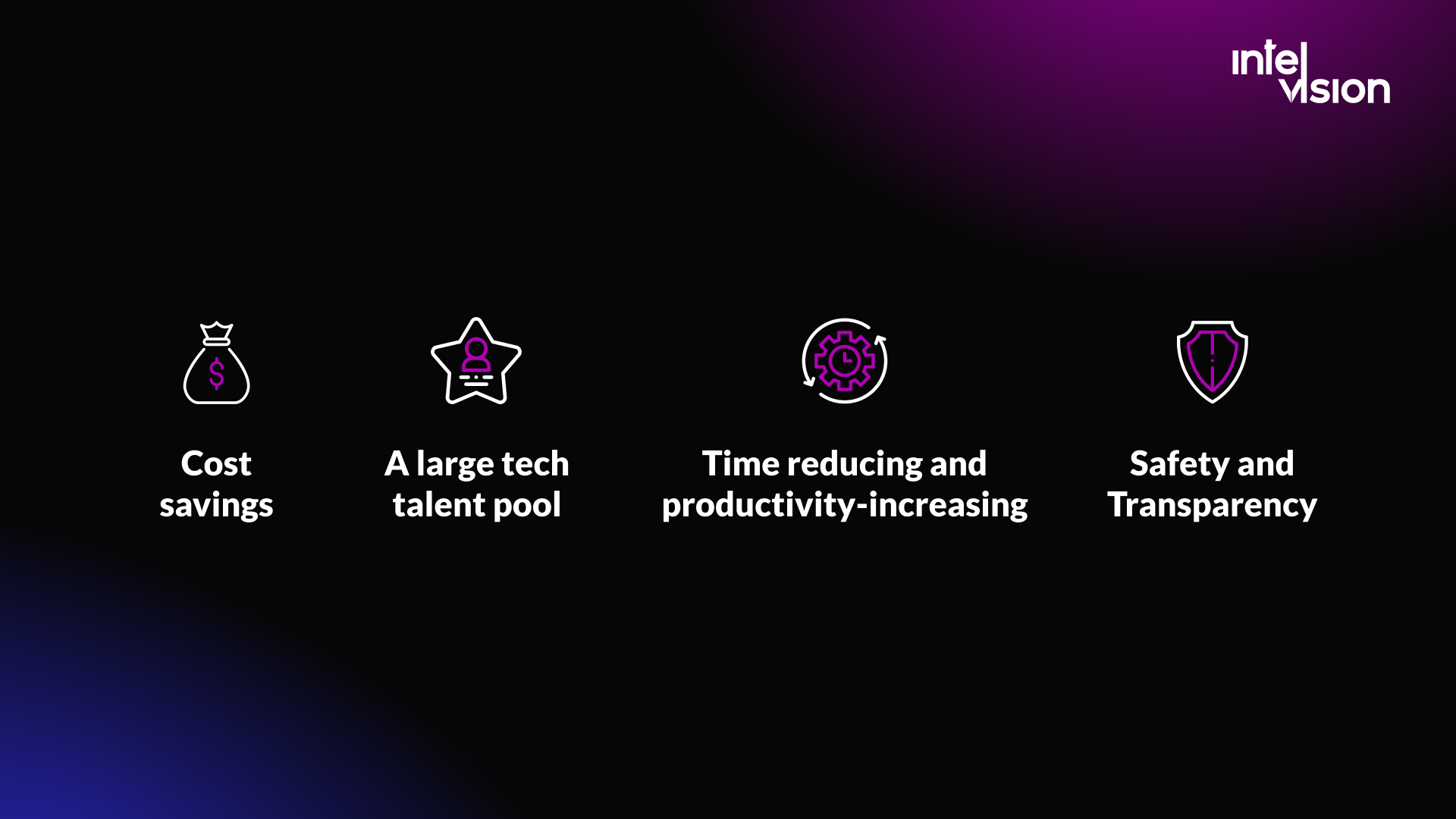
A software developer in the United States earned a median of $135,980 a year in May 2025, according to the US Bureau of Labor Statistics, before benefits, office space, equipment and recruiting fees. Outsourcing rates in Europe, Latin America and Asia are lower (see the cost section below), and with a vendor you pay for productive time rather than for the whole employment overhead. For startups and scale-ups, that difference often decides whether a product line gets funded at all.
Access to skills you cannot hire locally
Senior engineers in Western Europe and the US are expensive and slow to hire, and niche skills are harder still: data engineering for IoT, .NET modernization, integrations with construction or banking systems, or applied AI. A larger talent pool means you can match the skill to the problem rather than training whoever is available.
Speed to start
Hiring a senior engineer locally often takes months once you add sourcing, interviews and notice periods. A mature provider can usually present candidates within days. At Intelvision, our Tech Talent as a Service model sends a shortlist of engineer-vetted candidates in 3 to 4 days, and your new developer starts in under 20 days.
Flexibility
R&D budgets move with funding rounds, customer contracts and experiment results. An external team can grow for a launch and shrink after it, without redundancy processes.
Safety and transparency
Reputable providers sign non-disclosure agreements, assign intellectual property to the client in the contract, and give you full access to code repositories, task boards and documentation from day one. If a vendor resists any of those, treat it as a warning sign.
Nearshore, offshore and onshore: what is the difference?
An earlier version of this article mixed up offshore software development with offshore company registration and tax regimes. They are unrelated. In software outsourcing, the three terms describe distance and time zones:
| Model | Where the team is | Time zone overlap | Typical example |
|---|---|---|---|
| Onshore | Your own country | Full | A German company working with a Munich agency |
| Nearshore | A neighboring region, usually 0 to 3 hours away | Most or all of the working day | A German company with a team in Poland, Romania or Ukraine; a US company with a team in Mexico or Colombia |
| Offshore | A distant region, often 4 or more hours away | A few hours, sometimes none | A German company with a team in India or Vietnam; a US company with a team in Eastern Europe |
The same country can be nearshore for one client and offshore for another. Ukraine is one hour ahead of Berlin and seven hours ahead of New York, so it is nearshore for a German company and offshore for an American one. That is why "offshore versus nearshore" is less a choice of country than a choice of how many shared working hours your process needs.
A practical rule we use: if your team relies on daily conversations with product owners, design reviews and fast feedback on experiments, aim for at least four hours of overlap. If the work is well specified, such as test automation on a stable product, a larger gap can work and can even provide follow-the-sun coverage.
Top offshore software locations in 2026
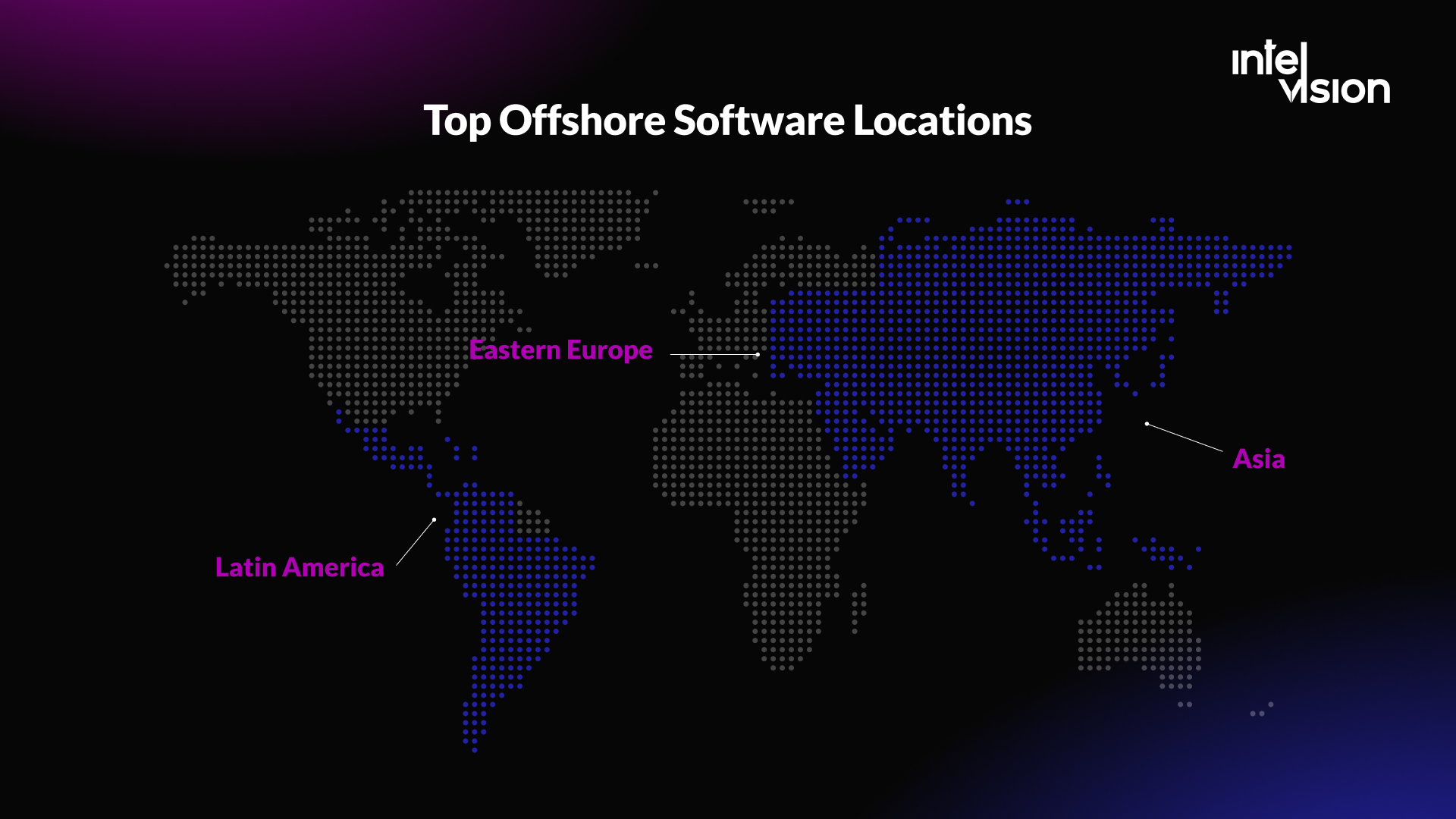
Western European and North American companies hire mainly from three regions. Each has a different balance of cost, overlap and specialization.
Eastern Europe
Poland, Ukraine, Romania, the Czech Republic and the Baltic states are the main hubs. Engineers here are known for strong computer science fundamentals and back-end, cloud and data work, and English is widely used in the industry. For European clients the time zone is close or identical.
Ukraine deserves a specific note because many buyers ask about it. Its IT industry kept growing through the full-scale war: IT exports reached $6.66 billion in 2025, 3.3% more than in 2024, according to Lviv IT Cluster figures reported by dev.ua. Still, ask every vendor for its business continuity plan: backup power and connectivity, distributed teams, and how work continues if one location is disrupted.
Latin America
Mexico, Colombia, Brazil, Argentina and Chile are the leading destinations. For US and Canadian companies the overlap is close to complete, which is why Latin America is the default nearshore region in North America. For European clients the gap of four to eight hours makes it an offshore option. Our comparison of Eastern Europe and Latin America for staff augmentation goes deeper into that choice.
Asia
India, Vietnam, the Philippines, Indonesia and Malaysia offer the largest talent pools and the lowest average rates. Quality varies widely between vendors, so selection matters more here than anywhere. Time zone differences of roughly three to seven hours from Europe, and more from the Americas, push teams towards asynchronous work and careful documentation.
The cost of hiring offshore software developers
Hourly rates fell slightly in 2025. Accelerance, which tracks software outsourcing rates, reported in its 2026 rate trends (published November 24, 2025) that average rates dipped in every major region, citing competition, automation and AI-augmented developers.
| Region | Junior developer (USD per hour) | Senior developer (USD per hour) | Change in 2025 |
|---|---|---|---|
| Europe | $31 to $39 | $64 to $76 | Down 4.4% |
| Latin America | $33 to $45 | $60 to $75 | Down 7.1% |
| Asia | $24 to $31 | $31 to $41 | Down nearly 8% |
Source: Accelerance. Their Europe figures are not split into Eastern and Western Europe; Accelerance notes that downward pressure was especially strong in Central and Eastern Europe.
For comparison, the US median salary of $135,980 from the Bureau of Labor Statistics works out to roughly $65 an hour across 2,080 working hours, before employer taxes, benefits, equipment and recruiting.
Rate is not cost
Hourly rates are the easiest number to compare and the least useful on their own. Accelerance makes the same point: buy by the outcome, not by the hour. When we model the real cost of an offshore team with clients, we look at:
- Effective output. A senior engineer at $70 who needs little supervision often costs less per delivered feature than two juniors at $35.
- Management time. Every hour your product owner or tech lead spends clarifying, reviewing and re-explaining is part of the price.
- Ramp-up. Plan for several weeks before a new engineer is fully productive on a complex codebase.
- Turnover. Each replacement repeats the ramp-up. Ask vendors for retention figures and how long engineers stay on one client.
- Rework. Defects found late, unclear requirements and missing tests cost more than any rate difference.
You can get an estimate for your own project from Intelvision by describing the work on our contact page. We will tell you which roles you need and what a realistic team looks like.
Tax incentives, IP and data protection: check before you sign
Offshore R&D has legal and tax consequences that the hourly rate does not show. Three areas cause the most surprises. This is general information, not tax or legal advice, so confirm the details for your company with an adviser.
R&D tax relief may depend on where the work happens
Some R&D incentive schemes now look at the location of the contractor or the work:
- United Kingdom. For accounting periods beginning on or after 1 April 2024, payments to contractors for R&D carried out overseas, and payments for externally provided workers whose earnings are not subject to UK PAYE, generally no longer qualify, according to HMRC's updated guidance. The exception applies only when the conditions needed for the R&D are absent in the UK and it would be wholly unreasonable to replicate them there, and the HMRC manual states that the cost of the work and the availability of workers are disregarded. In plain terms: hiring offshore because it is cheaper or because you cannot find people at home does not keep those costs claimable.
- Germany. Under the research allowance law (Forschungszulagengesetz), 70% of the fee for contract R&D commissioned after March 27, 2024 counts as eligible expenditure, as set out in § 3 FZulG. But § 2(5) FZulG only covers contractors with their management in an EU member state, or in another EEA state that commits to administrative assistance. A contract with a team managed from outside the EU may therefore fall outside the allowance, while the same work with an EU-managed partner may qualify.
If R&D tax relief is part of your business case, check eligibility before you choose a location, not after the first claim.
Intellectual property
Your contract should assign all intellectual property created for you, including code, designs, documentation and models, to your company on creation or on payment. Ask how the vendor secures the same rights from its own employees and subcontractors, because the chain is only as strong as its weakest link. For AI-assisted work, agree which AI tools may be used on your code and whether your code may be sent to external model providers.
Personal data
If the offshore team will touch personal data of EU residents, GDPR transfer rules apply. The European Commission maintains a list of countries with adequacy decisions, including Argentina, Brazil, Uruguay, Japan, the Republic of Korea, Switzerland and the United Kingdom, to which data can flow without extra safeguards. Many popular offshore destinations, including Ukraine, India and Vietnam, are not on that list, so transfers there need another mechanism such as the Commission's standard contractual clauses. Often the simplest approach is to keep production personal data out of developer environments altogether and work with anonymized or synthetic test data.
How AI-assisted development changes offshore teams
AI coding tools are now part of normal engineering work. The 2025 DORA report found that 90% of respondents use AI at work and more than 80% believe it increased their productivity. That changes how an offshore team should be chosen and run.
- Seniority matters more, not less. AI tools speed up writing code. They do not decide what to build, check whether the result is correct, or notice when an architecture is drifting. The same DORA report found that 30% of respondents have little or no trust in AI-generated code, and concluded that AI amplifies what is already there: strong teams get better, struggling teams see their problems grow.
- Review and testing become the bottleneck. In the 2025 Stack Overflow survey, 66% of developers named "AI solutions that are almost right, but not quite" as their biggest frustration. Ask vendors how they review AI-generated code and how test coverage is enforced.
- Rates are under pressure, outcomes are not. Accelerance links the 2025 rate declines partly to automation and AI-augmented developers, and argues that mature, AI-enabled delivery is becoming the new price multiplier. Compare vendors on cycle time and defect rates, not only on price.
- Agree the rules in writing. Which AI tools are approved, whether client code can leave your environment, and who is accountable for the result.
Our own hiring reflects this. A current full-stack vacancy of ours asks for confident daily use of AI coding tools such as Copilot, Claude or Cursor, and states that the engineer uses AI tooling as the implementation method while staying responsible for correctness, testing and quality of the result. Our AI-assisted software development work helps client teams set up the same discipline.
Engagement models: which one fits your work?
"Offshore team" covers several commercial models. Choosing the wrong one causes more trouble than choosing the wrong country.
| Model | How it works | Best for | Watch out for |
|---|---|---|---|
| Staff augmentation | Individual engineers join your team and work under your management | Filling specific skill gaps quickly; you have strong engineering leadership | You carry the delivery risk and the management load |
| Dedicated team | A stable cross-functional team works only on your product, often with a delivery manager from the vendor | Long-running product development and R&D roadmaps | Needs a clear product owner on your side |
| Project outsourcing | The vendor delivers a defined scope, often at a fixed price | Well-specified projects with clear acceptance criteria | Poor fit for experiments where the scope changes weekly |
| Own offshore center | You set up your own legal entity and hire directly, sometimes via build-operate-transfer | Large, permanent teams where long-term cost and control matter most | High set-up effort, local legal and HR obligations |
Deloitte's survey notes that insourcing is on the rise and that global in-house centers are regaining momentum, with many organizations using a build, operate, transform and transfer model to set them up. For most companies under a few hundred engineers, though, a dedicated team or individual full-time specialists give most of the control with far less set-up work.
Ways to find an offshore development team
There are four main routes, and most companies combine two of them.

Search development company directories
Review platforms such as Clutch and GoodFirms list software companies with verified client reviews, service focus, location and team size. Use them to build a long list, then read the reviews for projects similar to yours rather than relying on the overall score.
Try freelance and talent platforms
Open marketplaces such as Upwork handle contracts and payments for individual freelancers. Screened networks such as Toptal, which says every applicant to its network is tested and vetted and offers a trial period where you pay only if satisfied, reduce the screening effort. Both work well for individual specialists and short projects. For a team that has to work together for years, you will still need to provide the structure yourself. Our overview of Toptal alternatives for hiring developers in Europe compares the options.
Work with a development company
For R&D teams, a software development company is usually the safest route. It handles recruiting, employment, equipment, replacements and often delivery management, and it can assemble a cross-functional team of developers, QA engineers, designers, business analysts and project managers. At Intelvision, engineers work inside the client's own tools and routines full-time while being employed and supported by us, and clients pay only for the work done.
Check LinkedIn and your network
LinkedIn reports more than 1 billion members in more than 200 countries and territories. Use it to check the people a vendor proposes, their work history and how long they stayed in previous roles, and ask peers in your industry who they have worked with. Referrals remain the most reliable source of good partners.
How to hire the right offshore software development team
Your results depend on who you choose to work with. This is the checklist we would use if we were in your seat.
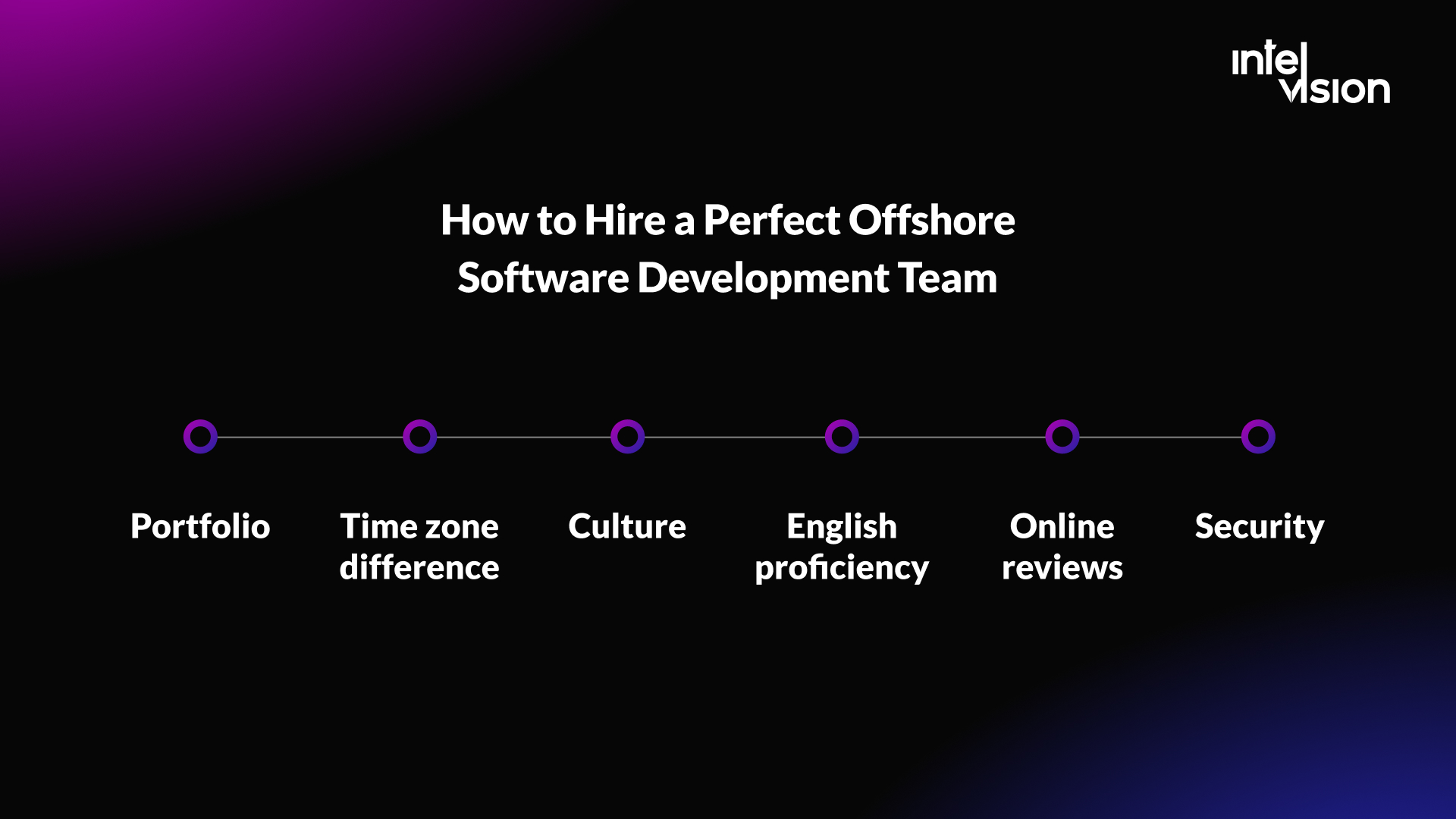
- Relevant portfolio. Look for products similar to yours in domain and complexity, and ask to speak with a client from one of them.
- Interview the actual engineers. Not the sales team and not a "bench" sample. Run a technical interview or a short paid test task with the people who will work on your code.
- Time zone overlap. Agree core hours in writing. For R&D with frequent decisions, plan for at least four shared hours a day.
- Communication. Engineers should be able to discuss requirements and trade-offs directly with your product owner in English, without an account manager translating.
- Culture and working style. Do engineers push back on unclear requirements, or build exactly what the ticket says? For R&D you want the first.
- Retention. Ask how long engineers stay on a client and what happens when someone leaves. Replacement terms belong in the contract.
- Reviews. Read verified reviews on Clutch and similar platforms, and check that the reviewers are real companies.
- Security. Ask for the vendor's security policies, access control practices and, where relevant, an ISO/IEC 27001 certificate or SOC 2 report. Check how devices are managed and how access is revoked when someone leaves.
- Contract terms. IP assignment, confidentiality, data processing terms, notice periods, and a clear exit plan with handover of code and documentation.
How to manage an offshore development team
Most offshore problems are management problems that distance makes visible. These practices make the biggest difference.
Give clear ownership and instructions
Define who owns each part of the product, who approves requirements and who makes architecture decisions. Write it down. Ambiguity costs more across time zones because a question that takes two minutes in an office can cost a day by message.
Share the product goals, not just the tickets
A team that understands the customer and the business goal makes better small decisions. Define the outcome you want, for example a new module that cuts a customer's reporting time, and share how you will measure it. The team will understand the value of daily tasks and get more involved in the product.

Keep a steady meeting rhythm
Short daily stand-ups inside the shared hours, weekly planning, and a demo at the end of each iteration. Keep stand-ups short; in our work with a German energy consultancy, a 30-minute daily stand-up limit was part of restoring delivery focus. Use video for planning and demos, and written updates for everything else.
Work in short iterations
Iterations of one to three weeks, each ending in something you can see and test, keep an offshore team aligned with changing priorities. They also make problems visible early, when they are still cheap to fix.
Write things down
Architecture decision records, a living README, clear acceptance criteria and recorded demos let people in different time zones work without waiting for each other. Documentation is not bureaucracy here; it is how the team avoids blocking.
Measure delivery, not activity
Track cycle time, release frequency, escaped defects and how often work is reopened. Hours logged and story points tell you the team is busy, not that it is delivering. If delivery slows and nobody can say why, an independent engineering diagnostic is faster than another round of status meetings.
Common mistakes with offshore development teams
- Choosing on hourly rate alone. The cheapest team often costs the most per delivered feature once rework and management time are counted.
- Sending only the work nobody wants. Teams that only get maintenance tickets never learn the product well enough to help with R&D.
- No product owner on the client side. Without one person who can make decisions quickly, the team waits or guesses.
- Skipping the legal checks. Discovering after the fact that R&D tax relief does not apply, or that personal data left the EU without safeguards, is expensive.
- Treating the team as interchangeable. Rotating engineers between clients destroys product knowledge. Ask for named people and stable allocation.
- Letting AI output go unreviewed. Faster code generation without stronger review simply produces defects faster.
How Intelvision builds offshore and nearshore teams
Intelvision is a European software engineering company. We started by placing senior developers in client teams, and that model still runs alongside software delivery, AI implementation and our Strike Team for projects in trouble. Today we work with more than 50 companies across Europe.
What clients get, as published on our site:
- A shortlist of engineer-vetted candidates in 3 to 4 days, and a new developer starting in under 20 days.
- Engineers who work inside your tools and routines full-time, employed and supported by Intelvision.
- Stability: 95% of our developers stay with clients for 12 months or more, and the average client relationship runs over three years.
- A 5.0 rating on Clutch from 14 verified reviews.
Some examples from our case studies:
- Visoplan (Germany): a construction collaboration platform where we scaled a dedicated team from one to five people, with a published 50% cut in development costs and 40% faster time to market.
- AI project orchestration platform (Switzerland): a Senior Back-end Developer started within 3 business days to support an AI product that keeps collaboration and delivery tools aligned.
- Food distributor (Germany): real-time IoT monitoring and predictive analytics for cold chain logistics, with an 85% reduction in inventory discrepancies and a 34% decrease in spoilage in cold storage.
- Renewable energy operator (EU): a smart monitoring and alerting system for solar and wind farms that cut downtime by 38% in six months.
You can read the full story of the first one in our Visoplan case study.
The bottom line
An offshore development team can give your R&D roadmap senior capacity, skills you cannot hire locally and the flexibility to scale with your funding. The companies that get those benefits choose the location by time zone and skills rather than by rate alone, check tax, IP and data protection before signing, insist on seniority and review discipline now that AI writes much of the first draft, and manage the team as part of their own organization.
What sets a good partner apart is a mix of industry knowledge and engineering depth, and people who stay. If you are planning an offshore or nearshore R&D team, tell us what you are building and we will tell you honestly what team it needs and whether we are the right fit.
Sources
- Global Outsourcing Survey 2024 (Deloitte)
- Software Developers, Occupational Outlook Handbook (US Bureau of Labor Statistics)
- Ukrainian IT exports returned to growth in 2025 (dev.ua, February 2026)
- 2026 Outsourcing Rate Trends: Asia, Europe, LATAM (Accelerance)
- R&D tax reliefs: new contracting out rules and overseas restrictions, updated guidance (HMRC)
- CIRD150500: R&D tax reliefs, overseas restrictions overview (HMRC internal manual)
- § 3 Forschungszulagengesetz (gesetze-im-internet.de)
- § 2 Forschungszulagengesetz (gesetze-im-internet.de)
- Adequacy decisions (European Commission)
- Standard contractual clauses (European Commission)
- Announcing the 2025 DORA Report (Google Cloud)
- Stack Overflow Developer Survey 2025: AI
- Toptal
- About LinkedIn
Read Intelvision often? Add us as a preferred source in Google Search.
Add to preferred sources