
How to Find a Reliable Software Development Partner: A Step-by-Step Guide
What's new: Rewritten as a nine-step process with current rate data, a pricing-model comparison, contract and EU compliance checks, a section on AI-assisted development, a scorecard and an FAQ.
Summarize with AI
Read summarized version with AI
- Write a two to three page brief (goal, users, constraints, success measures, what you delegate) before you contact any vendor.
- Budget on total cost of delivery, not hourly rates: Accelerance reported European rates of US$31 to $39 an hour for juniors and US$64 to $76 for seniors in November 2025.
- Check evidence instead of claims: case studies with team, duration and results, reference calls, and interviews with the engineers who will actually do the work.
- Match the model to your certainty: time and materials or a dedicated team for changing scope, fixed price only for a clear, stable phase.
- Put IP transfer, your ownership of repositories and accounts, a GDPR Article 28 agreement and exit terms in the contract, and start with a small phase you can measure.
- With AI coding tools now standard, judge partners on how they review and own AI-generated code, not on claimed speed.
Finding a software development partner you can fully rely on is still hard. The market is crowded, every website promises senior engineers and agile delivery, and the cost of a wrong choice only shows up months later, as missed releases, rising invoices and code nobody wants to own.
This guide is the process we would follow if we were on the buying side. It starts before you contact a single vendor, gives you current rate benchmarks, shows how to test claims instead of reading them, and covers the contract, security and AI questions that matter for European buyers in 2026. Where Intelvision's own published numbers help as a reference point, we use them and link to where they are published.
What a software development partner is, and when you need one
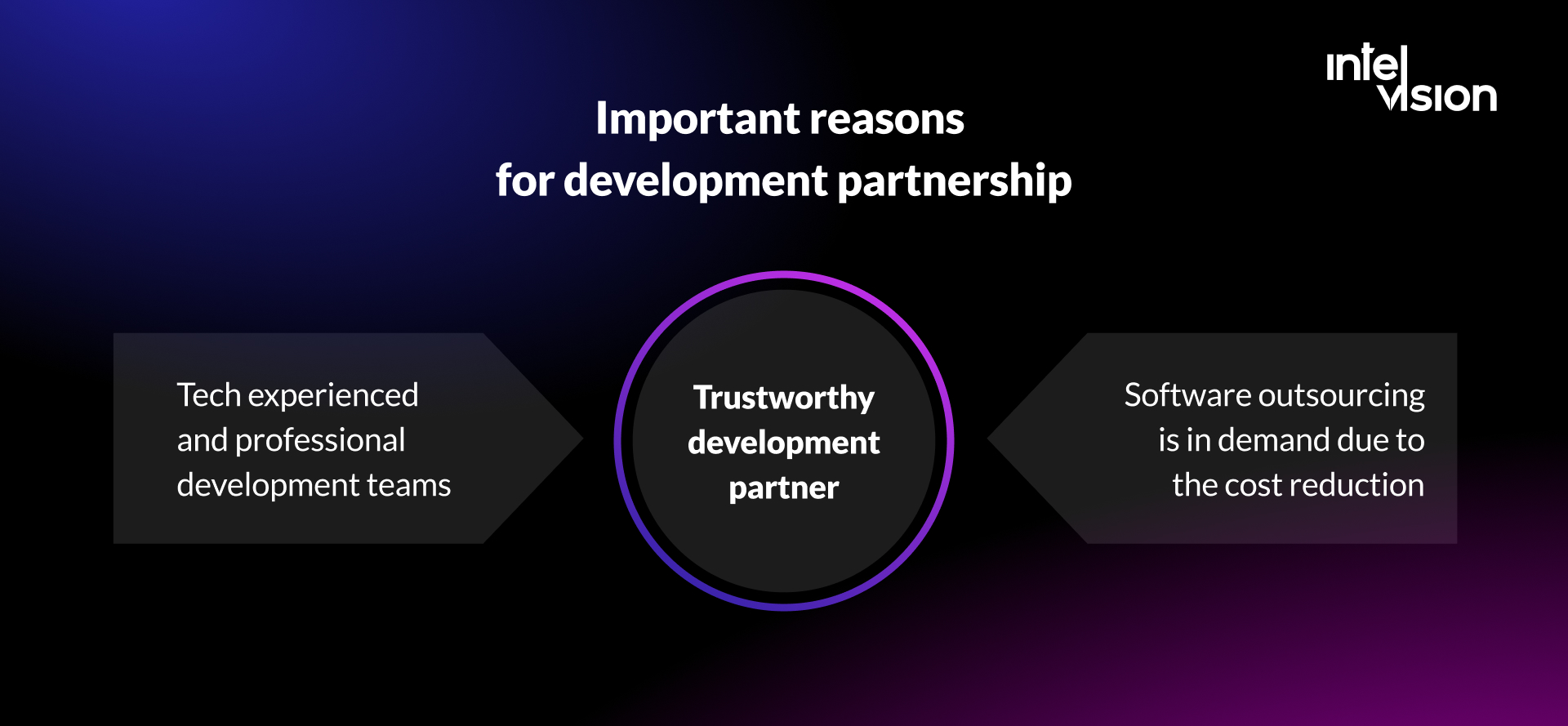
A software development partner is an external company that takes on part of the work of building or running your software: a whole product, one product area, or a few senior roles inside your own team. Startups use partners to build a first version without hiring a full team. Scale-ups use them to add capacity faster than recruiting allows. Larger companies use them for specialist skills, modernisation projects or a second delivery stream.
Partners differ a lot depending on what you buy, so the first decision is which kind you are looking for:
- Project delivery (outsourcing). The partner owns delivery of an agreed scope, usually with its own project manager and QA.
- Dedicated team. A cross-functional team works only on your product for a longer period. You set priorities; the team carries delivery.
- Staff augmentation. Individual engineers join your team, your tools and your process. You keep management and technical direction.
- Advisory or rescue. Senior people diagnose a delivery problem, an architecture decision or a struggling vendor relationship, and often stay to fix it.
Mixing these up is a common source of disappointment. A company that wants someone else to own the outcome but buys individual engineers ends up managing a team it never planned to manage. A company with a strong engineering lead that buys a full project team pays for management it does not need.
The complaints we hear from people who had a bad outsourcing experience have barely changed over the years:
- Too much of their own time spent managing the vendor
- Quality of the results
- Communication obstacles
- Delays in launching the project
- Inconsistency: a good first month, then a slow decline
Almost all of these trace back to how the partner was chosen and how the work was set up, not to geography or price. That is good news, because the selection process is in your hands.
Why companies look for a development partner in 2026
Cost used to be the main argument for outsourcing. It is no longer the only one. Deloitte's 2024 Global Outsourcing Survey, based on more than 500 executives, found that skilled talent and agility now sit next to cost reduction as key drivers, and that 83% of the executives surveyed already use AI as part of their outsourced services. The same report notes that tangible benefits such as productivity gains or cost reductions from AI have so far been limited (Deloitte).
In the conversations we have with CTOs and founders, three reasons come up again and again:
- Access to specific skills. Senior backend, data, DevOps and AI engineers are hard to hire locally, and a hiring process can take a quarter or more. A partner with people already employed shortens the search to weeks.
- Speed. Product windows close. A partner that can start in two or three weeks is often worth more than a cheaper one that needs months.
- Flexible capacity. Roadmaps change. Adding and removing engineers through a partner is easier than hiring and letting people go.
Knowing which of these is your main reason tells you what to look for. If it is skills, judge partners on their people. If it is speed, judge them on how fast they actually started on comparable engagements. If it is flexibility, read the contract terms for scaling up and down before anything else.
Step 1: Define the goal, the scope and what you will delegate
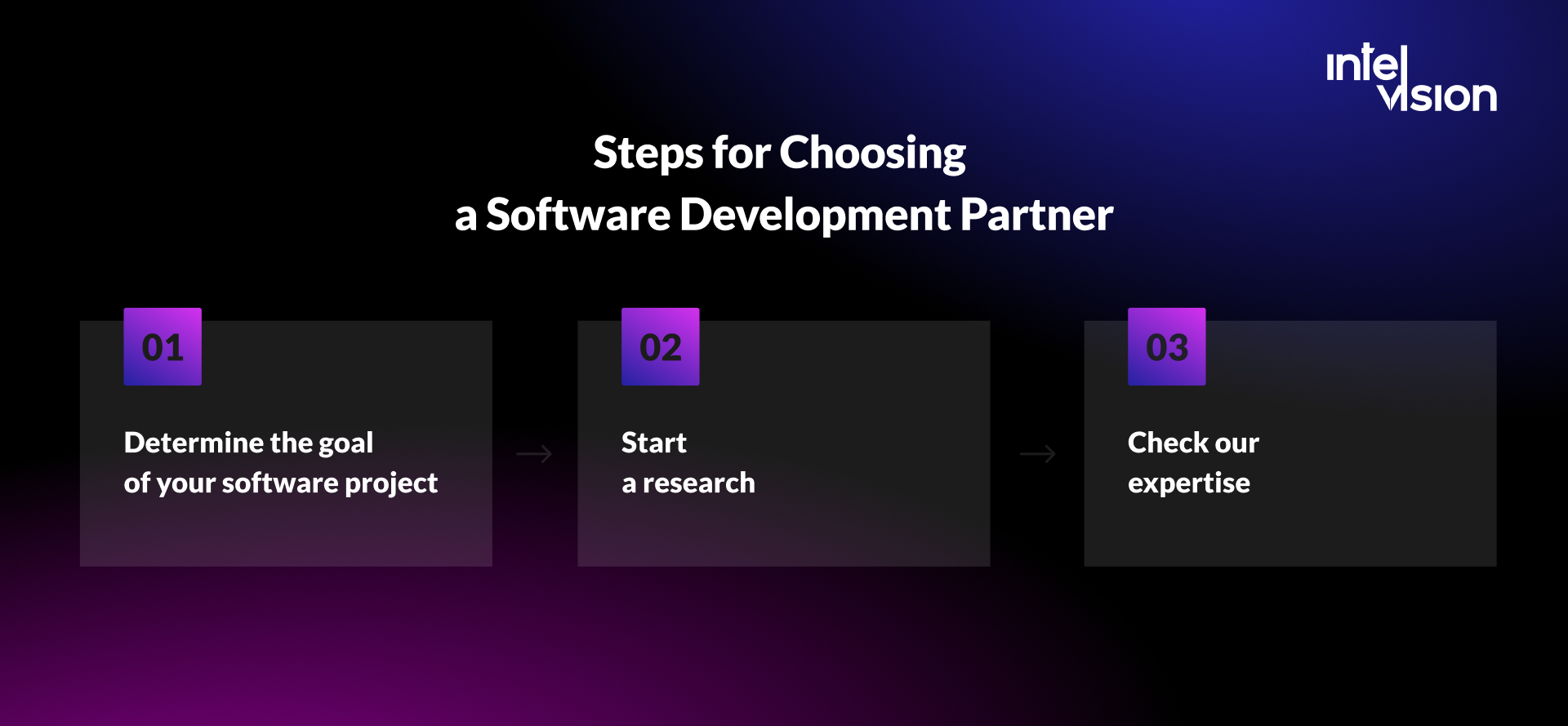
Surprisingly, searching for a dependable company should not be your first step. Before you contact anyone, write down what you are building and why. The clearer your description, the better the proposals you get back, and the easier they are to compare.
A useful brief fits on two or three pages and covers:
- The business goal. What changes for the business when this ships: revenue, cost, compliance, a commitment to a customer?
- Users and core workflows. Who uses the software and the handful of things they must be able to do on day one.
- Constraints. Existing systems and integrations, data residency, regulation, the technology your team already runs.
- What exists today. A prototype, an old system, a codebase from a previous vendor, designs, competitor examples. Sketches and screenshots help a lot.
- Success measures. The benchmarks that tell you the project is moving the way you want: a launch date, a performance target, a reduction in manual work. Keep them realistic.
- Timeframe. A target date and the reason behind it. Once you know how many weeks you have, you can split the project into phases.
- What you will delegate. Decide which parts go to the partner and which stay in-house: product ownership, architecture, QA, DevOps, support.
Also decide who on your side owns the partnership. Someone needs time every week to answer questions, accept work and make product decisions. If nobody has that time, choose a model in which the partner carries more of the management, and budget for it.
If the scope is genuinely unclear, do not fake certainty. A short paid discovery phase, in which the partner maps requirements, risks and architecture options before quoting the build, costs far less than a fixed price built on guesses. Our deep discovery work exists for exactly this situation.
Step 2: Set a realistic budget
Budget is where many searches go wrong. There is always a temptation to pick the lowest rate, and it usually backfires: you get a partner who works quickly but not effectively, and you pay for the rework later. Prioritise quality over quantity, and compare the total cost of delivery, not hourly rates.
Current market rates give you a reference point. Accelerance, which tracks rates across its network of outsourcing partners, reported in November 2025 that average rates dipped by single-digit percentages in every major region:
| Region | Junior developer | Senior developer | Change year on year |
|---|---|---|---|
| Europe | US$31 to $39 an hour | US$64 to $76 an hour | Down 4.4% |
| Latin America | US$33 to $45 an hour | US$60 to $75 an hour | Down 7.1% |
| Asia | US$24 to $31 an hour | US$31 to $41 an hour | Down nearly 8% |
Source: Accelerance, 2026 outsourcing rate trends.
For comparison, Intelvision publishes its own rates on the pricing page: a full-time specialist costs from €6,500 to €9,000 a month depending on seniority, the equivalent of €32 to €50 an hour, with no upfront recruitment or onboarding fees. Whoever you talk to, ask for rates in writing and ask exactly what they include.
To estimate the real cost of an engagement, add up:
- The team. Roles multiplied by the monthly rate and the number of months. Include QA, project or delivery management, design and DevOps if the partner provides them.
- Your own time. Product ownership, reviews and acceptance. On most engagements this is several hours a week from a senior person on your side, and it is real cost.
- Onboarding. The first weeks rarely run at full speed while people learn your domain and your codebase.
- Infrastructure and tools. Cloud, licences, AI coding assistants, test devices, monitoring.
- A contingency. Money for scope you have not discovered yet. The less you know at the start, the larger it should be.
Then compare proposals on what you get for the money: what will be in production by month three, not what an hour costs.
Step 3: Build a long list without wasting weeks
Once your brief and budget are ready, start the search. An unstructured Google search shows you the companies with the biggest marketing budgets and misses many good alternatives. Combine several channels instead:
- Referrals. Ask CTOs and founders you trust who they used and whether they would hire them again. This is still the strongest signal you can get.
- Review platforms. Clutch and GoodFirms let you filter by service, location, budget and industry and read client reviews. They are a good source for a long list.
- Proof in your domain. Search for case studies in your industry and technology. A partner that has built a similar integration or worked under the same regulation asks better questions from the first call.
- Professional networks. LinkedIn and engineering communities show who the senior people at a company are and how long they have stayed.
Read review platforms with care. Each company creates its own profile, and the platforms take steps to confirm that reviews come from real clients: Clutch, for example, asks reviewers to log in with a LinkedIn account or a company email before leaving a review (Clutch Help Center). That makes reviews useful, but it does not make a profile a complete picture. Companies invite the clients they expect to be happy. Look at the pattern: how recent the reviews are, whether they describe projects like yours, and what reviewers say about problems and how they were handled. A thoughtful four-star review often tells you more than a row of short five-star ones.
A long list of eight to twelve companies is enough. Cut it to three or four for detailed evaluation, using your brief: drop anyone without relevant experience, anyone outside your budget range and anyone who cannot start when you need them.
Step 4: Check expertise and evidence, not claims
With a shortlist in hand, check what each company has actually done. Start with their websites and portfolios; most partners publish case studies. Look for specifics. A good case study names the industry, the team, the duration, the technology and a result you could ask about. "We delivered a scalable platform" is a claim. "A core team of two full-stack developers, a QA engineer, a project manager, a business analyst and a UI/UX designer, an average time to hire of 18 days, and an engagement running since August 2022" is evidence; that example comes from our ING+ case study.
Keep in mind that many projects are built for internal use or under NDA and never appear on a website. An anonymised case with real figures is fine. A wall of logos with no detail is not.
Then go further than the website:
- Ask for references and call them. Ask for two or three current or recent clients with projects like yours. Prepare your questions: What went wrong and how was it handled? Did the team stay stable? Would you hire them again for the same work?
- Read reviews and testimonials on Clutch or similar platforms, and look at the clients' own products where you can.
- Check domain knowledge. If you build for construction, fintech or energy, ask how they handled the regulation, data or integrations specific to that industry. People who have done it answer quickly and concretely.
- Look at longevity. How long do client relationships last? How long do engineers stay? Long relationships are hard to fake.
For reference, the figures we publish about ourselves are a 5.0 rating across 14 verified reviews on Clutch, more than 100 software products delivered, an average client partnership of more than three years and 89% team retention. Ask every partner on your shortlist for the same kind of figures, and for the evidence behind them.
Finally, make sure the partner understands your customers, not only your technology. If you plan a long-term partnership, the people building the product need enough business context to make good small decisions every day without asking you.
Step 5: Examine how they deliver
To keep control of the outcome, you need to understand how the work runs at each company you consider. Ask them to walk you through a recent project instead of their sales deck:
- Roles and accountability. Who is your day-to-day contact? Who is accountable when delivery slips? Is there a technical lead, and who is it?
- Planning and estimation. How do they break down work, estimate it and report progress? Ask to see a real sprint report or roadmap, anonymised.
- Definition of done. Code review, automated tests, documentation, security checks: what has to be true before a feature counts as finished?
- Quality and release. Who tests, how often they release, how they roll back and how they handle incidents in production.
- Metrics. Do they already track delivery measures such as lead time, deployment frequency, change failure rate and time to restore service? Teams that measure can show you trends; teams that do not can only show you opinions.
- Tooling. Will they work in your Jira, repositories and CI/CD, or in their own? For long-term work, working inside your tools keeps the knowledge with you.
Think about the methodology that suits you and look for partners that fit it. Agile delivery works well when requirements will change and you can give regular feedback, but it depends on constant communication between partner and client. If you cannot attend sprint reviews, say so before you sign, not after.
At Intelvision, engineers work in the client's own tools, standups and release process, with direct access to the people making product decisions and no account layer in between. That is a choice with trade-offs: it gives you visibility and keeps knowledge in your systems, and it asks for a few hours a week of attention from your side.
Step 6: Choose the engagement and pricing model
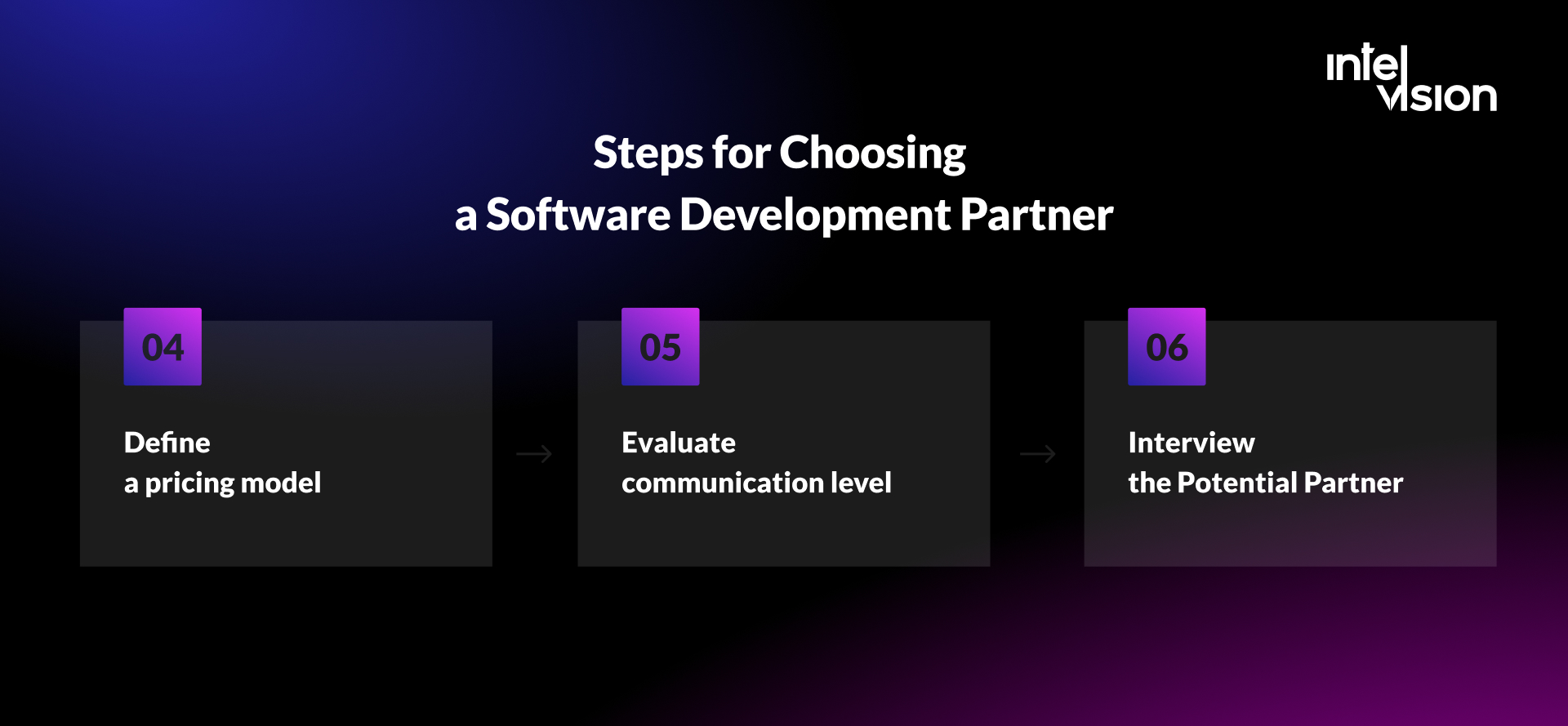
There are three common pricing models, plus staff augmentation as a fourth way to buy capacity. Each fits a different level of certainty about the scope.
| Model | How you pay | Works best when | Watch out for |
|---|---|---|---|
| Time and materials | For the hours or days actually worked | Scope will change, or you cannot yet estimate the size of the product | Weak reporting; agree a budget cap and regular forecasts |
| Fixed price | An agreed sum for an agreed scope | Requirements and deadlines are clear and stable, for example a well-defined phase | Change requests, padded estimates, pressure to cut quality to stay on budget |
| Dedicated team | A monthly rate per person | Long-term product work, where a stable team builds up domain knowledge | Paying for idle capacity if your backlog is not ready |
| Staff augmentation | A monthly or hourly rate per engineer | You have engineering leadership and need specific skills inside your team | You carry the management; the partner does not own the outcome |
The dedicated team is often the best choice for long-term partnerships. A team works only on your project, you control priorities and workload, and the team builds up knowledge that would otherwise walk out of the door at the end of each fixed-price phase. Our dedicated development teams work this way: you keep product ownership, the team keeps delivery ownership, and it scales up and down as the roadmap changes. One example from our published cases: the Visoplan team grew from one to five people over an engagement that has run since July 2021.
Whatever the model, check the commercial terms that matter after signing: notice periods, how fast you can scale up or down, what happens if a person is not a good fit, and whether there are setup or recruitment fees.
Step 7: Test communication and culture
Communication remains the deciding factor in most partnerships. It does not matter how strong a partner is technically if communication does not work. You should never struggle to get a clear answer, and the people doing the work should speak your working language well enough to discuss trade-offs, not just report status.
Poor communication drives a project to failure faster than poor code.
Agree on the communication setup before the work starts:
- Which meetings happen, how often and who attends: planning, standups, demos, retrospectives.
- Where decisions and documentation live, and in which language.
- How many working hours overlap each day. Teams that work closely together need a few shared hours every day, not one call a week.
- How bad news travels. Ask directly: "Tell me about the last time one of your projects was late. When did the client find out?"
A company's culture tells you a lot about how it will behave under pressure. Look at its stated values, how it treats its own people and how long those people stay. You want a partner that shares your standards but is willing to disagree and explain why. A partner that agrees with everything in the sales phase will agree with everything in delivery too, including bad decisions.
Visiting the office used to be the easiest way to understand a partner's culture. With distributed teams now normal, a working session on one of your real problems over video tells you more: you see how they think, what they ask and whether they listen. Trust your first impression, then test it.
Step 8: Interview the people who will do the work
When you start talking to a potential partner, you meet the sales team first, and they will give you a good pitch. You also need to know which people will work on your project. Talk to the engineers and the technical lead directly and check that they can deliver what was promised.
A good interview covers:
- A walk-through of a system they built, including what they would do differently today.
- A short design discussion on one of your real problems.
- A small code review: show them a piece of code and ask what they would change and why.
- How they use AI coding tools and how they check what those tools produce.
- Availability: are these named people committed to your project, and from which date?
Get the names into the agreement where it matters. "A senior developer" in a proposal can become a different person on day one. Ask what happens if someone leaves or is not a good fit, and how knowledge is handed over. Our own published terms, for example, say that if a developer does not meet your expectations within the first month, we replace them at no additional cost.
Step 9: Start small and measure
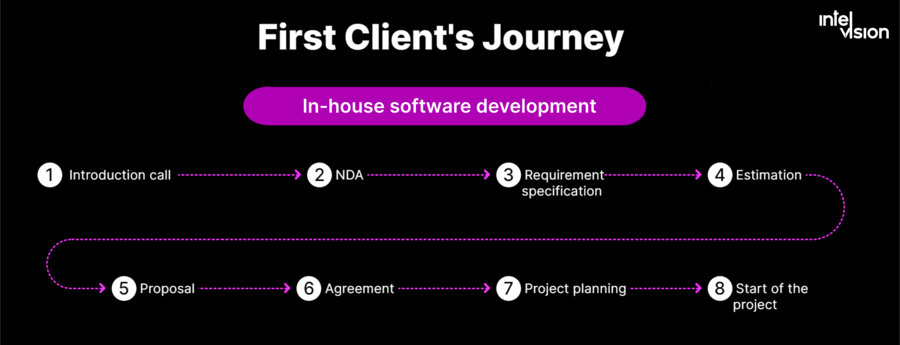
The safest way to choose a partner is to work with them on something real before you commit to something large. Most good partners will agree to a limited first phase:
- A paid discovery that produces requirements, architecture options, a delivery plan and an estimate you can hold them to.
- One engineer or a small team on a well-defined part of the backlog for the first month or two.
- A diagnostic of an existing system or delivery process, if you are replacing a previous vendor.
Define in advance what success looks like for that phase: working software in production, the quality of documentation, how estimates compared with reality, how problems were raised. Then decide whether to expand. Most of our own engagements start this way, smaller than the eventual scope, with the people, responsibilities and success measures agreed before the work grows.
Speed of start is part of this test. Ask each partner how long it took to get engineers working on comparable engagements, and check the answer with references. Across our published engagements, the time from brief to an engineer on the project is 12 to 18 days, and in one documented case a senior back-end developer started three business days after the request (the case study).
Contract, security and compliance checks for European buyers
Once you have chosen a partner, the contract decides what happens when things go wrong. Lawyers should draft it, but engineering leaders should know what to look for:
- Intellectual property. All code, designs and documentation transfer to you, ideally on payment of each invoice. Check what the partner reuses from its own libraries and under which licence.
- Access and exit. Your organisation owns the repositories, cloud accounts and domains from day one. Define handover obligations for the end of the contract: documentation, credentials, knowledge transfer sessions and a notice period.
- Personal data. If the partner touches personal data, GDPR requires a written processing agreement under Article 28: processing only on your documented instructions, confidentiality, security measures, rules for sub-processors, and deletion or return of the data at the end (GDPR Article 28).
- Subcontracting. Know whether the partner uses freelancers or subcontractors, and require your approval for them.
- Security practice. Device management, access control, secrets handling, dependency scanning, incident reporting. Ask for the policy and an example of how it is enforced.
- AI tools. Which AI coding assistants may be used on your code, with which data settings, and whether your code may be used to train models.
Some sectors and products carry further rules that reach your suppliers:
- Financial services. The Digital Operational Resilience Act (DORA) has applied since 17 January 2025. It covers how financial entities manage risk from ICT third-party providers, including key contractual provisions (EIOPA).
- Products with digital elements. The EU Cyber Resilience Act entered into force on 10 December 2024. Vulnerability reporting obligations apply from 11 September 2026 and the main obligations from 11 December 2027 (European Commission). If you sell software or connected devices in the EU, your partner's secure development and vulnerability handling become part of your compliance.
- AI systems. Under the EU AI Act, prohibited practices and AI literacy obligations have applied since 2 February 2025 and obligations for general-purpose AI models since 2 August 2025. After the AI Omnibus, rules for high-risk systems in sensitive use cases apply from 2 December 2027, and for AI embedded in regulated products from 2 August 2028 (European Commission). If your partner builds AI features, ask how it documents data, testing and human oversight.
How AI-assisted development changes partner selection
AI coding tools are now standard equipment. In the 2025 Stack Overflow Developer Survey, 84% of respondents said they use or plan to use AI tools in their development process, and about half of professional developers use them daily. Trust is lower than use: 46% of developers said they distrust the accuracy of AI output, against 33% who trust it (Stack Overflow). Google's 2025 DORA research, based on nearly 5,000 technology professionals, describes AI as an amplifier that magnifies the strengths of high-performing organisations and the dysfunctions of struggling ones; throughput improved with AI adoption, while delivery instability kept rising (InfoQ).
For a buyer, that changes three things:
- Do not pay for typing speed. If a partner says AI makes its developers twice as fast, ask how it measures that and whether the gain shows up in delivered features, defects and rework. Fast code that nobody can maintain is not a saving.
- Review discipline matters more. Ask how AI-generated code is reviewed, tested and documented, and who is accountable for it. The answer tells you more about quality than the list of tools.
- Seniority matters more. AI tools help most in the hands of engineers who can judge their output. A team of juniors with AI assistants can produce a lot of confident-looking code that a senior person later has to untangle.
Ask partners to show, not tell: a recent pull request where AI assistance was used, how it was reviewed, and how they protect your code and data when using these tools. If you want an outside view of how your own team uses these tools, our AI-assisted SDLC work starts with exactly that assessment.
Red flags that predict a bad partnership
- A fixed price for a vague scope, delivered within days and without questions.
- No access to the engineers before signing, or named people who change after signing.
- Reluctance to give references for projects similar to yours.
- The partner wants your code, cloud accounts or domains registered in its own name.
- No clear answer on who is accountable when delivery slips.
- Status reports that are always green, with no risks listed.
- Estimates that drop sharply as soon as you mention a competitor's price.
- Heavy use of subcontractors that only surfaces when you ask directly.
- Agreement with everything you say during the sales process.
None of these alone proves that a partner is bad. Two or three together should pause the process until you get clear answers.
A simple scorecard for comparing partners
Score each shortlisted partner from 1 to 5 on the criteria below and weight them for your situation. Base every score on evidence, not on impressions from the sales meeting.
| Criterion | What a 5 looks like | How to check |
|---|---|---|
| Relevant experience | Several comparable projects in your domain or stack, with concrete results | Case studies, reference calls |
| People | Senior, named engineers you have interviewed and who are available | Technical interviews, start dates in writing |
| Delivery process | Clear roles, a definition of done, metrics they already track | Walk-through of a real project, sample reports |
| Communication | Direct access to the team, honest answers about risks | Working session, reference calls |
| Commercial fit | Transparent rates, flexible scaling, no lock-in | Written proposal, contract terms |
| Security and compliance | Written policies, a processing agreement, your ownership of code and accounts | Policy documents, contract review |
| Stability | Long client relationships and low staff turnover | Published figures, references |
| Use of AI | Measured gains, strict review of generated code, clear rules for your data | Example pull requests, tool policy |
If two partners end up close, choose the one whose people you would rather work with on a bad day. Every long project has some.
When the partnership you have is not working
Sometimes the question is not how to find a partner but what to do about the one you already have. Deadlines keep moving, releases break, and the status report no longer matches what you see in the product. Before switching, find out where the problem actually sits: in the vendor, in the scope, or in the way the work is managed on both sides. Switching vendors without that answer often moves the same problem to a new company.
Our articles on the warning signs that a software project needs rescue and on taking over from an underperforming vendor walk through that decision. When a project is slipping, our Strike Team starts with a fixed-fee engineering diagnostic to find the real constraint, then stays to fix it.
Summary
Finding a reliable software development partner is not easy, but it is a process you can control. Start with what you want as the result, not with a vendor search. Set the budget on total cost, not hourly rates. Build a long list from referrals and review platforms, then check evidence: case studies with real figures, reference calls and interviews with the people who will do the work. Choose the engagement model that matches how certain your scope is, put ownership, data protection and exit terms into the contract, and start with a phase small enough to measure.
Done this way, choosing a partner stops being a leap of faith and becomes a decision you can defend. If you want to talk through your project with the people who would lead the work, get in touch. You get a direct answer on whether we can help and what should happen first.
Sources
- Deloitte, Global Outsourcing Survey 2024
- Accelerance, 2026 outsourcing rate trends: Asia, Europe, LatAm (November 2025)
- Clutch Help Center, how the Clutch review process works
- Intelvision profile on Clutch
- GDPR Article 28, Processor
- EIOPA, Digital Operational Resilience Act (DORA)
- European Commission, Cyber Resilience Act
- European Commission, AI Act regulatory framework
- Stack Overflow Developer Survey 2025, AI
- InfoQ, DORA report: State of AI-assisted software development 2025
Read Intelvision often? Add us as a preferred source in Google Search.
Add to preferred sources