
How to Hire .NET Developers in 2026: Skills, Costs and Interview Questions
What's new: .NET 10 and support dates, new skills including AI integration, cost data and hiring models, a step-by-step process, interview answers and a migration section. Earlier factual errors corrected.
Summarize with AI
Read summarized version with AI
- .NET 10 is the current LTS release, supported until November 2028; .NET 8 and .NET 9 both reach end of support on November 10, 2026.
- Test for modern C#, ASP.NET Core, EF Core performance, cloud, testing and security habits, and increasingly for AI integration with Microsoft.Extensions.AI and Agent Framework.
- Compare total cost, not salary or rate: include recruiting, the months a role sits empty and your own onboarding time.
- Interview with real problems from your codebase and define what a good answer covers before the interview.
- For a .NET Framework migration, start with a senior engineer who has done one before, not several juniors.
.NET runs a large share of the world's business software: banking back ends, ERP integrations, logistics platforms, internal tools, desktop trading apps and a growing number of AI-enabled services. If your product is built on it, or you are deciding whether to build on it, the hard part is rarely the technology. It is finding .NET developers who can work on a modern stack, make sound architecture decisions and, often, move older code forward without breaking the business.
This guide is written for CTOs, founders and engineering leads hiring .NET developers in 2026. It covers what has changed in the platform, the skills to test for at each level, what hiring costs, which hiring model fits which situation, a step-by-step process, interview questions with what a good answer sounds like, and the mistakes we see most often.
Why companies hire .NET developers in 2026
.NET is Microsoft's free, open-source, cross-platform development platform. It runs on Windows, Linux and macOS, in containers and in every major cloud. The language most teams use with it is C#; F# and Visual Basic are also supported. The original Windows-only .NET Framework still exists, but new development happens on modern .NET, which ships a new major version every November.
Demand is steady and broad. In the Stack Overflow 2025 Developer Survey, 27.8% of all respondents and 29.9% of professional developers used C#. ASP.NET Core was used by 19.7% of respondents among web frameworks, ASP.NET by 14.2% and Blazor by 7%.
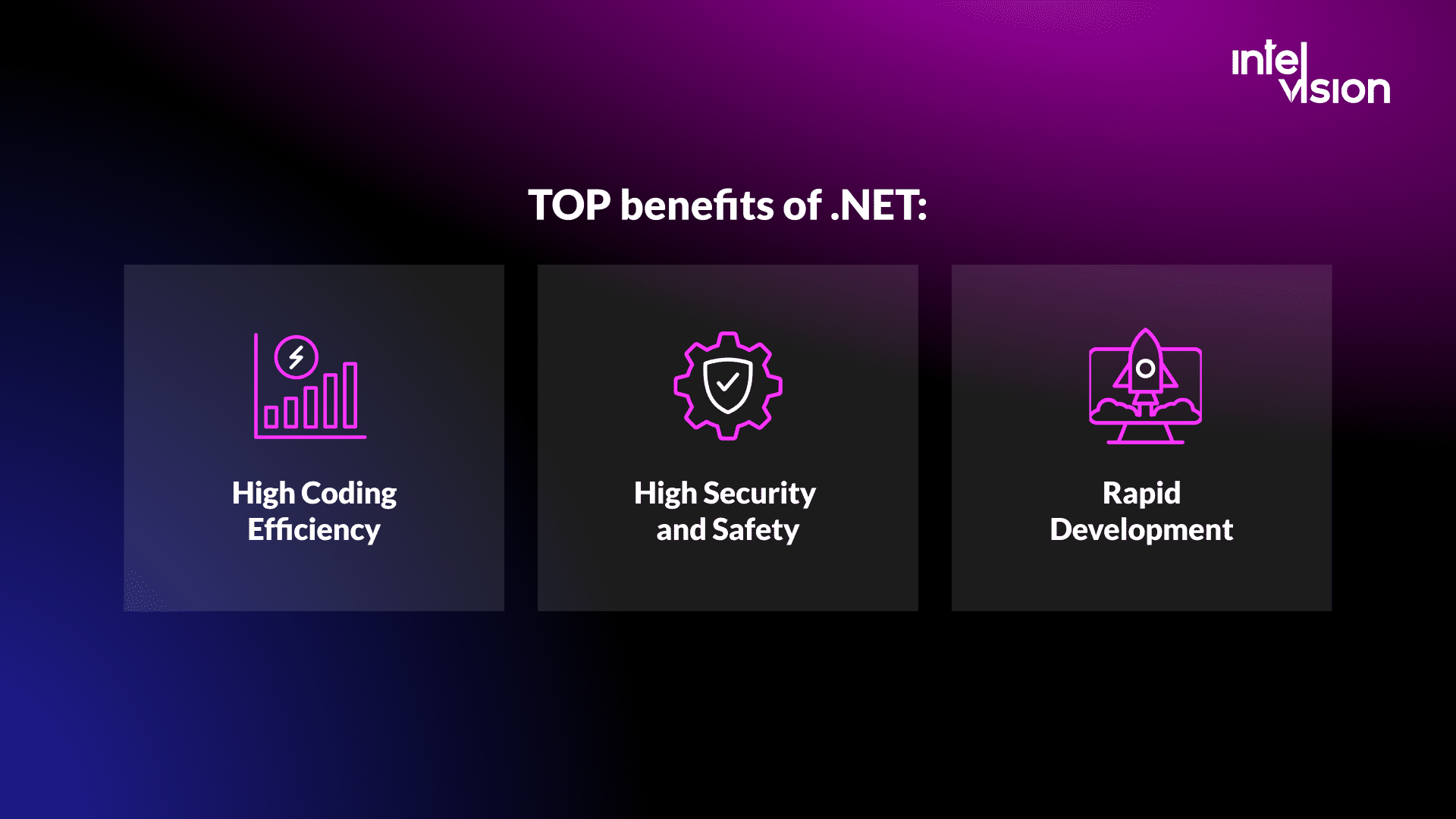
The platform also moved a long way in the last three years. .NET 10, released in November 2025, is a long-term support (LTS) release supported until November 2028. Its main benefits for a business:
Performance and lower running costs
Each release has brought runtime, JIT and memory improvements. .NET 10 added vectorization for newer CPU instructions such as AVX10.2 and Arm64 SVE, and improved Native AOT, which produces smaller apps that start faster. For cloud workloads, faster startup and lower memory use translate directly into smaller bills.
Security by default
ASP.NET Core Identity now supports passkeys, NuGet audits transitive dependencies for known vulnerabilities by default in .NET 10 projects, and the libraries include post-quantum cryptography algorithms (ML-DSA and ML-KEM). Built-in protection against common web attacks, role-based authorization and integration with identity providers such as Microsoft Entra ID remain core strengths, which is why .NET is common in regulated industries.
Productive tooling
Visual Studio, VS Code and JetBrains Rider, a mature package ecosystem, and Aspire, which shipped version 13 with .NET 10, for running and deploying multi-service applications locally and in the cloud. Reusable libraries and strong typing keep large codebases manageable over many years.
AI built into the platform
.NET now has first-party building blocks for AI features: Microsoft.Extensions.AI provides one abstraction (IChatClient) across model providers, the platform has templates for Model Context Protocol (MCP) servers, and the Microsoft Agent Framework is the successor to Semantic Kernel and AutoGen for building agents in .NET and Python. Its orchestration patterns reached version 1.0 in July 2026. For hiring, this means a .NET developer can now ship AI features inside your existing product without a separate Python team.
A correction to earlier versions of this article: we previously listed PHP, C++ and "ASP" as .NET languages and named several well-known desktop products as written in C#. Those claims were wrong. Modern .NET is primarily C#, with F# and Visual Basic, and ASP.NET Core is a web framework, not a language.
What .NET developers build, and where demand comes from
.NET is used by companies of every size across industries. The workloads you will most often hire for:
- Banking, fintech and insurance: transaction processing, payment integrations, risk and reporting services. Strong typing, mature security libraries and long support windows suit regulated environments.
- Enterprise and ERP integration: connecting Microsoft 365, Dynamics 365, Azure and line-of-business systems. Ready-made platforms always need customization, and that work is usually written in C#.
- Retail and ecommerce: product catalogs, order management, payment flows and back-office tools.
- Construction, proptech and energy: project and asset platforms, document workflows, monitoring systems and integrations with industry software.
- Desktop and industrial software: WPF and WinForms applications, many of them now being modernized, plus cross-platform desktop and mobile apps with .NET MAUI.
- IoT and data services: collecting device data, processing it in the cloud, and adding machine learning with ML.NET or external models.
- Games and real-time 3D: Unity uses C# for scripting, so C# skills carry over to game and simulation work, although game development is its own specialty.
A large part of current demand is not new products at all. It is moving existing .NET Framework applications to modern .NET, splitting monoliths, moving to the cloud and adding AI features to software that already earns money.
The .NET developer skills to look for in 2026
Every .NET developer should have a core set of skills. What has changed since 2023 is the weight of cloud, testing, security and AI integration.
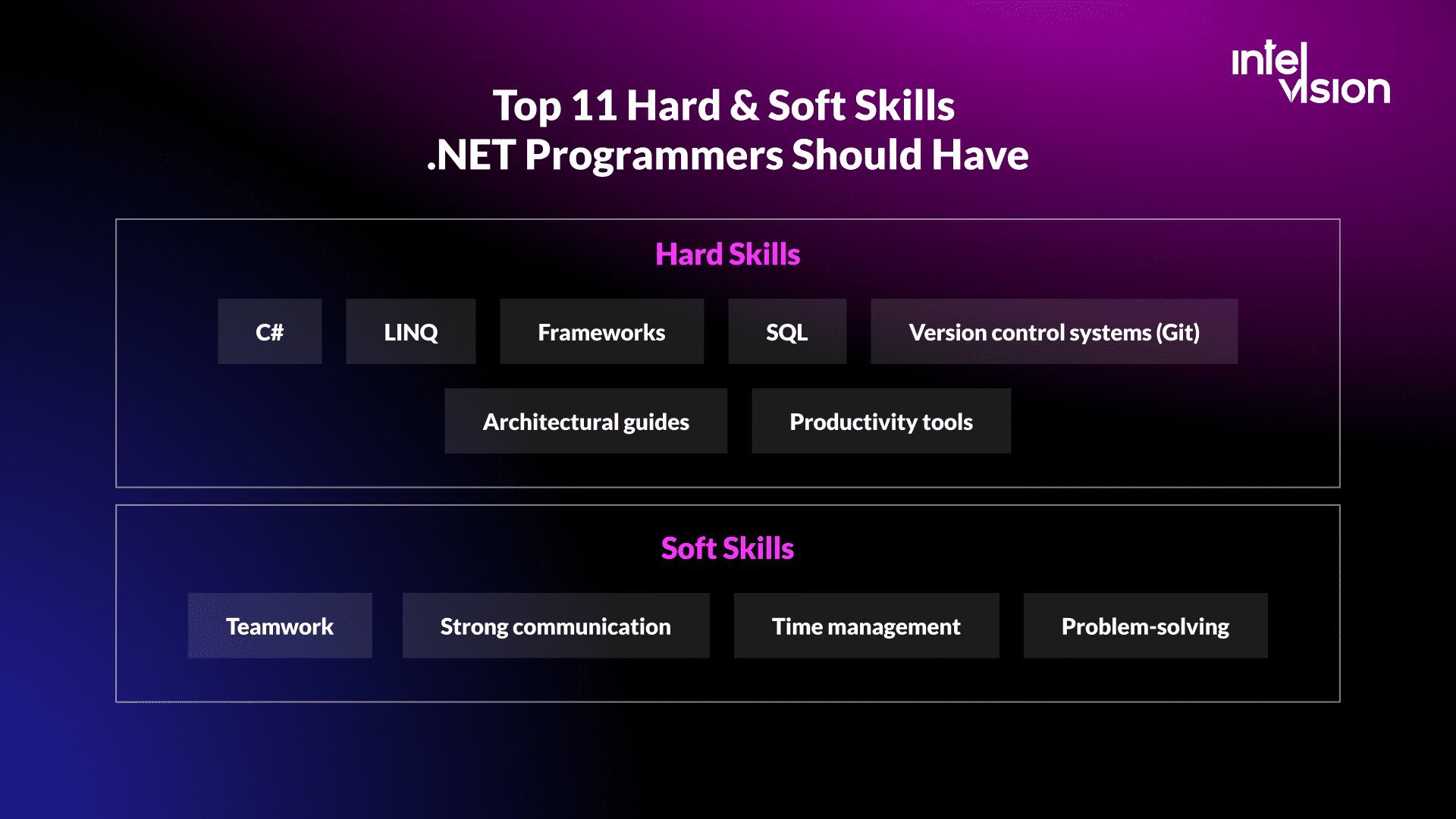
Core technical skills
- C# and the modern language: async and await, LINQ, generics, records, pattern matching, nullable reference types, and an awareness of recent features such as those in C# 14. LINQ is still where much business logic lives, so fluency matters.
- ASP.NET Core: Web API and minimal APIs, middleware, dependency injection, configuration, authentication and authorization, OpenAPI. For server-rendered or interactive UI, MVC, Razor Pages or Blazor.
- Data access: Entity Framework Core and its performance traps (N+1 queries, tracking, migrations), plus raw SQL when needed. SQL Server and T-SQL are common, PostgreSQL increasingly so.
- Architecture: layered and clean architecture, modular monoliths, when microservices are worth their cost, messaging with Azure Service Bus or RabbitMQ, and resilience patterns such as retries and circuit breakers.
- Cloud and DevOps: Azure (App Service, Functions, Container Apps, Key Vault) or AWS, Docker, CI/CD with GitHub Actions or Azure DevOps, logging and tracing with OpenTelemetry.
- Testing: unit tests with xUnit or NUnit, integration tests against real databases in containers, and the habit of writing them without being asked.
- Security: OWASP risks, secrets management, OAuth 2.0 and OpenID Connect, safe handling of personal data.
- Version control and review: Git, pull requests, and giving and receiving useful code review.
Skills that depend on your product
- Front end: Blazor if you want one language across the stack, or React or Angular for most product teams.
- Desktop and mobile: WPF, WinForms or .NET MAUI.
- Legacy migration: .NET Framework 4.x, WCF, Web Forms, and experience moving them to modern .NET.
- AI integration: Microsoft.Extensions.AI, Agent Framework, retrieval over your own data, prompt and output evaluation, and cost control for model calls.
Soft skills that decide whether a hire works
- Teamwork: collaborating, sharing knowledge and asking for help early.
- Clear communication: explaining a technical trade-off to a product manager in plain words, in writing as well as in meetings.
- Time management: estimating honestly and flagging slips early.
- Problem solving: diagnosing bugs and performance issues methodically rather than guessing.
- Ownership: caring whether the feature works for users, not only whether the ticket is closed.
Junior, mid-level and senior .NET developers: what each should handle
Titles mean different things in different companies. Hire against what the person must be able to do on your product.
| Level | Typical experience | Can own | Needs from you |
|---|---|---|---|
| Junior | Up to about 2 to 3 years | Well-defined tickets, bug fixes, tests, small endpoints | A mentor, code review on every change, clear tasks |
| Mid-level | About 3 to 5 years | Features end to end, database changes, integration with external APIs | Architecture guidance and review of design choices |
| Senior | 5+ years | Service or module design, performance work, security reviews, mentoring, estimates others can trust | Context on business goals and authority to make decisions |
| Lead or architect | 8+ years, with leadership | System architecture, migration strategy, technical hiring bar, cross-team standards | Direct access to product and business leadership |
For a first .NET hire, or for a legacy migration, start senior. A junior developer without a senior to learn from produces code the next person has to rewrite.
How much it costs to hire a .NET developer in 2026
Costs depend on country, seniority and hiring model. A few reference points from sources we checked:
| Option | Reference figure | Source |
|---|---|---|
| In-house back-end developer, Germany | Median salary about $87,000 a year (desktop or enterprise developers about $81,200) | Stack Overflow 2025 survey |
| In-house back-end developer, UK | Median salary about $108,900 a year | Stack Overflow 2025 survey |
| Nearshore senior engineer, Poland | $50 to $65 an hour | Innowise, 2025 rates |
| Nearshore senior engineer, Romania | $40 to $55 an hour | Innowise, 2025 rates |
| Intelvision developer (staff augmentation or dedicated team) | €6,500 to €9,000 a month by seniority, the equivalent of €32 to €50 an hour | Intelvision pricing page |
Salary medians are self-reported and exclude employer costs. For an in-house hire, add employer social contributions, benefits, equipment, recruiting fees (agency fees for senior developers are often a significant share of first-year salary) and the months the role sits empty. For an external developer, add your own onboarding and review time.
A quick way to compare
- Write down the fully loaded annual cost of an in-house hire in your country, including recruiting.
- Add the cost of delay: what does each month without this person cost your roadmap?
- Compare with 12 months of an external developer's monthly rate plus your onboarding time.
- Check flexibility: how quickly can you scale down if the roadmap changes?
The cheapest option on paper is often not the cheapest in practice. A senior developer who unblocks a migration in three months can be worth more than two juniors who take a year.
Hiring models: in-house, freelance, staff augmentation or a dedicated team
| Model | Time to start | Best for | Watch out for |
|---|---|---|---|
| In-house hire | Often several months including notice periods | Core, long-term roles that define your product | Slow, expensive recruiting; risk of a bad hire |
| Freelancer | Days to weeks | Short, well-defined tasks | Availability, continuity, knowledge leaving with the person |
| Staff augmentation | Days to a few weeks | Adding one or more developers to a team that already works | You still need a tech lead to direct the work |
| Dedicated team | A few weeks | A product area or migration that needs developers, QA and delivery management together | Needs a product owner on your side |
If you already have a .NET team and a working process, a full-time specialist inside that team is usually the fastest fix. If you need a whole stream of work delivered, a dedicated team brings engineering, QA and delivery management under one agreement.
How to hire .NET developers for your project, step by step
The .NET talent market is competitive: good developers have options and are rarely looking actively. A clear process wins candidates as much as it filters them.
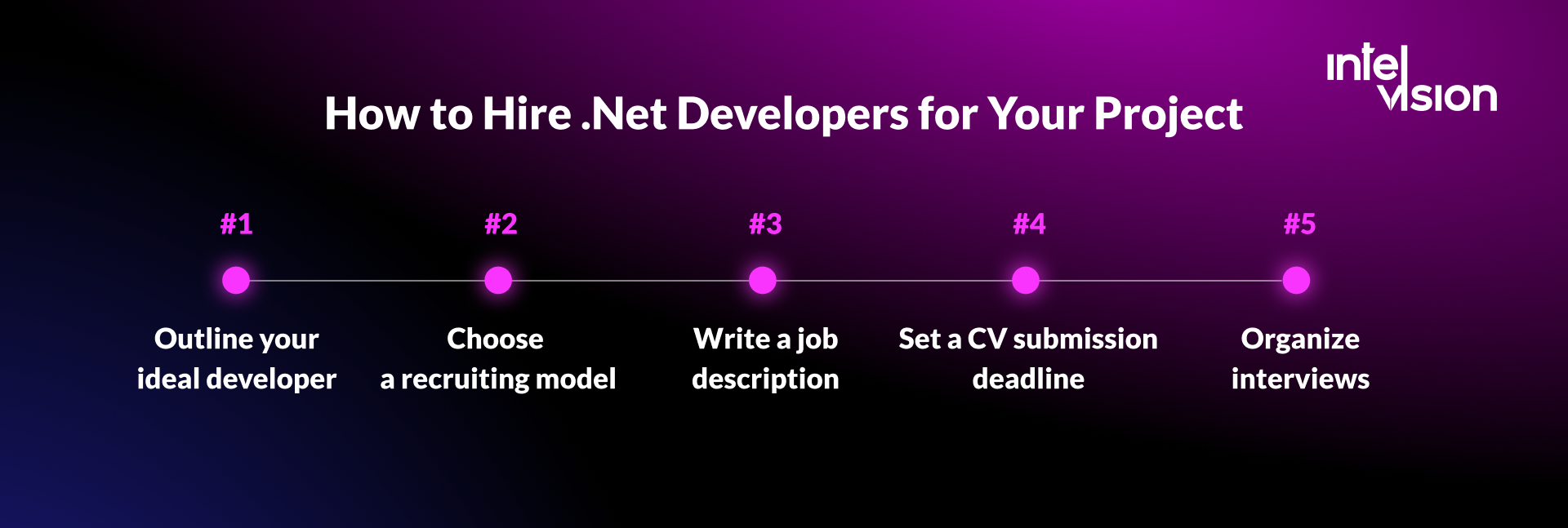
1. Outline your ideal developer
Before writing anything, decide what this person must achieve in the first six months, which parts of the stack they will own, and what level of autonomy you need. "Senior .NET developer" is not a role description. "Senior back-end developer to move our order service from .NET Framework 4.8 to .NET 10 and own its performance" is.
2. Choose the hiring model
Use the table above. Decide whether you need full-time, part-time or a team, and whether the need is permanent or tied to a project. This decision changes where you search and how fast you can start.
3. Write a job description that answers real questions
Explain why you need the role and what the person will do. Developers care about the product, the stack, the team, the way decisions are made and growth, not only salary. Formal phrases such as "friendly team", "fast-growing company" or "stable salary" suggest that you did not analyze the role, did not have time to write a proper job description, or have a bureaucratic culture.
Replace clichés with reasons to believe. Instead of "We have an interesting high-load project", write something like "Our product handles 3.7 million visits a day on 250 hosts." Name the .NET version, the cloud, the database and the main challenge. If you are hiring a junior developer, answer these questions in the description:
- What knowledge, skills and experience are required?
- What will the person work on in the first months?
- Who will mentor them, and how is code reviewed?
- What are the growth prospects?
- What is the most interesting part of the job?
- What is the salary range?
For trainee and junior roles, a clear application deadline helps candidates decide and keeps your process moving.
4. Search where .NET developers are
Referrals from your own engineers, LinkedIn, local .NET user groups and conferences, open-source contributors to the libraries you use, and specialist providers who already employ vetted .NET engineers. For senior roles, outbound search beats waiting for applications.
5. Screen quickly and respectfully
A 20 to 30 minute call to check motivation, communication, salary expectations and availability. Move good candidates to the next step within days; the best ones will have other offers.
6. Run a technical interview that resembles the job
A one-on-one technical conversation with one of your senior engineers, based on real problems from your codebase. Ask the candidate to talk through code they have written, review a pull request, or design a small service. Algorithm puzzles tell you little about how someone builds business software.
7. Consider a short paid task or trial
For senior roles, a short, paid, realistic task (a few hours, not a weekend) or a trial period with an external provider shows how the person works with your team. Keep a written record of each candidate's answers so that hiring managers compare like with like.
8. Onboard properly
Access to the repository and environments on day one, a buddy, a first small task that reaches production in the first week, and a 30, 60 and 90 day check-in. Most "bad hires" are partly bad onboarding.
Questions to ask when interviewing a .NET developer
Prepare your interview questions in advance and decide what a good answer looks like. The questions below are grouped by what they reveal.
Technical questions and what a good answer covers
| Question | A strong answer covers |
|---|---|
| How does async and await work in .NET, and when can it hurt you? | Non-blocking I/O, thread pool use, why to avoid blocking on async code with .Result or .Wait(), deadlock risks, ConfigureAwait, cancellation tokens |
| How do you find and fix a slow Entity Framework Core query? | Logging generated SQL, N+1 queries, Include versus projection, AsNoTracking, indexes, measuring before and after |
| Explain dependency injection lifetimes in ASP.NET Core. | Singleton, scoped and transient; capturing a scoped service in a singleton; how this affects DbContext |
| What is a delegate, and how do events and lambdas relate to it? | A type-safe reference to a method, multicast delegates, Func and Action, events built on delegates, closures in lambdas |
| What is the difference between managed and unmanaged code, and how do you release unmanaged resources? | The CLR and garbage collector, IDisposable, using statements, finalizers and when not to write them |
| How would you secure a public Web API? | OAuth 2.0 and OpenID Connect, token validation, authorization policies, input validation, rate limiting, secrets outside code |
| How do you test an API that talks to a database and a message queue? | Unit tests for logic, integration tests with real dependencies in containers, contract tests, what not to mock |
| Have you moved an application from .NET Framework to modern .NET? What broke? | Dependency analysis, unsupported APIs (WCF server, Web Forms, AppDomains), incremental migration, test coverage before the move |
| How would you add an AI feature to an existing .NET product? | A provider-neutral abstraction such as IChatClient, retrieval over your own data, evaluation of outputs, cost and latency limits, handling personal data |
System design questions for senior candidates
- Design an order service that must handle traffic spikes and integrate with a slow payment provider.
- When would you split a monolith, and how would you do it without stopping feature work?
- How do you make a background job idempotent and observable?
- How would you migrate a large .NET Framework application without a big-bang rewrite?
Questions about working with AI coding tools
- Which AI tools do you use, and for which tasks?
- How do you check AI-generated code before you commit it?
- Tell me about a time an AI suggestion was wrong. How did you notice?
Good candidates use these tools and are specific about their limits. Be wary of both extremes: someone who refuses to use them, and someone who cannot explain the code they submitted.
Soft skills questions
- Do you prefer working in a team or alone? Why?
- Tell me about a conflict with a teammate and how you resolved it.
- How do you prioritize when several deadlines collide?
- Give an example of a problem you solved that nobody asked you to solve.
- How do you explain a technical risk to a non-technical stakeholder?
Start the interview with a couple of general questions about the candidate's experience with .NET, note the answers and share the notes with the other interviewers. It makes the final comparison fairer and faster.
Red flags worth noticing
- Every past project was "a microservices architecture", but the candidate cannot say what problem the split solved.
- No tests in any code sample, and no clear view on what should be tested.
- Vague answers about production: no incidents, no monitoring, no idea how their code behaved under load.
- Blaming previous teams for every problem, with nothing learned.
- Strong on framework trivia, weak on explaining why one design is better than another for a given business need.
Onboarding a new .NET developer: the first 90 days
Hiring ends when the person is productive, not when the contract is signed. A simple plan makes the difference between a developer who contributes in week two and one who is still asking for access in week four.
Before day one
- Accounts for the repository, tracker, chat, cloud subscription and any VPN.
- A development environment that builds and runs from a short, current README.
- A named buddy who reviews the first pull requests.
- A first task small enough to reach production in the first week.
Days 1 to 30
The developer ships small changes, learns the domain, reads the architecture notes and meets the people they will depend on: product owner, QA, operations. By the end of the month they should be able to explain how a request flows through the system and where the riskiest parts of the code are.
Days 31 to 60
They own a feature end to end, including tests, review and release. This is when gaps show: missing knowledge of your data model, unfamiliar infrastructure, unclear expectations. Address them in a short check-in rather than waiting for a formal review.
Days 61 to 90
A senior hire should now be improving things, not only delivering tickets: proposing a fix to a slow query, a better test setup or a simpler deployment. Agree on goals for the next quarter and on how you will measure them.
The same plan applies to external developers. The only difference is that a good provider handles contracts, equipment and replacement, so you can focus on context and decisions.
Hiring for a .NET Framework migration
A special case worth its own section, because many .NET hiring requests in 2026 are really migration requests.
Two dates matter. According to Microsoft's .NET support policy, both .NET 8 and .NET 9 reach end of support on November 10, 2026, which leaves .NET 10 as the supported LTS release. And according to the .NET Framework lifecycle FAQ, .NET Framework 4.8 and 4.8.1 are supported as components of Windows, following the lifecycle of the Windows version they run on. That means your .NET Framework application is not suddenly unsupported, but it will not get the performance, cloud and AI features of modern .NET, and the pool of developers who want to work on it is shrinking.
For a migration, hire for these specific skills:
- Experience with an actual migration from .NET Framework to modern .NET, including what could not be moved directly.
- Comfort writing tests around legacy code before changing it.
- Knowledge of incremental approaches, such as running old and new side by side behind a proxy and moving one route or module at a time.
- The judgment to say when part of the system should be replaced rather than migrated.
If the migration is large or the system is business-critical, a senior architect plus a small team usually beats several individual hires. Our migration and modernization work is set up that way.
Common mistakes when hiring .NET developers
- Hiring for .NET Framework skills alone. Unless the job is purely maintenance, test for modern .NET, cloud and testing habits too.
- A shopping list job description. Twenty technologies tell candidates you do not know what the role is.
- Puzzle interviews. They select for interview practice, not for building and maintaining business software.
- A slow process. Strong candidates accept other offers while you schedule the third round.
- A first hire who is junior. Without a senior to learn from, juniors cannot set architecture or standards.
- Ignoring communication. Developers who cannot explain their work create risk you only notice when something goes wrong.
- No onboarding plan. Even an excellent developer is slow for weeks without access, context and a first real task.
Checklist before you make an offer
- At least one of your senior engineers has interviewed the candidate on real problems.
- You have seen code the candidate wrote, or watched them work through a realistic task.
- References or verified reviews confirm what the candidate or provider claims.
- The contract covers IP assignment and confidentiality before repository access is granted.
- The first 90 days are planned, with a first task and a named buddy.
- You know what happens if it does not work out: probation terms for an employee, replacement terms for an external developer.
How Intelvision can help you hire .NET developers
Intelvision places senior engineers inside client teams and builds software with dedicated teams. Our developers are employed by us, work full time (40 hours a week) inside your tools and process, and are vetted by engineers before you see them. You can hire .NET developers as full-time specialists, part-time from 40 hours a month, or as part of a dedicated team.
- Speed: 2 to 4 days to see the first candidates, and 12 to 18 days from brief to an engineer on the project across our published engagements.
- Pricing: €6,500 to €9,000 per developer per month depending on seniority, with no upfront recruitment fees.
- Low risk: if a developer does not meet your expectations within the first month, we replace them at no additional cost.
- Proof: a 5.0 rating across 14 verified reviews on Clutch, a 3+ year average client partnership and 89% team retention.
Our published .NET work includes:
- Finsemble: for this fintech desktop application framework, a five-person team delivered a .NET library with real-time WebSocket communication in six months, supporting both .NET Core and .NET Framework.
- AVIDENO: the first role was filled in 7 days, and two senior full-stack developers working in C#, .NET and Blazor have supported the process-automation platform since 2022, with development costs reduced by 40%.
- ING+: a six-person dedicated team runs delivery on a construction platform built on .NET, including a phased migration from Blazor to Angular, with a 40% development cost reduction.
If you are comparing providers, our guide to .NET nearshore development companies in Europe explains what to check.
Sources
- Stack Overflow 2025 Developer Survey: Technology
- Stack Overflow 2025 Developer Survey: Work and salary
- Microsoft .NET Blog: Announcing .NET 10
- Microsoft: .NET and .NET Core support policy
- Microsoft Learn: Lifecycle FAQ, .NET Framework
- Microsoft Agent Framework blog: Migrate Semantic Kernel and AutoGen projects to Agent Framework Release Candidate
- Microsoft Agent Framework blog: Announcements
- Innowise: Outsourcing software development to Eastern Europe, costs and rates
- Clutch: Intelvision profile and verified reviews
Read Intelvision often? Add us as a preferred source in Google Search.
Add to preferred sources