
Dedicated Development Teams: Everything You Need to Know
What's new: New market and rate data, real team compositions, example budgets, a model comparison, provider questions, contract essentials, AI-assisted delivery and an FAQ. Fixed-budget claim corrected.
Summarize with AI
Read summarized version with AI
- A dedicated team is a stable, cross-functional group working only on your product; you own priorities, the team owns day-to-day delivery.
- It fits long-running product work with an evolving backlog, typically six months or more; for short, fixed scopes or a single missing skill, other models are cheaper.
- Budget is people times monthly rate: at Intelvision's published €6,500 to €9,000 per person, a four-person MVP team costs €26,000 to €36,000 a month, plus your product owner's time.
- The main risks are an empty or unclear backlog, no product owner on your side and knowledge concentrated in the vendor.
- With AI coding tools standard, quality gates, QA and senior judgment matter more than headcount.
The market for outsourced IT services keeps growing. Grand View Research estimates the global IT services outsourcing market at US$797.4 billion in 2025, with growth projected at 8.3% a year from 2026 to 2033. Within that market, the dedicated team model is a common way for software companies to add delivery capacity without building every role in-house.
Remote work made the model normal. A team of engineers employed by a partner can join the same standups, repositories and planning sessions as your own people. Established companies and growing startups use dedicated teams to close talent gaps, launch new product lines and keep long-running platforms moving.
This guide explains what a dedicated development team is, who is on it, how the model works step by step, what it costs in 2026, its real advantages and pitfalls, how AI-assisted development changes it, and how to choose a provider and run the team well.
What is a dedicated team model
A dedicated development team is a group of software professionals, typically engineers, QA and analysis or delivery management, who work only on your product for an extended period. The provider recruits, employs, equips and replaces them. You direct the product: what gets built and in what order.
The size of the project, the budget, how well the scope is known, the timeline and the expected number of changes all affect which cooperation model fits. The three classic commercial models in software development are fixed price, time and materials, and the dedicated team. Staff augmentation is a fourth, closely related option. The difference lies in who owns what:
| Model | How you pay | Who owns scope and delivery | Fits when |
|---|---|---|---|
| Fixed price | A set price for a defined scope | The provider delivers the agreed specification | The scope is small, clear and unlikely to change |
| Time and materials | Hours actually worked | Shared; scope evolves as you go | Short or uncertain work where flexibility matters |
| Dedicated team | A monthly rate per person for a stable team | You own the product; the team owns day-to-day delivery | Long-running product work with an evolving backlog |
| Staff augmentation | A monthly or hourly rate per specialist | You own product and delivery; specialists join your team | Your team works, but lacks specific skills or capacity |
Dedicated teams suit products with a horizon of several months or longer. The original version of this article said three months; in our experience the model pays back its ramp-up best on work of six months or more. The client sets priorities and reviews progress, while the team plans, builds, tests and releases. The more a team understands the product and its users, the less day-to-day direction it needs.
Who is on a dedicated development team
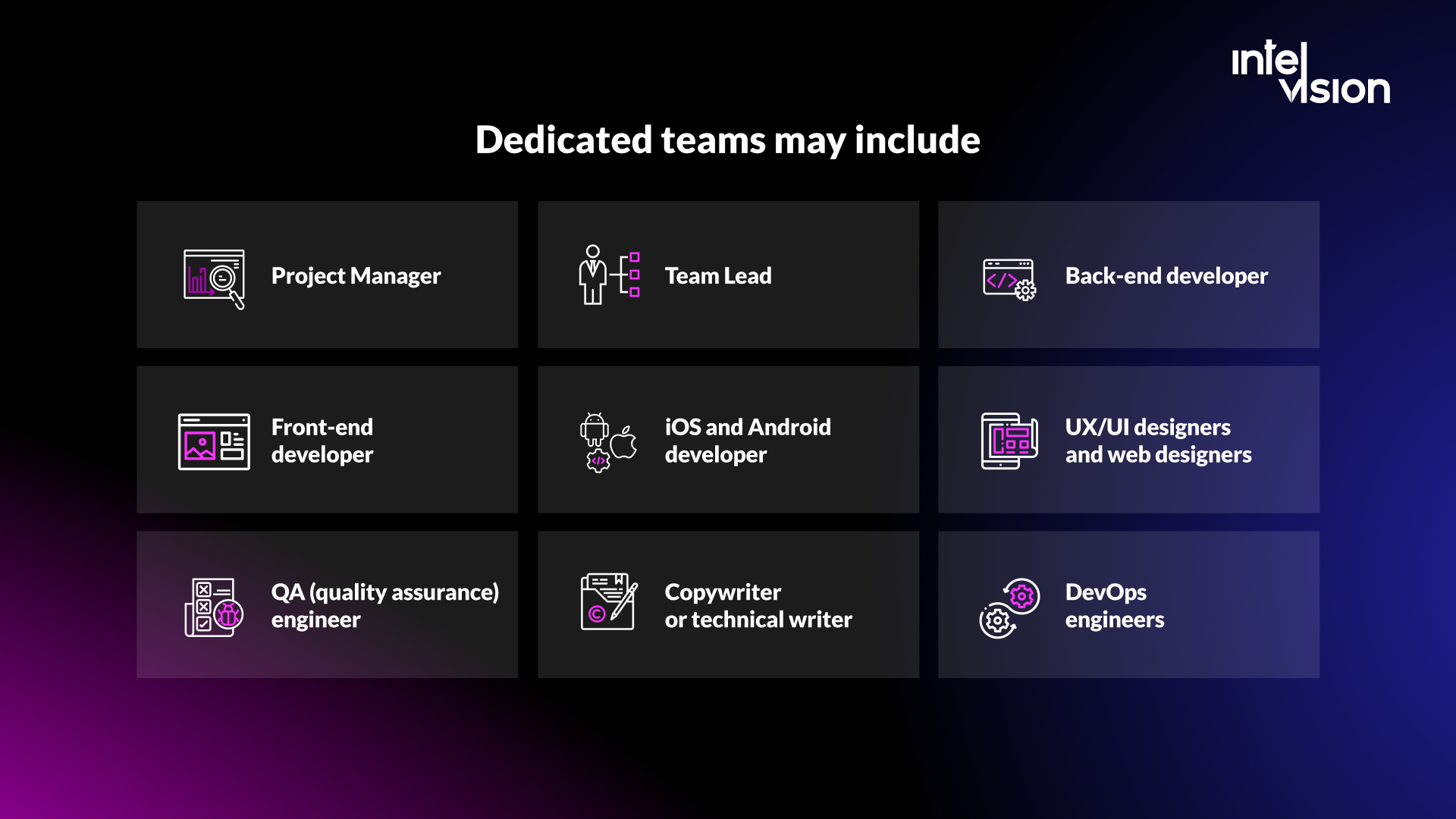
The structure depends on the product and its stage, and it can change over time by adding or removing people. A dedicated team may include:
- A project or delivery manager who runs planning, tracks risks and keeps communication between you and the team clear. The load is highest at the start; later, some coordination can move to the team lead.
- A team lead or tech lead who owns technical decisions, code quality and how the engineers work together.
- Back-end developers who build the server side: business logic, data, integrations and APIs.
- Front-end developers who build the web interface users see.
- iOS and Android or cross-platform mobile developers when the product needs native or React Native and Flutter apps.
- UI and UX designers who design user flows and interfaces, usually most involved early and around major features, often part time.
- A business analyst who turns business needs into clear requirements and acceptance criteria, so engineers build the right thing.
- QA engineers, manual and automation, who test continuously rather than only at the end. Leaving testing to the last week of a release pushes defects into production.
- DevOps or cloud engineers who own infrastructure, CI/CD, monitoring, backups and security hardening, often shared across teams or part time.
- A technical writer, when documentation is part of the product or required by customers or regulators.
Real teams are smaller than this list suggests. Three examples from our published case studies show typical shapes:
| Product | Team | Duration |
|---|---|---|
| ING+, construction platform, Germany | 2 full-stack developers, 1 QA, 1 PM, 1 BA, 1 UI/UX designer | Since August 2022 |
| Jincom, safety e-learning tools | 1 BA, 1 PM, 1 front-end developer, 1 back-end developer, 1 QA | Since August 2022 |
| Visoplan, BIM platform, Germany | 1 full-stack, 1 back-end, 2 front-end developers, 1 QA | Since July 2021, grown from one engineer |
How does the dedicated team model work
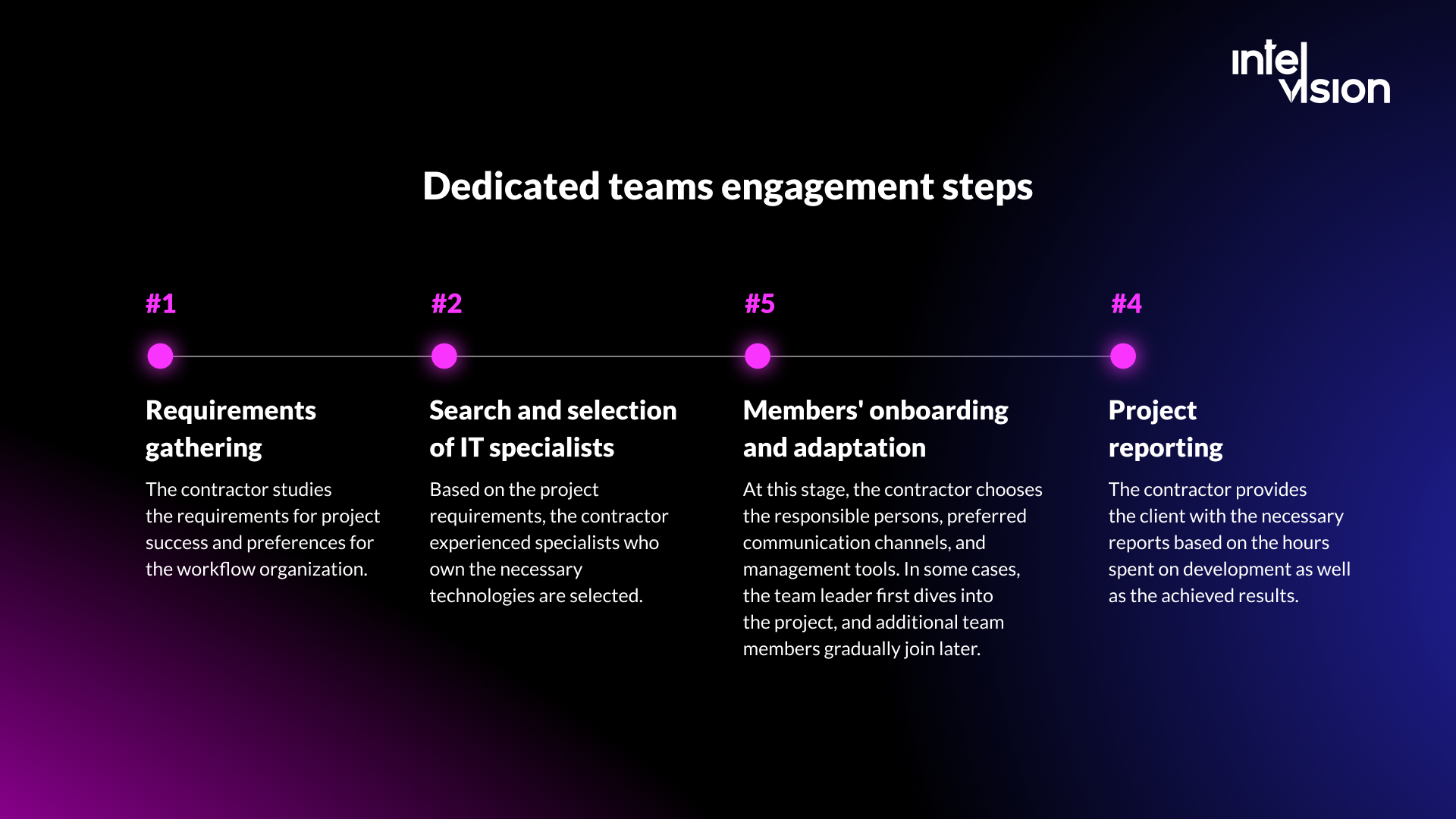
The goal is to give you a working team quickly that fills a gap in skills and capacity. It can replace an internal team entirely, extend it, or own one product area next to it. A typical engagement runs through these steps:
- Requirements gathering. The provider learns the product, the goals, the tech stack, the team you already have and how you prefer to work: tools, rituals, reporting and time zone overlap.
- Team design. Together you agree on roles, seniority and size. A good provider will challenge the request if a different mix would deliver more, for example a business analyst instead of a third developer.
- Selection. The provider presents candidates with the right technologies and domain experience. You interview and approve each person.
- Onboarding. Access, documentation, a buddy on your side, and agreement on who is responsible for what. Sometimes the team lead joins first and the rest of the team follows over a few weeks.
- Delivery. The team works in sprints or a continuous flow, inside your tools, with regular demos of working software.
- Reporting. You receive reports on hours and on outcomes: what shipped, what is at risk, how estimates compare with actuals.
- Scaling. The team grows or shrinks with the roadmap, under notice periods agreed in the contract.
- Handover or continuation. When the work ends, the team documents and transfers knowledge. Many teams simply continue for years.
The dedicated team advantages for your project
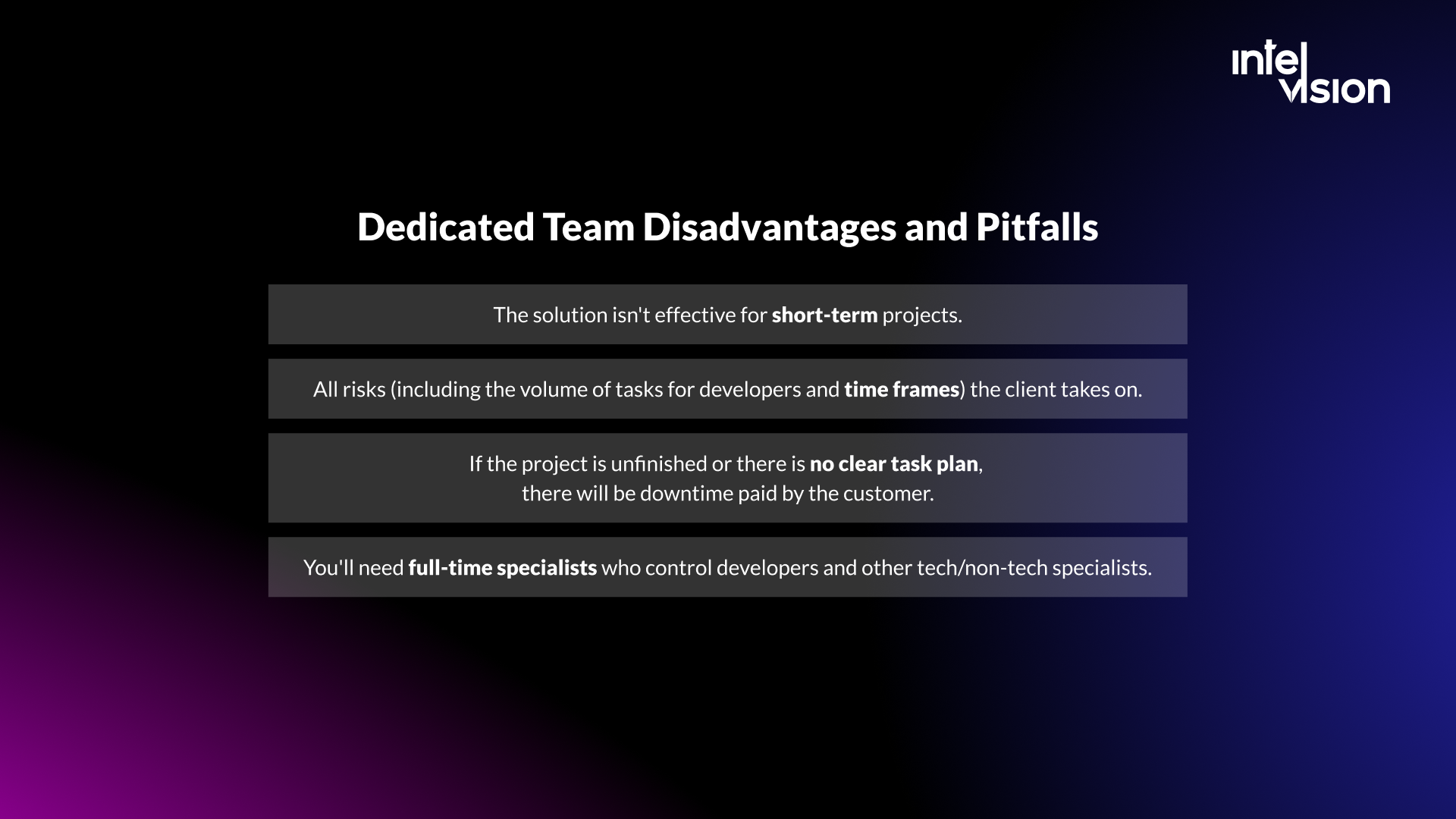
A dedicated team model takes recruiting, employment and team-building work off your plate. A provider with an existing network can usually assemble a cross-functional team faster than a company can recruit, onboard and train the same people. The main advantages:
- Predictable monthly cost. You pay a known rate per person each month. Note that this is a predictable budget, not a fixed price for a fixed scope; the first version of this article blurred that distinction.
- Flexible scope. Priorities can change between sprints without renegotiating a contract, as long as the team size stays the same.
- Control over priorities. You decide what the team works on, and you can see the work in your own tracker and repositories.
- Deep product knowledge. Team members work on one product for months or years, so they understand the code, the users and the business goals.
- Speed to start. Weeks instead of the months a full in-house hiring round takes.
- Easier scaling. Adding a QA engineer or a second developer is a conversation, not a recruitment campaign.
- Less administration. Payroll, benefits, equipment, replacements and retention are the provider's job.
- Continuous communication. The team uses your channels daily, typically Slack or Microsoft Teams, Jira or a similar tracker, and video calls.
As the name suggests, the team is dedicated to one client and one set of business objectives. That focus is the model's main difference from an agency that rotates people across projects.
Dedicated team disadvantages and pitfalls
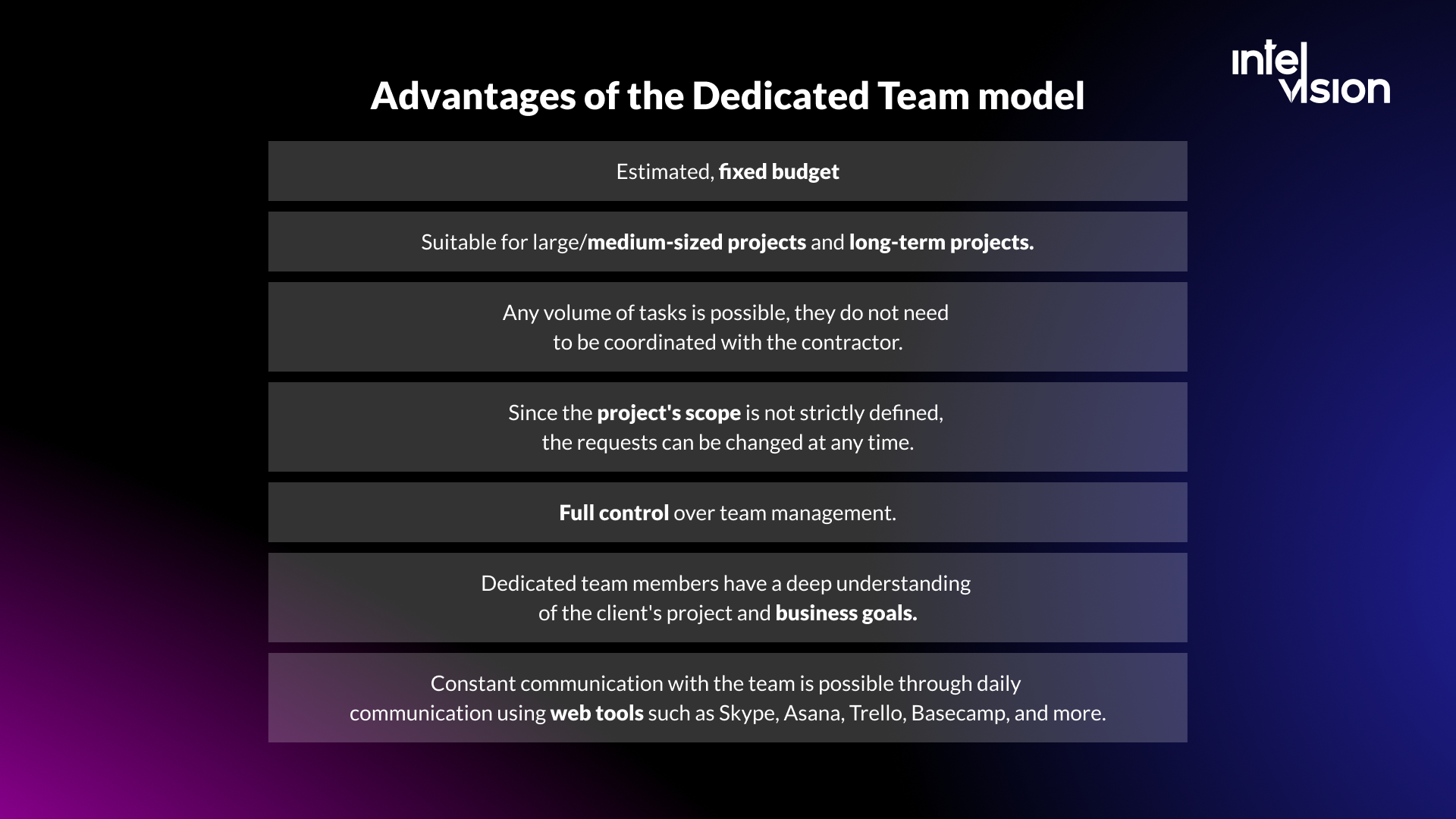
Effective in many cases, dedicated teams have their downsides too. It is better to know them before you sign:
- Not efficient for short projects. The first weeks go into learning the product. For a two-month job, a fixed-scope project or a specialist is usually cheaper.
- You carry the scope risk. You decide the volume of work and the priorities. If the plan is wrong, the team builds the wrong thing on time.
- Idle time costs you. If the backlog is empty or decisions are slow, you still pay for the team. A dedicated team needs a prepared backlog, typically for at least the next month.
- Product ownership stays with you. Someone on your side must own priorities and answer questions quickly, usually a product owner, and in many cases an analyst who keeps the backlog ready.
- Knowledge can concentrate in the vendor. If the team works in its own tools and nobody documents decisions, switching provider later becomes expensive.
- Communication overhead. Time zones, language and culture need deliberate work, especially with large time differences.
Dedicated teams suit large and long-running projects with a task plan for at least the coming month. If your real problem is unclear priorities or a delivery process that does not work, fix that first. An engineering diagnostic is often a cheaper first step than a larger team.
Reasons why you might need a dedicated development team
Some companies work with freelancers, some build entirely in-house, and many combine models. A dedicated team is the right choice when:
- You plan to grow quickly and the roadmap is larger than your current team can deliver.
- You run a large project and want your internal team on strategic work, while the dedicated team carries a product area or a defined stream.
- Your in-house team lacks the experience for a new technology, platform or domain.
- You need flexibility to grow and shrink the team as funding and priorities change.
- You need ongoing support after release: new features, updates, bug fixes and reliable operation.
- You are launching a new product line and do not want to pull people off the core product.
- You need to modernize a legacy system while the existing team keeps the current one running.
And it is the wrong choice when the work is short and well defined, when you have no one to own the backlog, or when you need one specific skill inside a team that otherwise works. In the last case, a single specialist through staff augmentation is faster and cheaper.
How much a dedicated development team costs in 2026
The cost is roughly the number of people times the monthly rate per person. Rates depend on country, seniority and role. For orientation:
| Reference | Figure | Source |
|---|---|---|
| Senior engineer, US and UK | $80 to $150 an hour | Innowise, 2025 rates |
| Senior engineer, Poland | $50 to $65 an hour | Innowise, 2025 rates |
| Senior engineer, Romania | $40 to $55 an hour | Innowise, 2025 rates |
| Intelvision, per team member | €6,500 to €9,000 a month by seniority, the equivalent of €32 to €50 an hour | Intelvision pricing page |
Example budgets at published Intelvision rates
| Team | People | Monthly cost range |
|---|---|---|
| Small product team: 2 developers, 1 QA | 3 | €19,500 to €27,000 |
| MVP team: 2 developers, 1 QA, 1 BA or PM | 4 | €26,000 to €36,000 |
| Product team: 3 developers, 1 QA, 1 PM, 1 designer | 6 | €39,000 to €54,000 |
The arithmetic is simple; the judgment is in the mix. Not every role needs a senior, and not every role needs to be full time. A designer or DevOps engineer is often part time. Ask the provider what is included in the rate (salaries, benefits, equipment, training, replacement) and whether there are setup or recruitment fees. At Intelvision there are none; you pay the agreed monthly rate once the engagement begins.
Costs that are not on the invoice
- Your product owner's time, often half a role or more.
- Your tech lead's time for architecture decisions and reviews in the first months.
- Ramp-up: the first two to four weeks are slower while the team learns the product.
- Tool licenses and cloud environments for additional people.
- Knowledge transfer at the end, if the team does not continue.
Dedicated team vs staff augmentation vs in-house: how to decide
| Question | If yes, lean towards |
|---|---|
| Do you need a whole product area or stream delivered, not individual skills? | Dedicated team |
| Does your team already deliver well, and you only need more hands or one missing skill? | Staff augmentation |
| Is the role core to your company for the next five years, and can you wait months to fill it? | In-house hire |
| Is the scope fixed, small and unlikely to change? | Fixed-price project |
| Is delivery failing and nobody can say why? | Diagnose first, then choose |
The models also combine well. A common pattern is a dedicated team that builds a product area, with one or two of its engineers later hired permanently by the client. Larger companies sometimes go further and use a build, operate, transfer arrangement, in which a provider sets up a team or center that the client later takes over. Deloitte's 2024 Global Outsourcing Survey notes that insourcing is on the rise and global in-house centers are regaining momentum, and describes a build, operate, transform and transfer variant of this approach.
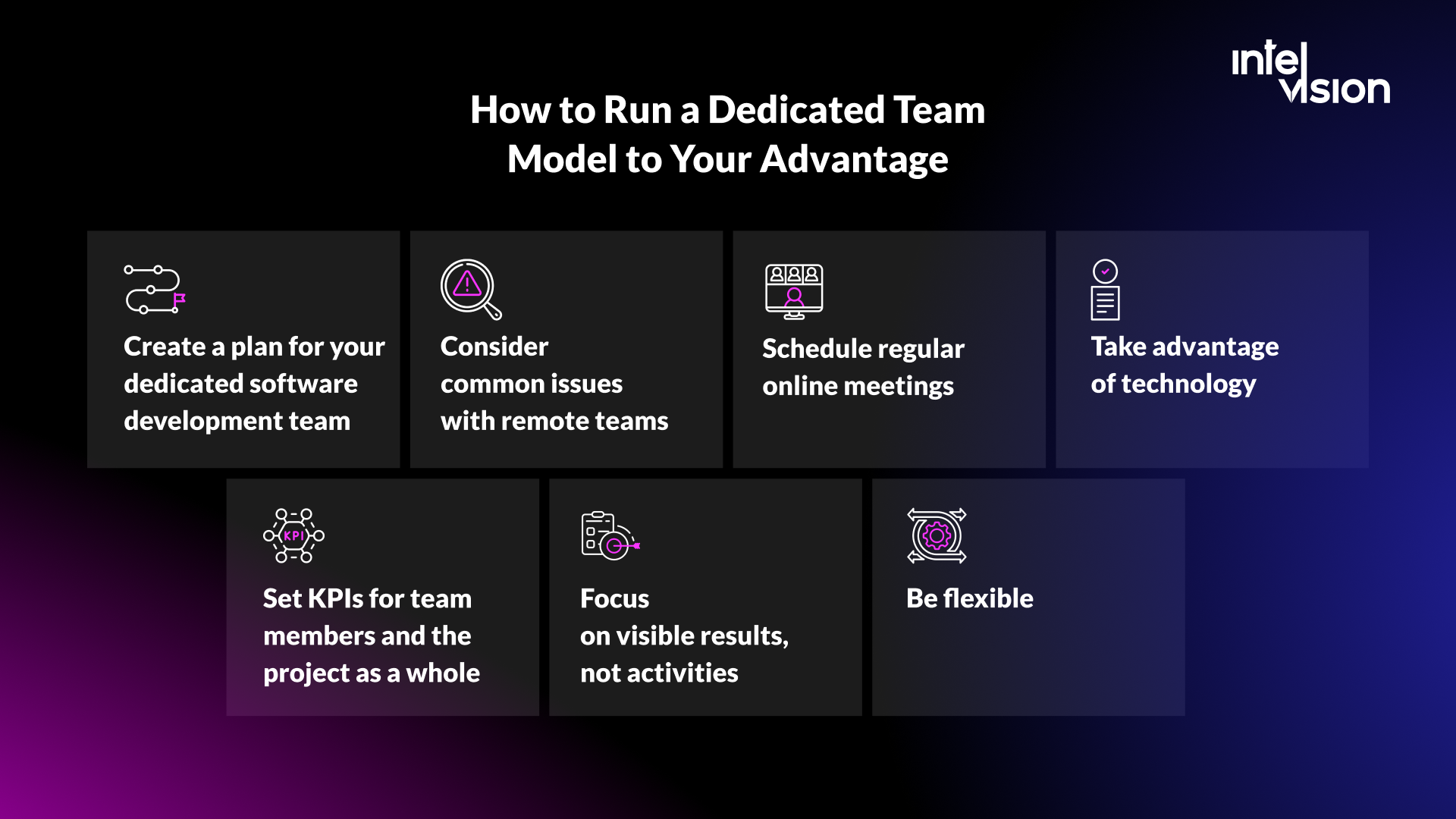
How to run a dedicated team model to your advantage
A good dedicated team needs planning and time. First, know what you are going to build: the main features, the constraints and the time frame. Once you have a clear scope for the first months, you can start looking for a team to bring it to life. Points that are often overlooked:
- Consider personalities and communication, not just technical skills.
- Build a diverse team; people with different backgrounds catch different risks.
- Trust the team's engineering experience and let them propose solutions.
- Provide the tools and access the team needs from day one.
- Agree a reasonable working schedule with enough overlap for live collaboration.
Create a plan for your dedicated team
A clear plan tells you which roles you need, how many people, and which hard and soft skills matter. Write down the first three months of goals, not only the first sprint.
Consider common issues with remote teams
Remote teams struggle with a lack of face-to-face contact, unequal access to information, social isolation and distractions at home. Most of these have simple, cheap fixes: shared documentation, recorded decisions, regular video contact and an occasional in-person meeting at key moments such as kickoff or a major release.
Schedule regular online meetings
Short daily standups, a weekly or biweekly planning session, a demo of working software and a retrospective. Video on for planning and retrospectives builds the trust that chat alone does not.
Take advantage of shared tools
Use the same tracker, repository, CI pipeline, documentation space and chat as your own team. When the dedicated team works in your tools, the knowledge stays with you.
Set goals and measure what matters
Development becomes more efficient when expectations are explicit. Many teams use OKRs (objectives and key results). Google's re:Work guide recommends about three key results per objective, graded from 0.0 to 1.0, and expects an average of 0.6 to 0.7; consistently higher scores suggest the goals are not ambitious enough.
For a software team, measure two kinds of things:
- Delivery health: lead time from idea to production, deployment frequency, the share of releases that cause incidents, time to restore service and estimate accuracy.
- Business results: adoption of the features shipped, retention, revenue or cost effects, and customer satisfaction.
Hours logged and story points completed show that a team is busy. They do not show that it is effective.
Focus on visible results, not activities
Define the goal and the outcome, then let the people with the training and resources to deliver it choose how. It increases ownership and usually produces better solutions than detailed instructions.
Be flexible
Every team member has their own circumstances, and no plan survives contact with real users unchanged. Each of these practices is simple but not easy: they take time, attention and consistency. They pay back in a team that stays and improves.
The first 30 days with a new dedicated team
The first month decides how fast the team becomes productive. A simple plan that works for most products:
Week 1: access and context
Accounts for every tool, a working local environment, an introduction to the product and its users, and a walkthrough of the architecture by your tech lead. Each team member ships one small change to production, even a minor fix, to prove the pipeline works for them.
Week 2: first real stream of work
The team takes a small, real feature end to end: analysis, design, build, test and release. Your product owner is available daily to answer questions. The delivery manager sets up the reporting you agreed.
Weeks 3 and 4: rhythm and first review
Planning, demos and a first retrospective with both sides present. At the end of the month, hold a short review: what slowed the team down, which decisions were waiting on you, whether the team mix is right. Adjust now, when changes are cheap.
Signs the team is working by month three
- Working features reach production every sprint or more often.
- Estimates are close to actuals, and slips are flagged early.
- The team proposes improvements instead of only taking tickets.
- Documentation and tests grow with the code.
- Your own leaders spend less time directing and more time on product decisions.
Common mistakes with dedicated development teams
- Hiring a team before the backlog exists. The team waits, you pay, and the first impression of the partnership is idle time.
- No product owner. Questions go unanswered, the team guesses, and rework follows.
- Treating the team as outsiders. Separate channels, meetings they are not invited to and decisions they hear about later produce a vendor, not a team.
- Too many juniors to save money. The saving disappears in review time, rework and slow delivery.
- Skipping QA. Developers testing their own work in the last week of a release is a recipe for production incidents.
- Measuring hours instead of outcomes. A busy team is not necessarily an effective one.
- Letting knowledge live only with the vendor. Insist on your repositories, your tracker and written decisions from the first day.
- Growing the team to fix a process problem. If delivery is unpredictable, more people make it more unpredictable. Fix the way work flows first.
How AI-assisted development changes dedicated teams
AI coding assistants are now part of how almost every team works. Google's 2025 DORA report, based on nearly 5,000 technology professionals, found that 90% use AI at work and more than 80% believe it has increased their productivity. It also found that AI adoption still has a negative relationship with software delivery stability, because more change volume overwhelms weak testing and review. The report's conclusion is that AI amplifies what a team already has.
For a dedicated team, that means:
- Quality gates matter more. Automated tests, code review and a reliable release pipeline decide whether faster coding becomes faster delivery or more incidents.
- Seniority is worth more than headcount. A smaller team of experienced engineers who can judge AI output often beats a larger, junior one.
- QA and analysis stay essential. When code is cheaper to write, knowing exactly what to build and checking that it works become the constraints.
- Rules must be written down. Agree which AI tools the team may use on your code and data, and how AI-assisted code is reviewed and owned.
How to choose a dedicated development team provider
Ask every provider on your shortlist the same questions and compare the answers:
- Who exactly will be on the team, and can we interview each person?
- Are they your employees, or subcontracted freelancers?
- How quickly can you start, and how quickly can you replace someone who is not a fit?
- What is included in the rate, and are there setup or recruitment fees?
- What notice period applies to scaling down or ending the engagement?
- Can you show comparable projects and verified client reviews?
- How do you handle IP, confidentiality, GDPR and, if relevant, financial-sector requirements?
- What is your policy on AI tools, and how do you review AI-assisted code?
- How do you report progress: hours only, or delivery and business outcomes too?
- What is your team retention, and how long do your engagements usually last?
Our list of dedicated development team providers in Eastern Europe is a starting point if you are building a shortlist.
Contract essentials
- IP assignment to you for all work produced, including unfinished work.
- An NDA binding every team member.
- A processing agreement under GDPR Article 28 if the team handles personal data.
- Replacement terms and notice periods for scaling.
- Your ownership of repositories, accounts and documentation.
- An exit and knowledge-transfer clause.
If you are an EU bank, insurer, payment or investment firm, there is one more layer. The Digital Operational Resilience Act has applied since 17 January 2025 and requires in-scope financial entities to keep a register of all contractual arrangements with ICT third-party service providers. A dedicated development team working on your systems belongs in that register, so involve your risk and compliance colleagues before you sign, not after.
How Intelvision runs dedicated teams
A dedicated team from Intelvision is a cross-functional group that carries a product area: engineering, quality, and the analysis or delivery management that keeps it moving. You keep product ownership; the team keeps delivery ownership; and the team scales up and down as the roadmap changes, under one agreement with a monthly rate per person.
- Track record: 100+ software products delivered, a 3+ year average client partnership and 89% team retention.
- Verified reviews: a 5.0 rating across 14 verified reviews on Clutch.
- Speed: 2 to 4 days to see the first candidates, and 12 to 18 days from brief to an engineer on the project across our published engagements.
- Pricing: €6,500 to €9,000 per person per month by seniority, no upfront fees, and replacement at no additional cost if someone does not meet expectations in the first month. Long-term engagements can get custom pricing.
Three published examples:
- ING+: a six-person team of developers, QA, PM, BA and a designer has run delivery since 2022, including a phased migration from Blazor to Angular, with a 40% development cost reduction.
- Visoplan: the team grew from one engineer to five building a BIM platform, with development costs cut by 50% and 40% faster time to market.
- Jincom: a five-person team was assembled in 14 days and delivered an MVP in three months for safety e-learning tools, with development costs cut by 25%.
For more on how we work with dedicated teams, read why work with Intelvision's dedicated development teams.
Sources
- Grand View Research: IT Services Outsourcing Market report
- Innowise: Outsourcing software development to Eastern Europe, costs and rates
- Deloitte: Global Outsourcing Survey 2024
- Google re:Work: Set goals with OKRs
- Google Cloud: Announcing the 2025 DORA report
- European Banking Authority: Preparation for DORA application
- Clutch: Intelvision profile and verified reviews
Read Intelvision often? Add us as a preferred source in Google Search.
Add to preferred sources