Dedicated Development Team: Why Work With Intelvision?
What's new: Current rates and start times, real team setups and results from published case studies, contract and legal checks, AI-assisted delivery, when not to hire us, and an FAQ. Outdated figures replaced.
Summarize with AI
Read summarized version with AI
- An Intelvision dedicated team is a cross-functional group that carries a product area: you keep product ownership, the team keeps delivery ownership, and each person stays on one client engagement.
- Published rates are €6,500 to €9,000 per developer per month (about €32 to €50 an hour), with no setup or recruitment fees; a four-person team costs €26,000 to €36,000 a month.
- First candidates usually arrive in 2 to 4 days; across published engagements engineers were on the project 12 to 18 days after the brief.
- Before any provider starts, settle IP, a GDPR data processing agreement, the legal structure of the engagement (in Germany, the AÜG) and an AI tool policy.
- AI coding tools make senior review and QA more important, not less; real teams in our case studies all include QA.
- A dedicated team is the wrong choice for small fixed-scope work, without a product owner on your side, or for a project already in trouble.
If you are reading this, you are probably weighing a dedicated development team and asking whether Intelvision should be the partner behind it. This page answers that question as directly as we can: what you get, how a team is put together, what it costs per month, how the first weeks run, what to check in any provider's contract, and when we are not the right choice.
The short version. Intelvision is a European software engineering company, based in Dublin, that builds software, implements AI and places senior engineers inside client teams. A dedicated team from us is a cross-functional group that carries a product area for you: engineering, quality, and the analysis or delivery management that keeps it moving. You keep product ownership. The team keeps delivery ownership. Each person is employed by Intelvision, is assigned to one client engagement and stays with it, so nobody on your team is quietly moved to another client halfway through a release.
This article was first published in 2021. We rewrote it in 2026 because both the company and the market have changed: our published figures are different, our services are broader, and AI coding tools have changed what a good team looks like.
Intelvision in 2026: the facts behind the pitch
Every provider says it is reliable and senior. The useful question is what it can show. These are the figures Intelvision publishes on its own site, each traceable to a page or a case study:
| What | Published figure |
|---|---|
| Software products delivered | 100+ |
| Average client partnership | 3+ years |
| Team retention | 89% |
| Developers who stay with a client for 12 months or more | 95% |
| Clutch rating | 5.0 from 14 verified reviews |
| First candidates | Usually within 2 to 4 days |
| From brief to an engineer on the project | 12 to 18 days across published engagements |
| Longest continuous engagement published | 3.5 years, one platform team |
| Monthly rate per developer | €6,500 to €9,000, by seniority |
Client work in our case studies spans Ireland, Germany, Switzerland, France, Croatia and the United States, with most of it in construction tech, proptech, fintech, energy, logistics and B2B software. A typical engagement is between one and six people, not a department.
Our values
We do not send CVs and hope for the best. We pick who we believe will fit and stay.
That line from our values describes the whole model. A dedicated team only works if the people on it stay long enough to understand your product, your users and your codebase. Our published values, and what they mean in day-to-day client work:
- Constant growth. Engineers have a personal development plan and a periodic review based on technical evaluation and English level, so the people on your team keep improving while they work for you.
- Professional commitment. Every developer we place is manually screened, technically interviewed by senior engineers and matched to your stack and team culture.
- Communication and flexibility. We do not run from hard conversations, and we treat honest feedback as part of the work. The practical test: you should hear about a sprint at risk early and with a proposal, not at the demo.
- Investment in talent. Training, certification support and weekly English lessons are part of how we keep engineers, which is also how we keep teams stable for clients.
- Passion for excellence. We measure ourselves on outcomes, and our engineers get involved wherever they can help rather than defending a narrow job description.
Benefits of Intelvision's Dedicated Development Team
Cost-efficient model
Building the same team in-house means salaries, employer contributions, recruiting fees, equipment, office space, training and the months a seat stays empty while you search. In Germany that search is the hard part. Bitkom's 2026 labor market study found that Germany is short of 79,000 IT specialists, and 97% of companies with IT vacancies find them hard to fill; 31% receive practically no applications. With us you pay one monthly rate per person. It covers salary, benefits, tools, workspace and continuous training, and there are no setup charges or recruitment fees.
Control over the processes
You decide what gets built and in what order. The team works in your repositories, your Jira or equivalent, your Slack or Teams and your standups. There is no account manager between you and the engineers, so you can talk to any person on the team directly. If you want a stronger hand on day-to-day delivery, the team's own project or delivery manager runs planning and reporting; if you prefer to run the process yourself, the engineers follow it.
Collaboration support
A dedicated team is a working relationship, not a ticket queue. Engineers join refinement, challenge requirements that do not make sense and adjust when priorities change. Our engineers talk to clients directly in English, and many of them have worked with German and Swiss companies, so documentation habits, time zones and meeting culture are familiar.
Access to expert knowledge
A single in-house team tends to see every problem through the same few skill sets. With a dedicated team you can add a specialist for one phase, for example a DevOps engineer for a cloud migration or a data engineer for a reporting rebuild, and release them when the phase ends. Behind the team sit Intelvision's senior leaders: Yurii Kotula, our CEO and engineering leader, and Wayne Arendse, who leads our Strike Team and steps in when a project needs a structural fix rather than more hands.
Continuity
The most expensive thing in a long-running product is lost context. Engineers are employed by Intelvision, our published team retention is 89%, and 95% of our developers stay with a client for 12 months or more. If a developer does not meet your expectations within the first month, we replace them at no additional cost.
Engagement Models for Hiring Intelvision Dedicated Development Teams
In 2021 we described three models: a managed product, an extended team and a dedicated team. The ideas still hold, but the way we sell them is simpler now. There are four ways to add engineers, plus two routes for when you need more than capacity:
| Option | What it is | Pricing basis | Fits when |
|---|---|---|---|
| Full-time specialist | One engineer, full time, inside your team and process | Monthly rate, €6,500 to €9,000 | Your team works but lacks one skill or one pair of hands |
| Part-time specialist | Senior expertise needed regularly but not daily | Hourly, from 40 hours a month | You need an architect, DevOps or QA lead two days a week |
| Dedicated team | A cross-functional group that carries a product area | Monthly rate per person, one agreement | You have a roadmap and no team to deliver it |
| Permanent placement | We run the search; the hire joins your payroll | Fee based on first-year salary, paid when the hire starts | The role belongs in your company long term |
| Software development | Discovery, architecture, team and delivery under one contract | Per agreed scope or delivery phase | You want an outcome built, not people to direct |
| Strike Team | Senior leaders diagnose a slipping project, then stay to fix it | Starts with a fixed-fee diagnostic | Delivery is off track or a large decision is ahead |
The old "extended team" model is what we now call a full-time or part-time specialist: you know your goals, you have a team, and you need specific people inside it. The old "managed product" model is our software development service, where we own delivery from discovery to release. The dedicated team sits between the two. You set direction and priorities; the team plans, builds, tests and ships.
Most engagements start smaller than their final scope: one engineer, a paid discovery or a defined delivery phase. People, responsibilities and success measures are agreed before the work grows.
Dedicated Development Team Structure
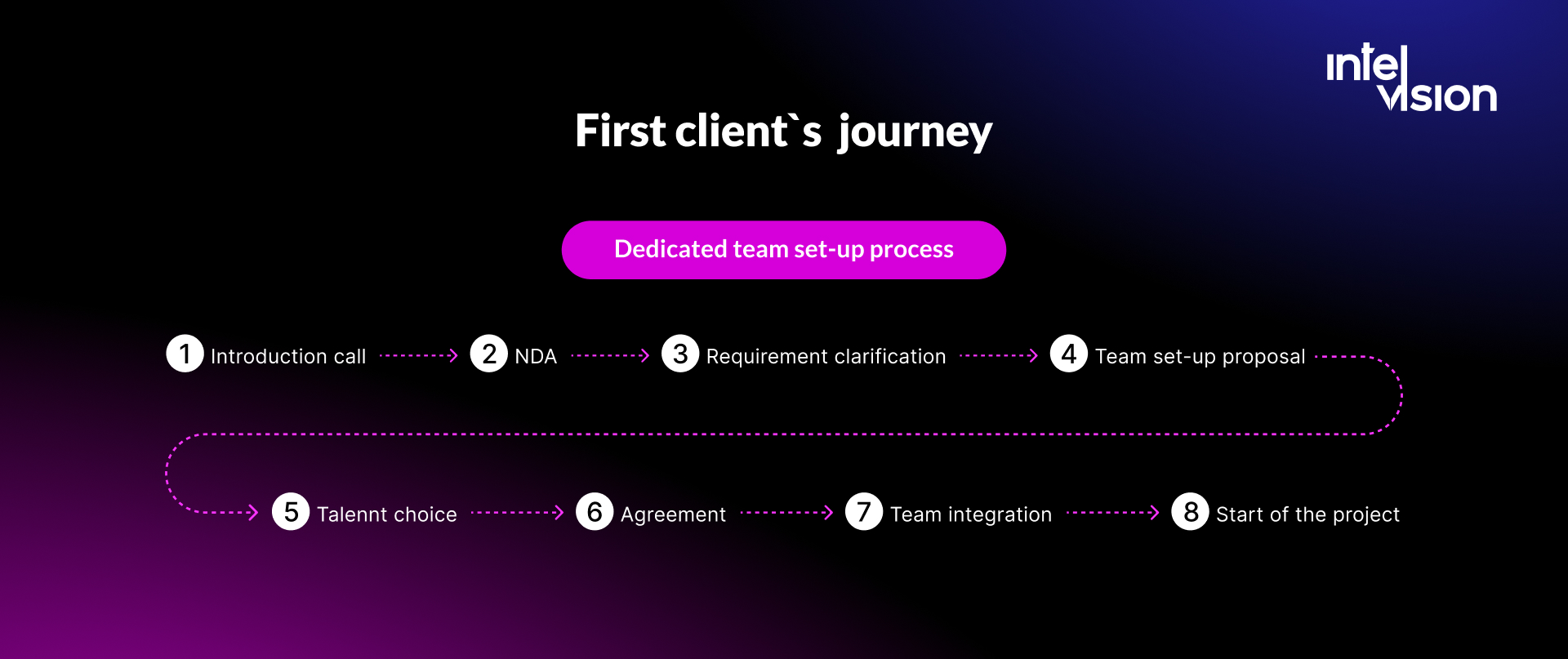
A dedicated team is shaped by the product, not by a template. The roles we staff across our engagements:
- Front-end engineers build and test the user interface: web frameworks such as React and Angular, accessibility, performance in the browser.
- Back-end engineers own business logic, APIs, data models and integrations, in stacks such as .NET, Node.js and Python.
- Full-stack and mobile engineers cover both sides of a feature, or the iOS, Android and cross-platform apps that field teams and customers use.
- QA engineers design test strategy, write automated tests and keep releases from breaking what already works.
- DevOps and data engineers run CI/CD, cloud infrastructure and monitoring, and the pipelines that move and clean data.
- UI and UX designers turn requirements into flows and screens users can work with.
- Business analysts translate business needs into clear, testable requirements and keep the backlog tied to outcomes.
- Project and delivery managers run planning, track progress, manage risk and report to you.
Here is how real teams were composed, as published in our case studies:
| Client | Team | Duration |
|---|---|---|
| Visoplan, construction collaboration platform, Germany | 1 full-stack, 1 back-end and 2 front-end developers, 1 QA | 3.5 years, ongoing |
| ING+, infrastructure management platform, Germany | 2 full-stack developers, 1 QA, 1 PM, 1 BA, 1 UI/UX designer | 2.5 years, ongoing |
| Jincom, safety communication and e-learning, Ireland | 1 BA, 1 PM, 1 front-end and 1 back-end developer, 1 QA | 2.5 years, ongoing |
| Renewable energy operator, EU | 1 BA, 1 delivery manager, frontend, backend and data engineers, 1 QA | 2.5 years, ongoing |
Two patterns stand out. QA is in every team, because a team without testing capacity ships faster for a month and slower for a year. And analysis or delivery management is in most of them, because someone has to keep the backlog connected to what the business needs.
What an Intelvision dedicated team costs
Our pricing page publishes the numbers: monthly rates from €6,500 to €9,000 per developer, depending on seniority and skill set, which is roughly €32 to €50 an hour. Full-time means 40 hours a week. The rate includes salary, benefits, tools, workspace and training. There are no upfront fees, setup charges or recruitment costs; you pay the agreed monthly rate once the engagement begins and receive one detailed invoice a month. Long-term engagements can get custom pricing.
A dedicated team budget is therefore simple arithmetic: people times rate. Some worked examples at the published range:
| Team | People | Monthly budget |
|---|---|---|
| Lean product team: 2 engineers and 1 QA | 3 | €19,500 to €27,000 |
| MVP team: 2 engineers, 1 QA, 1 PM or BA | 4 | €26,000 to €36,000 |
| Platform team: 3 engineers, 1 QA, 1 BA, 1 delivery manager | 6 | €39,000 to €54,000 |
These figures assume every role at the published per-developer range. Roles you need only part of the time, such as a designer or an architect, can join from 40 hours a month, which lowers the total.
For comparison, GermanTechJobs reports a median advertised salary of €62,500 a year for software developers in Germany, based on salary ranges in more than 2,000 job postings. That is gross salary only, before employer social contributions, recruiting fees, equipment, management time and the months a role stays open. The honest comparison is not salary against rate, but the total cost and delay of the in-house route against a team that can start within weeks.
Two things are not in the rate and should be in your budget: your product owner's time, typically several hours a week for a small team, and the tools and cloud environments the team works in, which you normally own.
How the first 30 days run
- Brief (day 0). You describe the product, the roadmap, the stack and the roles you think you need. Most engagements start smaller than their eventual scope, and we will say so if a smaller team should go first.
- Candidates (days 2 to 4). You receive profiles of engineers who have already been screened and technically interviewed by our senior engineers. No long lists.
- Interviews (1 to 3 days after the shortlist). You interview the people who would actually join, as many rounds as you need. You decide.
- Start (within about 2 to 3 weeks). Across published engagements, engineers were on the project 12 to 18 days after the brief. ING+ had two senior full-stack developers and a QA specialist onboarded in 18 days.
- Onboarding (weeks 1 to 2 on the project). Access to repositories, environments and tools; architecture walk-through; a first small change merged and released to prove the pipeline end to end.
- First review (end of month one). You assess each person. If someone does not meet your expectations, we replace them at no additional cost.
The most common delay is not on our side. It is access: accounts, VPNs, test data and approvals. Start that process the day you sign.
Aspects to Know before Hiring a Dedicated Development Team
These points apply to any provider, including us. Settle them before the first engineer starts.
Awareness of the software development process
Agree who owns what. Who writes and prioritizes the backlog, who accepts work, who decides on architecture, who handles production incidents at 2 a.m. Write it down in one page. Most conflicts in outsourced teams come from responsibilities that were assumed rather than agreed.
Capabilities of your experts
Learn what each person on the team is strong at beyond their job title. A back-end engineer who has run a database migration before, or a QA engineer who can build a performance test suite, can save you a separate hire later.
NDA, IP and code ownership
Protecting confidential information is still the first trust question in outsourcing. Sign an NDA before you share anything sensitive. Check that the contract assigns all work results to you, including unfinished work and code produced with AI tools, and that the provider secures the same assignment from its own employees and any subcontractors. Keep the code in repositories you own.
Data protection
Engineers almost always touch personal data, if only in logs or test databases. Under Article 28 GDPR, a processor works under a contract that sets out the subject, duration, purpose and data types, requires confidentiality and security measures, controls sub-processors and covers deletion or return of data at the end. Sign the data processing agreement before access is granted.
How the engagement is structured legally
In Germany, the line between buying a service and leasing workers matters. Under Section 1 of the Temporary Employment Act (AÜG), workers are leased when they are integrated into the client's organization and follow its instructions; leasing needs a permit, the contract must be explicitly labeled as such, and the same worker may generally be leased to the same client for no more than 18 consecutive months. For individual freelancers, the Deutsche Rentenversicherung judges self-employment by how the work is actually done, not by what the contract says. Ask any provider how its contracts are structured and have your lawyer confirm the setup fits how you intend to work with the team. This is not legal advice; it is the question to put on the table.
Regulated industries
If you are a bank, insurer, payment institution or other financial entity, the Digital Operational Resilience Act has applied since 17 January 2025 and includes rules on ICT third-party risk and key contractual provisions. Your dedicated team provider is part of that third-party picture.
A detailed and transparent contract
The contract should describe the development process, payment and invoicing, notice periods, how people are replaced, warranty terms, and which AI tools the team may use on your code and data.
Dedicated teams and AI-assisted development
AI coding tools are now standard equipment. In Stack Overflow's 2026 Developer Survey, 73% of respondents who use AI coding assistants or agents use them daily. Bitkom's 2026 study found that 42% of German companies with IT roles already use AI in their IT teams, and a further 36% plan to.
The evidence on what this does to delivery is more mixed than the marketing. Google Cloud's 2025 DORA report, based on nearly 5,000 technology professionals, found that AI adoption now correlates with higher throughput but still with lower delivery stability, and describes AI as an amplifier: strong teams get better, struggling teams get their problems faster. In a controlled study, METR found that experienced open-source developers took 19% longer with early-2025 AI tools, while believing they had been 20% faster. METR itself notes that tools have moved on since, but the gap between felt and measured speed is the lesson.
What that means when you choose a team:
- Seniority and review matter more than headcount. AI makes code cheap to write and expensive to check. In one of our Strike Team diagnostics, a Swiss AI software company had 27,000 lines of AI-generated code enter its codebase in a single session, unreviewable at that scale, with around half of all merge requests shipping without peer review.
- QA and automated tests are the safety net. More changes per week need more and better tests, not fewer testers.
- Tool policy belongs in the contract. Agree which tools engineers use, under whose license, and whether your code may be sent to external models.
When a client wants AI built into the delivery process itself, with measured effects on speed and quality, that is a separate piece of work under our AI-assisted delivery service.
Intelvision Expertise in Remote Development with a Dedicated Team
The results below are the ones published in our case studies, worded as published.
Visoplan, Germany. A collaboration platform for construction projects, with a BIM viewer and plugins for ArchiCAD, Navisworks and Revit. The dedicated team grew from 1 to 5 engineers over 3.5 years, with an average of 14 days to hire. When Visoplan needed more testing capacity, we added a senior QA specialist. Published results: 50% development costs cut, 40% faster time to market and 5+ product-scale features released.
ING+, Germany. An infrastructure management platform using automation and AI. The team proposed and ran a phased migration from Blazor to Angular while the product stayed in use. Published results: 40% development cost reduction and 60% better user experience.
Jincom, Ireland. Visual health, safety and environment communication tools and e-learning for global workforces. The team delivered an MVP in 3 months, with 25% development costs cut and 45% faster time to market. In the words of Tom Peacock, Head of Digital Solutions at Jincom: "Intelvision quickly assembled a highly skilled development team, enabling us to deliver our MVP within an ambitious three-month timeframe."
Renewable energy operator, EU. A smart monitoring and alerting system for solar and wind farms, built by a six-person team. Published results: 38% decrease in downtime within six months and 60% fewer on-site visits.
Long engagements also let us see problems a short contract never would. With one European B2B SaaS client, we had been an embedded engineering partner for more than three years when the delivery data pointed to a deeper issue. The audit that followed identified €220k a month in visible revenue leakage and rebuilt the backlog so that every item traced to a business outcome.
When a dedicated team from Intelvision is not the right choice
We would rather lose a deal than start a team that will disappoint. A dedicated team from us is probably the wrong answer if:
- The work is small and fully specified. A fixed-scope project of a few weeks does not repay the ramp-up of a team.
- Nobody on your side can own the product. A team without a product owner will build what is easiest, not what matters. If that is your situation, start with discovery or a fractional CTO, not a team.
- You need people on site every day. Our model is remote-first, with engineers working inside your tools rather than your office.
- The project is already in trouble. Adding people to a late, unclear project usually makes it later. A fixed-fee engineering diagnostic first will tell you whether you need more people, different people or a different plan.
- You only need one missing skill. Then a single full-time or part-time specialist is cheaper and simpler.
Hire Intelvision Dedicated Development Team
If the model fits, the next step is a conversation, not a contract. Tell us what you are building, what is in the roadmap for the next six months and where your current team is stretched. You get a direct answer on whether we can help, a proposed team with real profiles and start dates, and a monthly budget you can take to your finance team.
Questions worth bringing to that first call, for us or any other provider:
- Who exactly would join the team, and can we interview them?
- Who employs them, and what happens if one of them leaves?
- How do you handle code review, testing and AI tool use?
- Which of your clients can we speak to, with a team like the one we need?
- What does the first month look like, and how do we end the engagement if it does not work?
For a broader, vendor-neutral view of the model, including when staff augmentation or a fixed-scope project fits better, read our guide Dedicated Development Teams: Everything You Need to Know.
Sources
- Bitkom: Der Arbeitsmarkt für IT-Fachkräfte, Bitkom-Studie 2026
- GermanTechJobs: Software developer salaries in Germany
- GDPR Article 28: Processor
- Arbeitnehmerüberlassungsgesetz (AÜG), Section 1
- Deutsche Rentenversicherung: Scheinselbstständigkeit
- EIOPA: Digital Operational Resilience Act (DORA)
- Stack Overflow: The results of the 2026 Developer Survey are here
- Google Cloud: Announcing the 2025 DORA report
- METR: Measuring the impact of early-2025 AI on experienced open-source developer productivity
Read Intelvision often? Add us as a preferred source in Google Search.
Add to preferred sources