
eCommerce Website Development Guide for 2026: Process, Costs and Compliance
What's new: New platform comparison, current cost ranges and real project budgets, EU compliance checklist (EAA, withdrawal button, PCI DSS 4.0.1), AI and agentic commerce, and an FAQ.
Summarize with AI
Read summarized version with AI
- 78% of EU internet users bought online in 2025 (Eurostat), but the average cart abandonment rate is still 70.22% (Baymard), so checkout design matters as much as traffic.
- Choose the build approach from your business model: a hosted platform for standard catalogs, open source for content-led stores, headless for multi-brand setups, custom only for what no platform models well.
- Current market ranges run from about $5,000 to $25,000 for a template store to $25,000 to $150,000 for a custom mid-market store, before platform, payment and maintenance costs.
- EU stores must plan for PCI DSS v4.0.1 payment page script controls (since March 31, 2025), the European Accessibility Act (since June 28, 2025) and the online withdrawal button (since June 19, 2026).
- AI shopping agents are becoming a channel: Google's Universal Commerce Protocol and the Agentic Commerce Protocol from Stripe and OpenAI depend on accurate product data and clean order and payment APIs.
This guide walks you through eCommerce website development step by step, from choosing a platform and a team to testing, compliance, launch and marketing, with current costs and timelines. It is based on real projects, starting with the Swiss Scholar portal our team rebuilt, and it is updated for what changed by 2026: new EU rules for online shops, stricter payment page security, and AI shopping agents that now sit between some stores and their customers.
eCommerce website development in 2026: why it still deserves a plan
An online store is probably one of the most important investments an online business makes, and the market keeps growing. According to Eurostat, 78% of EU internet users aged 16 to 74 bought or ordered goods or services online in 2025, up from 62% in 2015. Buyers are experienced and not easily satisfied: only 63% of EU e-shoppers said they ran into no problem at all when purchasing online in 2025.
Conversion is still the hard part. The Baymard Institute puts the average documented cart abandonment rate at 70.22%, based on 50 studies. In other words, most stores lose most of their buyers between the cart and the confirmation page.
Three things changed the build itself since we first wrote this guide in 2021:
- Regulation. The European Accessibility Act now covers online shops, and from June 19, 2026, EU stores need an online withdrawal button for contracts with a right of withdrawal.
- Payment security. PCI DSS v4.0.1 made controls over the scripts on payment pages mandatory from March 31, 2025.
- AI. AI writes code next to developers, powers search and recommendations inside stores, and assistants such as ChatGPT, Gemini and Google's AI Mode now surface products from merchant data. Google has announced checkout inside AI Mode and Gemini for eligible US retailers.
So start where we always start: define your target audience and their needs. Every later decision, from platform to checkout design, depends on it.
What is eCommerce website development?
Many people ask what eCommerce website development actually is. It isn't only about development. It is a process with several stages: business analysis, platform choice, design, development, integrations, testing, compliance, launch, and the work after launch that keeps the store fast, secure and selling.
Whatever your business goals, your eCommerce project has to be based on an analysis of the product or service you are selling and the people you hope to sell it to.
That analysis includes the type of business you run. The two classic models are business to business (B2B) and business to consumer (B2C), and each changes what you build:
| Model | What changes in the build |
|---|---|
| B2C store | Fast mobile checkout, guest checkout, many payment methods, promotions, reviews, returns flow |
| D2C brand | Strong product storytelling, subscriptions or bundles, tight link to marketing and CRM |
| B2B shop | Customer-specific prices, quotes, purchase orders, approval flows, invoices, ERP integration, bulk ordering |
| Marketplace | Seller onboarding, split payments, commissions, seller ratings, dispute handling |
| Digital goods and services | Instant delivery, licensing or access control, booking or order forms instead of shipping |
Knowing your model and your audience does more than help you generate leads and increase sales. It tells you which platform your business needs in the first place.
Choose your build approach: SaaS platform, open source, headless or custom
The platform decision drives most of the cost, the speed to launch and how much freedom you have later. There are four broad approaches.
| Approach | Examples | Best for | Main trade-off |
|---|---|---|---|
| Hosted SaaS platform | Shopify, BigCommerce | Standard B2C and D2C catalogs that need to launch fast | Monthly and transaction fees; limits on checkout and data customization |
| Open-source platform | WooCommerce on WordPress, Shopware, Adobe Commerce (Magento) | Content-heavy stores, unusual catalogs, teams that want to own the code | You own hosting, updates and security patches |
| Headless or composable | A commerce API (for example commercetools or Shopify's APIs) with a custom React or Next.js frontend | Brands with several storefronts, apps and markets, and a team to run them | Highest build and operating complexity |
| Custom build | .NET, Node.js or another stack built around your own domain model | Business models no platform supports well | Everything is yours, including every bug and every security update |
Hosted platforms publish their prices, which makes the running cost easy to model. On Shopify's pricing page, in euros, Basic costs €32 a month billed monthly or €24 billed yearly, Grow €92 or €69, and Advanced €384 or €289, with online card rates falling from 2.1% + €0.30 on Basic to 1.6% + €0.30 on Advanced. Shopify Plus starts at €2,100 a month with an online card rate of 1.3% + €0.30.
WordPress remains the most common foundation on the web: W3Techs counts it on 39.6% of all websites, with Shopify at 5.3%. That reach is why WooCommerce is still a sensible choice for content-led stores, and why we used WordPress for Swiss Scholar.
Simple rules of thumb we use with clients:
- If your catalog, checkout and fulfillment look like most stores in your category, start on a hosted platform and spend the budget on content, design and marketing.
- If content and SEO drive your sales and you want full control over templates, an open-source platform makes sense.
- If you run several brands, countries or channels on one product catalog, consider headless, but only with a team that can operate it.
- If the core of your business is something a store platform cannot model, such as configurable B2B products, bookings or a new kind of gift flow, build that part custom and keep standard parts standard.
Things to consider in eCommerce website development (based on the Swiss Scholar project)
Have you determined your goals? Have you defined your business model? Do you know what your users need for a good experience? These guidelines are based on a real project our team delivered: Swiss Scholar, an educational portal that helps students with assignments, presentations, exams and online courses, and sells those services online.
Swiss Scholar came to us with an underperforming website built on a generic WordPress theme that was neither optimized for its audience nor technically robust. Our job was to rebuild it so it met the needs of the business and of its students. We assembled a dedicated team of two WordPress developers, a UI/UX designer, a business analyst and a project manager, onboarded within 14 days. The project ran from November 2020 to January 2021 on a budget of EUR 10k+, and the case study records 30% cost savings on development.
The lesson from that project still holds: eCommerce website development is not just technology. It is the expertise of the people working on it, and the questions they ask before they write any code. Below, we go through the stages of the process using Swiss Scholar as the example, and add what has changed since.

1. Select your tech provider
Choosing your tech provider is half the work. It comes down to rapport, healthy communication and effective cooperation over months or years. You can often identify the right development team from the first calls: pay attention to the questions they ask. Qualified people ask about your customers, margins and operations before they talk about frameworks.
For Swiss Scholar, the first thing our team did was audit the old website, the market and the behavior of its visitors, so the new store would match what its audience expected. That analysis shaped every decision that followed.
Questions worth asking any provider before you sign:
- Who exactly will work on the project, and will they stay until launch and after it?
- How do you run discovery, and what do I get at the end of it: a scope, an estimate, a backlog, designs?
- Which commerce platforms have you shipped on, and can I talk to one of those clients?
- Who owns the code, the hosting accounts, the payment provider account and the analytics data? (The answer should be: you.)
- How do you handle security updates, payment page scripts and accessibility?
- What does support look like after launch, and what does it cost per month?
If you are still shaping the project, our step-by-step guide to website project planning covers the preparation that makes these conversations faster.
2. Discuss technologies
With goals and objectives in place, the next step is the technology. For Swiss Scholar we used WordPress with a custom theme, supported by an SMTP server for sending emails, Figma for design, Trello for project management, a CDN to speed up page loading, and Cloudflare to improve loading times and protect the site from DDoS attacks.

Every technology choice should serve the same goal: a fast, mobile-friendly store that is easy to change. In 2026 that goal has a measurable definition. Google's Core Web Vitals set "good" at a Largest Contentful Paint of 2.5 seconds or less, an Interaction to Next Paint of 200 milliseconds or less, and a Cumulative Layout Shift of 0.1 or less, measured at the 75th percentile of real page loads. INP replaced First Input Delay as a stable Core Web Vital in 2024, so older performance reports may be measuring the wrong thing.
Beyond the platform, agree on these parts of the stack early:
- Payments: a provider that supports the methods your customers use, Strong Customer Authentication and hosted payment fields.
- Search: platform search for small catalogs; a dedicated search service once the catalog or traffic grows.
- Product data: where product information lives (platform, PIM or ERP) and which system is the source of truth for prices and stock.
- Hosting and delivery: CDN, image optimization and caching for every page that does not depend on the user.
- Analytics and consent: analytics that respects consent choices, set up before launch, not after.
Our published commerce projects show the range: WordPress for Swiss Scholar, .NET and React for GiFiT, and Xamarin for the Posude mobile ordering app. The stack follows the business model, not the other way around.
3. Define your feature list
A store needs a long list of features, but not all at launch. First among them: user-friendly navigation. No educational portal or shop will be in demand if visitors find it uncomfortable to move through. Our article on the 15 must-have eCommerce features goes through the full list; here is how we split it between launch and later.
| Launch with | Add once you have data |
|---|---|
| Clear navigation and category structure | Personalized recommendations |
| Fast search with filters | Wishlists and saved carts |
| Product pages with real photos, prices and stock | Product reviews and Q&A (once you have buyers to write them) |
| Cart, guest checkout and the payment methods your market expects | Loyalty program and referral codes |
| Order confirmation, tracking and returns flow | Live chat or an AI assistant trained on your policies |
| Account, login and password recovery | Subscriptions and bundles |
| Analytics, consent management and email notifications | Marketing automation and segmentation |
The test for every feature is the same: does it help a customer find, trust or buy, or does it help your team run the store?
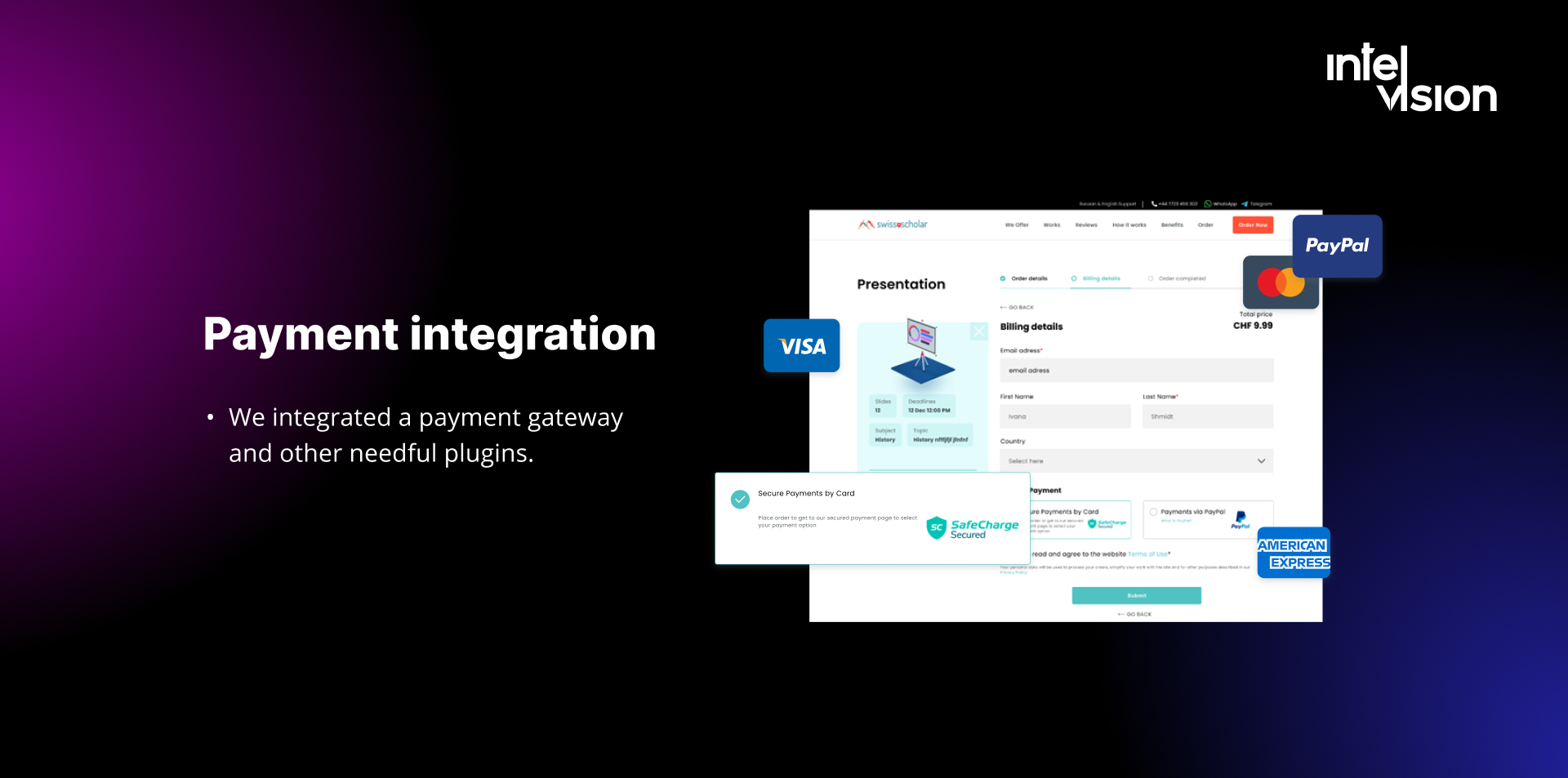
For Swiss Scholar, the team designed a client-oriented user flow based on user behavior analysis, built a custom UI/UX design and WordPress theme, integrated a secure payment gateway and an intuitive shopping cart, improved login, registration and password recovery, added an automatic Instagram feed, an analytics module for business statistics and a live chat for real-time help.


4. eCommerce SEO
How do you make your eCommerce website easy to find? Customer behavior changed a lot over the past few years, but people never stopped searching. What changed is where the answers appear: classic results, shopping listings, and now AI answers in search and in assistants.
The fundamentals from 2021 still apply. Keywords matter for content and for technical SEO, so build them into the site architecture and URLs from the start, as we did for Swiss Scholar. Then add what a 2026 store needs:
- Product structured data plus a Merchant Center feed. Google's product documentation says that structured data on your pages together with a Merchant Center feed maximizes your eligibility for shopping experiences, and pages where customers can buy qualify for merchant listings with shipping and return details.
- Clean category architecture. One indexable URL per category, with filter combinations controlled so search engines do not crawl thousands of near-duplicate pages.
- Original product content. Write descriptions that answer buyers' real questions. Generating thousands of pages with AI is risky: Google's spam policies name "using generative AI tools or other similar tools to generate many pages without adding value for users" as scaled content abuse.
- Fast pages. Core Web Vitals are Google's own measure of loading, interactivity and visual stability. Track them per template, because one slow category template affects thousands of URLs.
- Feeds for AI shopping surfaces. In January 2026 Google announced new Merchant Center data attributes to help products get discovered in AI Mode, Gemini and its Business Agent (Google). Accurate, complete product data is now an SEO asset in its own right.
5. eCommerce design
There's a proverb: "It's not the clothes that count, but the things the clothes cover." The architecture of your store matters most. Still, design is what turns traffic into orders, and responsive design is not optional when shoppers arrive from every kind of device.
For Swiss Scholar, our team built the UX and UI around the target audience, students, with a focus on conversion. In 2026 good commerce design also means:
- Accessibility by default. The European Accessibility Act covers e-commerce services and could be enforced by EU member states from June 28, 2025 (Travers Smith). WCAG 2.2 at level AA is the usual practical target: keyboard navigation, visible focus, sufficient contrast, labelled form fields and text alternatives for images.
- A checkout designed against the known reasons people leave. Baymard's research shows what to fix first.
| Why shoppers abandon checkout (Baymard) | Share | Design response |
|---|---|---|
| Extra costs too high (shipping, tax, fees) | 40% | Show full delivery cost and taxes on the product page and in the cart, not at the last step |
| Delivery too slow | 20% | Show delivery dates per option before checkout; offer a faster paid option |
| Did not trust the site with card details | 19% | Use recognized payment methods and hosted payment fields, show security cues and real contact details |
| Site required an account | 18% | Offer guest checkout and invite account creation after the order |
Baymard calculates these shares after excluding the shoppers who were just browsing. Interface trends come and go: sticky navigation, chatbots, smarter pop-ups, animation and original illustrations were all on our 2021 list. They help only when they serve one of the problems above.

6. eCommerce website development
Customers cannot talk to a salesperson, touch the product or try anything on. The store has to do that work, which is why the development team is such an important player. The process starts well before development itself. We begin with consulting: auditing, analyzing and planning, so we understand the challenges before we estimate them. Then you meet the dedicated team that will build the store. That is the approach we used for Swiss Scholar.
A typical build runs in short iterations after discovery:
- Discovery and architecture. Business model, catalog structure, integrations, non-functional requirements (traffic peaks, markets, languages), and a backlog with estimates.
- Design system and key templates. Home, category, product, cart, checkout, account. Approve these before building the rest.
- Core build in sprints. Two-week sprints with a demo at the end of each, so you see working software, not status reports.
- Integrations. Payments, shipping and carriers, tax, ERP or accounting, CRM, email, search, analytics. Integrations are where estimates most often go wrong, so start them early.
- Content and data migration. Products, customers, orders and redirects from old URLs to keep search rankings.
- Hardening. Performance, security, accessibility and payment tests, then launch.
The GiFiT project shows the same process on a custom build. GiFiT, a Czech eCommerce startup, lets customers attach personalized video, photo and text greetings to physical gifts, revealed through a QR code. Our team of a backend developer, a frontend developer, a project manager, a DevOps engineer and a QA engineer built the MVP from scratch in three months, working in two-week Scrum sprints, on .NET and React with Azure Media Services for video streaming, Azure Blob storage and a CRM integration, on a budget of USD 20k+. The client's tech lead put it this way in the published case study: "They followed all the agreed arrangements and delivered exactly what I asked for." For the sales side of the same project, see how to boost eCommerce sales: the GiFiT case study.
Quality eCommerce website development is about planning the work, carrying it out and reporting on it throughout the project and after launch. That discipline is what keeps deadlines and budgets intact. If you are starting from an idea, our MVP and product development service is built around this sequence.
7. Test and release your eCommerce website
You are close to launch. As at school: check before handing in. eCommerce testing is more complex than most because it has to look at the store from every side: performance and security, usability and data, responsive UI, functional behavior and A/B tests.
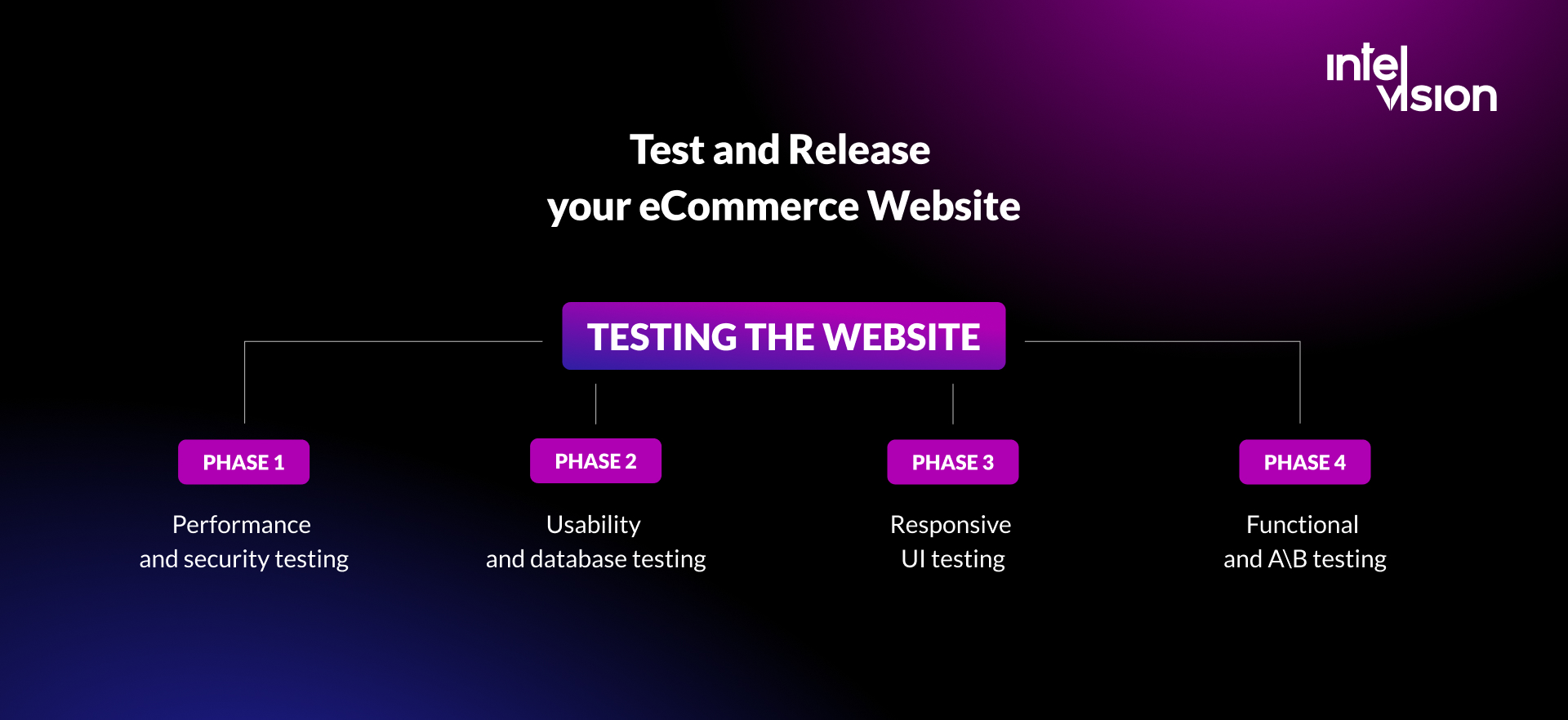
Your homepage is your business card, but the checkout is your cash register. Our team checks page speed with tools like Google PageSpeed Insights and GTmetrix, color and font consistency, behavior in different browsers, scrolling and carousels, whether every link goes to the right page, and whether login, signup and cart buttons are easy to find and work properly. Page speed was a priority for Swiss Scholar; students do not wait for slow pages.
A pre-launch checklist for 2026:
- Core Web Vitals within the "good" thresholds on mobile for home, category, product and checkout pages.
- Payment flows tested for success, decline, refund, partial refund and a Strong Customer Authentication challenge, on mobile and desktop.
- Payment page scripts inventoried and monitored. PCI DSS v4.0.1 requirements 6.4.3 and 11.6.1, which deal with scripts on payment pages and detecting unauthorized changes, became mandatory on March 31, 2025 (PCI Security Standards Council). Merchants who embed a provider's payment iframe and qualify for SAQ A must confirm their site is not susceptible to script-based attacks.
- Accessibility checked with automated tools and a manual keyboard and screen reader pass.
- Withdrawal function working for every contract that carries a right of withdrawal (see the compliance section below).
- Load test at a multiple of your expected peak, including search and checkout, before the first sales campaign.
- Redirects, sitemaps, structured data and analytics verified on the production domain.
8. Market your eCommerce website
Online customers are not easy to engage, and most carts never become orders: Baymard's average documented abandonment rate is 70.22%. Marketing therefore starts inside the store, with the checkout fixes above, and continues outside it.
For Swiss Scholar, social media came first because students are very active there, so the team integrated the Instagram feed into the site and connected analytics. The integrations that make marketing possible belong in the build: analytics, consent, email and SMS, CRM and product feeds for shopping channels.
- Email and lifecycle messages: abandoned cart, back in stock, post-purchase and review requests.
- Content: buying guides and category content that answer real questions, which also feeds SEO and AI answers.
- Social and community: where your audience already spends time, as with Swiss Scholar's students.
- Shopping feeds: Merchant Center and other channels, kept accurate on price and stock.
- Measurement: one agreed definition of conversion, revenue and margin per channel, so the team optimizes the right number.
EU compliance checklist for online stores in 2026
If you sell to consumers in the EU, these rules shape the build. This is a practical summary for planning, not legal advice; check national implementation for every market you sell into.
| Rule | What it means for your store | Applies since |
|---|---|---|
| PSD2 Strong Customer Authentication | Customer-initiated online card payments where both the merchant and the card issuer are in the EEA need authentication with two independent factors, with exemptions such as low-value payments under €30 (Stripe) | In force |
| PCI DSS v4.0.1, requirements 6.4.3 and 11.6.1 | Inventory, authorize and check the integrity of every script on payment pages, and detect unauthorized changes | March 31, 2025 |
| European Accessibility Act | Online shops must be accessible; microenterprises with fewer than ten employees and turnover under €2 million are exempt from some requirements | June 28, 2025 |
| Withdrawal button, Directive (EU) 2023/2673 | A function labelled "withdraw from contract here" or an equivalent, a confirmation step labelled "confirm withdrawal", and a confirmation of receipt on a durable medium (Greenberg Traurig) | June 19, 2026 (national transposition deadline) |
| GDPR and cookie consent | Lawful basis for every use of personal data, consent before non-essential tracking, data processing agreements with every vendor | In force |
The withdrawal button does not apply to contracts without a statutory right of withdrawal, such as bespoke goods, perishable goods or sealed hygiene products. For everything else, it has to be built, tested and kept available for the whole withdrawal period.
How AI changes eCommerce website development in 2026
AI affects an eCommerce project in three places: how the store is built, what the store does, and where customers shop.
How the store is built
AI coding assistants speed up scaffolding, tests, data migrations and repetitive templates. They do not remove the need for review. Payment flows, pricing logic, tax rules and personal data are exactly where a confident but wrong suggestion costs real money, so those parts get human review and tests every time.
What the store does
The most useful AI features in commerce today are practical ones: search that understands intent, recommendations, support answers grounded in your own policies, and help with product data enrichment and translation. Start with one feature tied to a measurable outcome, such as search conversion or support tickets per order, and keep humans in control of what is published. Our AI product features work follows that approach.
Where customers shop
AI agents are becoming a sales channel. In September 2025, Stripe and OpenAI released the Agentic Commerce Protocol, an open standard that lets merchants sell through AI agents. Its shared payment token lets an agent start a payment without exposing the buyer's card details, scoped to one merchant and one cart total. In January 2026, Google announced the Universal Commerce Protocol, co-developed with Shopify, Etsy, Wayfair, Target and Walmart and compatible with A2A, AP2 and MCP, with checkout from eligible US retailers in AI Mode and the Gemini app announced as the first step. Shopify says its merchants can manage these channels centrally through Agentic Storefronts.
You do not need to rebuild your store for this. You do need what every agent depends on: complete and accurate product data, real-time price and stock, clear shipping and return policies in machine-readable form, and order and payment APIs that a platform or partner can connect to. Those are good engineering practices anyway.
How much does eCommerce website development cost?
The eCommerce website development process is complex, from preparation to marketing, so the cost is never one number. It depends on the platform, the custom design and features, the number of integrations, data migration, hosting and the approach to delivery. Two stores with similar homepages can differ several times over in cost because of what sits behind the checkout.
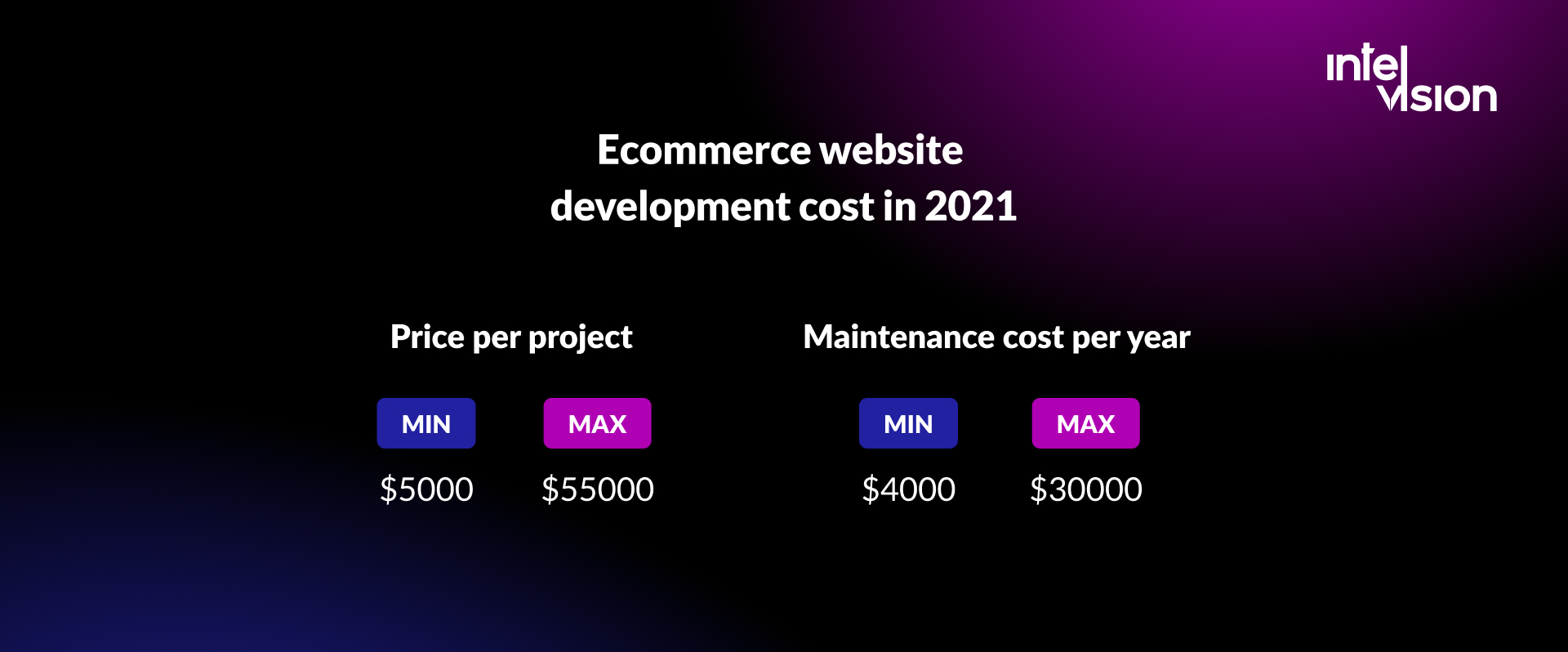
When we first published this guide, we quoted 2021 figures of $5,000 to $55,000 to build an eCommerce site and $4,000 to $30,000 a year to maintain it. Those numbers are out of date.
Current market ranges, from Elogic Commerce's cost index (updated October 2026), excluding license fees and tax:
| Store type | Typical build cost | Typical timeline |
|---|---|---|
| Template store on a platform | About $5,000 to $25,000 | 1 to 4 months |
| Custom mid-market store | About $25,000 to $150,000 | 4 to 9 months |
| Complex B2B with ERP integration | About $150,000 to $500,000 or more | 6 to 12 months |
| Enterprise and multi-store | About $100,000 to $500,000 or more | 9 to 18 months or more |
The same source plans annual maintenance at roughly 10% to 15% of the implementation cost for essential maintenance, 15% to 25% for managed commerce and 25% to 40% for business-critical operations, and lists Magento developer rates of about $40 to $80 an hour in Eastern Europe, $60 to $130 in Western Europe and $100 to $250 or more in the US. These are one agency's planning ranges, not a market survey, but they are a useful order of magnitude.
Real budgets from our own published projects:
| Project | What was built | Team and timeline | Budget |
|---|---|---|---|
| Swiss Scholar | Redesign and rebuild of a WordPress portal selling educational services, with payments, cart and analytics | 5 people, November 2020 to January 2021 | EUR 10k+ |
| GiFiT | Custom .NET and React gifting platform with video greetings, QR codes and CRM integration | 5 people, 3-month MVP | USD 20k+ |
| Posude | Mobile B2B order-taking app for sales reps, offline-first with CRM sync | 1 full-stack developer and 1 QA engineer, 3 months | NDA |
| WallaWalla | Not a store: ongoing maintenance, security and SEO for a studio's WordPress website, with a 30% site speed improvement; a reference for running costs | 1 full-stack developer, 1+ year | EUR 75k+ |
The running cost deserves as much attention as the build. Budget for:
- Platform fees: for example Shopify's monthly plans above, or hosting and licenses for an open-source or headless stack.
- Payment fees: Stripe's German pricing lists 1.5% + €0.25 for standard EEA cards, 2.8% + €0.25 for premium EEA cards and 3.15% + €0.25 for international cards, plus 2% if currency conversion is needed.
- Apps, plugins and services: search, reviews, email, tax, shipping labels, consent management.
- Maintenance: security patches, platform upgrades, performance and small changes. Our support and maintenance engagements cover exactly this.
- Growth work: new features, A/B tests and integrations, which never really stop.
To get an estimate you can trust, bring a provider four things: your business model and markets, a prioritized feature list, a list of systems to integrate, and the amount of data to migrate. With those, a serious team can give you a range after a short discovery, and a fixed scope after a longer one.
Common eCommerce development mistakes and how to avoid them
- Choosing the platform before the business model. The platform should follow how you sell, not the other way around.
- Building every feature for launch. Launch with what helps customers buy; add the rest when data shows it is needed.
- Underestimating integrations and data migration. ERP, tax, shipping and product data take longer than templates. Start them in the first sprints.
- Hiding costs until the last checkout step. It is the most common reason shoppers abandon, at 40% in Baymard's data.
- Forcing account creation. Offer guest checkout.
- Treating accessibility and compliance as a later task. Retrofitting accessibility and a withdrawal flow costs more than building them in.
- Adding scripts to the payment page without control. Every tag on a payment page is now a PCI DSS question.
- No owner after launch. A store without maintenance gets slower and less secure every month.
Intelvision's expertise in eCommerce website development
Intelvision values long-term relationships with clients; across our clients, the average partnership runs over three years. Swiss Scholar is one example of how we work on commerce projects, and it is not the only one. Four of them:
- Swiss Scholar (Switzerland, education): full redesign and rebuild of a WordPress portal that sells educational services, with payments, cart, analytics, social integration and live chat.
- GiFiT (Czech Republic, eCommerce): a custom gifting platform built from scratch, MVP released in three months.
- Posude (retail): a mobile B2B order-taking app for sales representatives, offline-first with CRM synchronization, delivered in three months by a full-stack developer and a QA engineer deployed within 12 days.
- WallaWalla (USA, website maintenance rather than a store): a dedicated full-stack developer maintaining a game studio's WordPress website for more than a year, improving site speed by 30% and handling security scans and SEO.
We work as a dedicated team or with individual engineers inside your team, across WordPress, .NET, React, Angular and mobile. Intelvision holds a 5.0 rating on Clutch from 14 verified reviews and has delivered more than 100 software products. Our industry experience includes education, logistics, fintech, construction and proptech.

The eCommerce website development process in 10 steps
eCommerce website development is part craft, part discipline. Focus on your target audience's needs, and choose technologies that meet them. Here is the whole process in one list:
- Define your audience and business model.
- Choose the build approach: hosted platform, open source, headless or custom.
- Pick a tech provider you can work with for years, and ask the hard questions first.
- Agree on the stack, with Core Web Vitals as a hard requirement.
- Split features into launch and later.
- Build SEO, structured data and product feeds into the architecture.
- Design for accessibility and against the known reasons for cart abandonment.
- Develop in short iterations, starting integrations early.
- Test performance, payments, payment page scripts, accessibility and the withdrawal flow before launch.
- Market from inside the store first, then outside it, and keep someone responsible for the store after launch.
After launch you are available to anyone, anywhere. Follow the steps above and the store has a good chance of succeeding, and a team that maintains and supports it will help it keep growing.
Sources
- Eurostat: E-commerce statistics for individuals
- Baymard Institute: Cart abandonment rate statistics
- Shopify pricing
- W3Techs: Usage statistics of content management systems
- web.dev: Web Vitals
- Google Search Central: Product structured data
- Google Search Central: Spam policies
- Google: New tech and tools for retailers in an agentic shopping era
- Shopify: The agentic commerce platform
- Stripe: Instant Checkout in ChatGPT and the Agentic Commerce Protocol
- Travers Smith: The European Accessibility Act now applies
- PCI Security Standards Council: Guidance for e-commerce requirements effective after 31 March 2025
- Greenberg Traurig: EU consumer law, new withdrawal button requirements
- Stripe: Strong Customer Authentication guide
- Elogic Commerce: Ecommerce website cost index
- Stripe pricing (Germany)
Read Intelvision often? Add us as a preferred source in Google Search.
Add to preferred sources