Advantages of SaaS Development for Your Business
What's new: Current adoption data, advantages for SaaS builders, a buy-or-build comparison, architecture choices, cost estimates, EU rules, AI's impact, a build process and an FAQ. Outdated figures removed.
Summarize with AI
Read summarized version with AI
- SaaS is subscription software run, secured and updated by the provider; in 2025, 52.74% of EU enterprises paid for cloud services.
- For users, SaaS means low upfront cost, scalability, flexibility and continuous updates, but security is shared and backups are not a reason to skip your own exports.
- For builders, SaaS brings recurring revenue and one codebase, in exchange for hard problems in multi-tenancy, compliance, cloud costs and churn.
- At €6,500 to €9,000 per developer per month, a focused MVP team costs about €58,500 to €108,000; ongoing development costs more than the first version.
- EU rules now shape SaaS design: GDPR processor contracts, the Data Act's switching framework, NIS2, the Accessibility Act and the Cyber Resilience Act.
- AI-native app spend more than doubled in a year, which pushes SaaS toward domain-specific AI features and usage-based pricing.
Most businesses now run on software they rent rather than install. In the EU, 52.74% of enterprises paid for cloud computing services in 2025, up 7.42 percentage points from 2023, and 84.67% of large enterprises did. Email, office software, file storage, security, accounting, CRM and ERP are increasingly bought as a service.
This guide covers both sides of that shift: the advantages of SaaS for the businesses that use it, and the advantages and real challenges of building a SaaS product of your own, with current costs, architecture choices, EU rules and the way AI is changing SaaS in 2026.
What Is SaaS?
If your work and lifestyle involve a lot of travel, it makes sense to buy a car. If you only travel occasionally, a taxi or car sharing is cheaper: you pay for the trip, not for tax, insurance, fuel and repairs. SaaS is the taxi of the software world. If you need a service, you subscribe and use it. When you no longer need it, you stop renewing.
SaaS stands for software as a service: a subscription-based model where the software runs in the provider's cloud and users reach it through a browser, a mobile app or an API. The provider runs, secures, updates and supports it. Simply put, the customer pays for access to a ready-made tool and can start using it the same day.
Google Docs is a familiar example. There is nothing to install: you sign in and work with documents, spreadsheets and presentations in the browser, while colleagues edit, comment and suggest changes in real time.
SaaS now covers almost every area of business and private life, from streaming services such as Netflix and Spotify to banking, CRM, telephony and analytics. Some common categories:
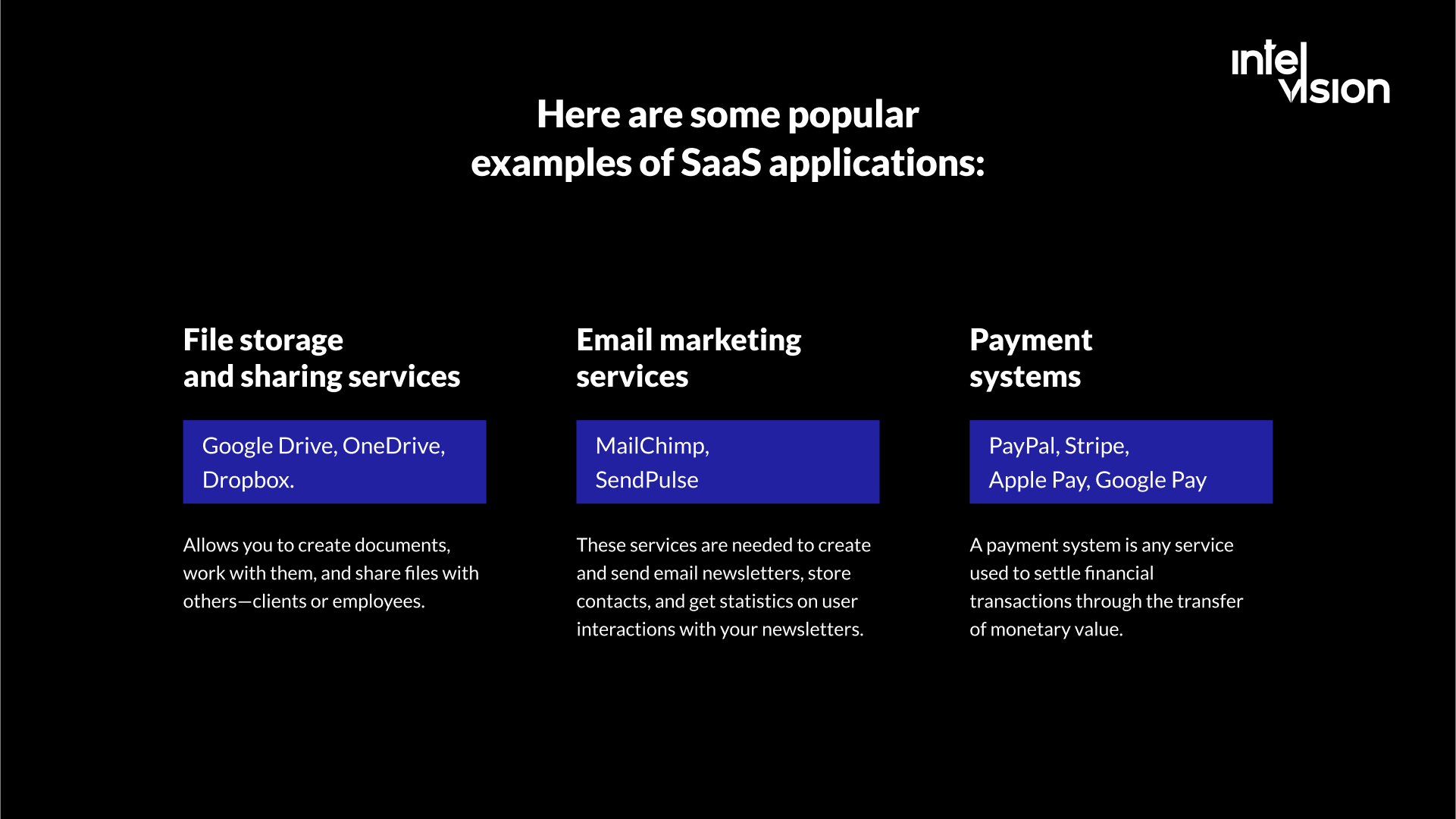
- File storage and collaboration: Google Drive, OneDrive, Dropbox. Create and share documents with clients and colleagues.
- Email marketing: Mailchimp, Brevo and similar services create and send newsletters, store contacts and report on how people interact with your emails.
- Payments: Stripe, PayPal, Adyen. They process and settle financial transactions for online businesses through an API.
- Vertical SaaS: software built for one industry, such as construction collaboration, property management or partner management. This is where much of the new SaaS development happens, because general tools rarely fit specialist workflows.
SaaS in 2026 in numbers
- Adoption keeps rising. Among EU enterprises that buy cloud services, Eurostat's 2025 data shows 85.15% use them for email, 71.69% for office software, 58.16% for accounting and finance software, 30.12% for ERP and 27.91% for CRM.
- Companies run many apps. Zylo's 2026 SaaS Management Index puts the average portfolio at 305 applications, with average annual SaaS spend of $55.7M among the companies it tracks, up 8% year over year.
- AI is where the growth is. In the same index, spend on AI-native apps rose 108% year over year.
- The infrastructure underneath is growing fast. SRG, the cloud market analyst now part of TechInsights, reports cloud infrastructure services revenue of $143.4 billion in Q2 2026, up 43% year over year, driven mainly by generative AI.
What are the Advantages of SaaS Development?
The SaaS model combines working software with an ongoing service. It brings benefits to the businesses that use it and to the companies that build it.
Cost savings
SaaS needs no installation and no servers on your side, so the upfront cost is low. The subscription is predictable and fits into a budget. Large companies can also use a tool for a short period, for a project or a peak season, and stop paying afterwards.
Tip: most SaaS products offer a free trial or a free tier. Use it on a real task, with real data, before you commit. And review your subscriptions every year: with hundreds of apps in a typical portfolio, unused licenses add up.
Scalability & Accessibility
You can add users, storage or features in minutes rather than buying hardware. A browser and an internet connection are enough to work from any device and any location, and data stored in the cloud is available wherever your team is.
Flexibility
Most SaaS services offer several plans and add-ons, so you pay for what you use and change plans as needs change. Good B2B SaaS products are also configurable: workflows, fields, roles and integrations can be set up per customer without custom code.
Data Security
Established SaaS providers invest in security at a level few small and mid-sized companies can match on their own: encryption, multi-factor authentication, single sign-on, monitoring and certified processes. But security is shared. The provider secures the platform; you remain responsible for who has access, how strong their authentication is and what data you put in. Ask for security certifications, such as ISO 27001 or a SOC 2 report, and read the data processing agreement.
Back-Up & Data Recovery
Data stored on a single local machine is always at risk of failure or loss. SaaS providers replicate and back up their platforms, which removes most of that risk. It does not remove all of it. A deleted record, a ransomware-encrypted sync folder or a provider outage can still cost you data or time, and many contracts limit how far back a restore can go. Check retention and export options, and keep your own exports of business-critical data.
Upgrades
The service is updated continuously with bug fixes and new features. The provider does this work, which reduces the load on your IT team for maintenance and configuration, and improvements reach you as they ship instead of waiting for a major version.
Advantages for the company that builds the SaaS
- Recurring revenue. Subscriptions turn one-off sales into predictable monthly or annual income, which makes the business easier to plan and to finance.
- One codebase, many customers. You maintain one version of the product instead of many installations, so fixes and features reach everyone at once.
- Faster learning. Usage data shows which features matter and where users get stuck, so you can improve the product every week.
- Reach. A SaaS product can be sold and delivered across borders without shipping anything or sending engineers on site.
SaaS vs custom software vs off-the-shelf: which fits your business?
"SaaS development" can mean building a product to sell, or building an internal platform as a cloud service. Before you build anything, compare the options:
| Buy SaaS | Build your own SaaS product | Custom internal software | |
|---|---|---|---|
| Best when | Your need is common and a good product exists | Many companies share a problem no product solves well, and you can sell to them | Your process is specific and a competitive advantage |
| Time to value | Days to weeks | Months to first paying customers | Months |
| Upfront cost | Low | High: product, team, go-to-market | Medium to high |
| Ongoing cost | Subscription per user or usage | Team, cloud, support, sales | Maintenance team and hosting |
| Control | Low: the vendor owns the roadmap | Full | Full |
| Main risk | Lock-in and price rises | No market fit | Cost of keeping it current |
If you are unsure which column you are in, a short paid discovery that tests the business case before any code is written is cheaper than finding out after a year of development. Our deep discovery work exists for exactly that decision.
Challenges of SaaS Development
The SaaS model has many advantages, but there are pitfalls. For some companies, they decide the question.
- Dependence on the internet. If the connection is slow or absent, work stops. For field teams, warehouses and construction sites, design the product to work offline and sync when the connection returns.
- Customization versus configuration. Customers will ask for changes that only they need. A product that says yes to every request becomes many products sharing one codebase. Build configuration options, roles and integrations, and decide clearly what you will not customize.
- Security and compliance. Enterprise buyers screen SaaS vendors on security certifications, data residency and incident handling before they talk about features. Plan for this early; retrofitting it is expensive.
- Multi-tenancy. Keeping each customer's data separate, performance fair and upgrades safe across all tenants is the core technical challenge of SaaS. More on this below.
- Cloud costs. Costs that are trivial for ten customers can be serious for a thousand, especially with AI features that call large models. Track cost per tenant from the start.
- Churn. Customers can leave as easily as they joined. Retention, not acquisition, decides whether a SaaS business works.
Some of these have improved since this article was first published in 2022: connections are faster, encryption and identity tools are better, and cloud providers offer more managed security services. Others, especially cost control and compliance, have become more demanding.
Key architecture decisions when you build a SaaS product
A few early decisions shape the cost and risk of a SaaS product for years.
Tenancy model. AWS describes three patterns. In the silo model, each tenant gets dedicated resources, such as its own database. In the pool model, tenants share resources for economies of scale. The bridge model mixes the two, for example siloing services that hold regulated data and pooling the rest. Even a silo model still uses shared identity, onboarding and operations; otherwise it is a managed service, not SaaS.
Identity and access. Business customers expect single sign-on, roles and audit logs. Build them in rather than bolting them on before the first enterprise deal.
Configurability. Decide what customers can configure themselves: fields, workflows, views, permissions, integrations. For AVIDENO, a Swiss no-code platform for digitizing business processes, the product is built around a configurable, multilingual data model with field-level change tracking, event-driven automation, a REST API, a complex permission system and multi-tenant workspaces. Two senior full-stack developers from Intelvision have worked on it for 3.5 years; the published results are 40% reduced development cost and 35% faster time to market.
Integrations. Most B2B SaaS lives or dies on how well it connects to the customer's other systems. Plan a public API and webhooks from the first version. For Kiflo, a French partner relationship management platform for SMBs, the brief was a scalable multi-tenant SaaS platform with cross-platform integration capabilities; with two Intelvision full-stack developers over three years, the published results are 25% faster time to market and 30% cost savings on development.
Billing and metering. Per-seat, usage-based or hybrid pricing needs accurate metering and a billing system that can change as your pricing does. AI features with real per-use costs push many products toward usage-based components.
Observability and data residency. Know which tenant is causing which load and cost, and where each tenant's data is stored. European and Swiss customers increasingly ask for in-region hosting.
What it costs to build a SaaS product in 2026
The honest answer is a range, driven by four things: scope of the first version, number of integrations, compliance requirements and team composition. A practical way to estimate is team size times duration times rate.
At Intelvision's published rates of €6,500 to €9,000 per developer per month, some examples:
| Scope | Typical team | Duration | Team cost |
|---|---|---|---|
| Focused MVP: one core workflow, basic roles, one integration | 2 engineers, 1 QA | 3 to 4 months | €58,500 to €108,000 |
| Market-ready product: multi-tenancy, SSO, billing, several integrations | 3 to 4 engineers, 1 QA, 1 BA or PM | 6 to 9 months | €195,000 to €486,000 |
| Ongoing product development after launch | 2 to 5 people | Per month | €13,000 to €45,000 a month |
These are team costs only. Add cloud hosting, third-party services such as authentication, email and payments, security testing, and any certification work. Our own published MVPs give a sense of timelines: Jincom, a safety communication and e-learning platform, launched its MVP in three months with a five-person team, and Get Worker, an HR system for a construction company, went from onboarding to release in two months.
The bigger cost is usually not the first version but the years after it. Budget for continuous development from the start; a SaaS product that stops improving starts losing customers.
EU rules every SaaS company should know
None of this is legal advice, but each point below has changed how SaaS products are built and sold in Europe.
- GDPR. When your product processes customers' personal data, you are their processor and need a contract that meets Article 28 GDPR: subject, duration, purpose, data types, security, sub-processors, deletion and audits. Have a standard data processing agreement ready before your first sales call.
- Data Act. Since 12 September 2025, the Data Act sets a framework for customers to switch between data processing services, and gives users rights to data from connected products. Design export and migration paths as a feature, not an afterthought.
- NIS2. The NIS2 Directive covers sectors including energy, transport, health, finance, digital infrastructure and digital services, and makes top management accountable when cybersecurity risk management measures are not met. If your customers are in scope, their supply chain requirements will reach you.
- European Accessibility Act. Products and services placed on the market after 28 June 2025, including online shops, ticketing platforms and banking services, must meet accessibility requirements. Service businesses with fewer than 10 employees and under €2 million turnover are exempt.
- Cyber Resilience Act. The CRA covers products with digital elements, including apps and computer programs. It entered into force on 10 December 2024, its reporting obligations apply from 11 September 2026 and its main obligations from 11 December 2027. If you ship desktop or mobile software alongside your SaaS, check whether it is in scope.
Future of SaaS Development
The direction for the next few years is already visible.
- AI inside every product. With spend on AI-native apps more than doubling in a year, buyers now expect assistants, summaries, document extraction and agents that complete tasks inside the product. The products that win use AI on their own domain data, not as a generic chatbot on top.
- Pricing beyond seats. When an AI agent does work that a user used to do, charging per seat stops making sense. Expect more usage-based and outcome-based pricing, which needs careful metering.
- Vertical depth. General-purpose tools are crowded. Much of the opportunity lies in SaaS for specific industries such as construction, energy, property and professional services, where workflows and regulation are specific.
- Delivery discipline matters more. AI coding tools make it faster to write code and easier to lose control of it. In one of our Strike Team diagnostics, an early-stage Swiss AI SaaS company preparing for enterprise customers under SOC 2 Type II, ISO 27001 and Swiss data residency had 27,000 lines of AI-generated code enter its codebase in a single session, with around half of all merge requests shipping without peer review. The diagnostic found about 43% of annual delivery cost recoverable.
The lesson from established SaaS companies is similar. For one European B2B SaaS client, where we had been an embedded engineering partner for more than three years, a delivery audit found that more than 90% of user stories had no link to any business capability and identified €220k a month in visible revenue leakage. A SaaS product is a long game, and the delivery system behind it decides whether the roadmap turns into revenue.
How to build a SaaS product step by step
- Validate the problem. Talk to at least a dozen potential customers. Find out what they use now, what it costs them and what they would pay to fix it.
- Define the smallest valuable product. One core workflow, done well, for one type of customer. Write down what you will not build yet.
- Make the architecture decisions that are expensive to change later: tenancy model, identity, data model, integration approach, hosting region.
- Build in short cycles with automated tests and continuous delivery from day one, and show working software to pilot customers every two weeks.
- Launch to a small group of paying customers, measure activation and retention, and fix what blocks them.
- Add the enterprise layer when your customers need it: SSO, audit logs, security certification, data processing agreements, uptime commitments.
- Scale the team and the platform with the revenue, and keep the backlog tied to measurable business outcomes.
Let's Wind It Up
SaaS has reshaped how businesses buy and build software. For users, it means lower upfront cost, flexibility, scalability and a product that keeps improving. For the companies that build it, it means recurring revenue, one codebase and direct feedback from every customer, in exchange for real challenges in multi-tenancy, security, compliance, cloud costs and retention.
If you are planning a SaaS product or modernizing one, we can help you decide what to build, design the architecture and staff the team. Intelvision builds MVPs and SaaS products, extends product teams with senior engineers, and steps in through our Strike Team when delivery is off track.
Sources
- Eurostat: Cloud computing, statistics on the use by enterprises
- Zylo: 2026 SaaS Management Index
- Synergy Research Group: Q2 cloud market passes $143 billion (2026)
- AWS Well-Architected SaaS Lens: Silo, pool and bridge models
- GDPR Article 28: Processor
- European Commission: Data Act
- European Commission: NIS2 Directive
- Your Europe: Accessibility requirements for products and services
- European Commission: Cyber Resilience Act
Read Intelvision often? Add us as a preferred source in Google Search.
Add to preferred sources