Node.js vs .NET Core: What to Choose in 2026
What's new: Current Node.js and .NET versions and support dates, corrected processing and hosting details, 2026 developer survey data instead of unverified company lists, AI, security and a decision table.
Summarize with AI
Read summarized version with AI
- Choose Node.js for I/O-heavy APIs, real-time features and one language across the stack; choose .NET for CPU-heavy work, complex domain logic and large, long-lived systems.
- .NET Core is now just .NET: .NET 10 is the current LTS release, supported until 14 November 2028, and .NET 8 and 9 both reach end of support on 10 November 2026.
- Node.js 24 and 22 are the current LTS lines, Node.js 26 becomes LTS on 28 October 2026, and from Node.js 27 every yearly release gets 30 months of LTS.
- Node.js now runs TypeScript natively and has a stable permission model, but the npm supply chain needs active control after the 2025 Shai-Hulud worm.
- Benchmark your own heaviest endpoint on both platforms, weigh your team and hiring market, and use both only where each clearly earns its place.
Node.js and .NET are both mature, open-source, cross-platform choices for building back ends, APIs and real-time services. We first compared them in 2021. Since then both platforms have changed enough that the old comparison needed a rewrite: .NET Core is now simply called .NET and ships a long-term support release every two years, Node.js runs TypeScript files natively, and from Node.js 27 every release line will get long-term support. This guide gives you the 2026 picture and a practical way to decide.
Node.js vs .NET Core: the short answer
Choose Node.js when your product is I/O-heavy (APIs, real-time features, many concurrent connections), your front end is JavaScript or TypeScript and you want one language across the stack, or you need to move fast with a small team.
Choose .NET when your back end carries heavy business logic or CPU-intensive work, when you want strong typing and a large standard library built in, when you integrate with the Microsoft ecosystem, or when the system is large and long-lived and will be maintained by several teams.
Many products use both: .NET for the core domain and Node.js for a real-time or backend-for-frontend layer. The table summarizes the differences that usually decide it.
| Criterion | Node.js | .NET (formerly .NET Core) |
|---|---|---|
| What it is | JavaScript runtime built on the V8 engine | Runtime, libraries and SDK for C#, F# and Visual Basic; ASP.NET Core for web |
| Language | JavaScript or TypeScript | C# (mostly) |
| Concurrency model | Single-threaded event loop, worker threads for CPU work | Multithreaded thread pool with async/await |
| Best at | Many concurrent I/O-bound requests, real-time, full-stack JavaScript | CPU-heavy and complex domain logic, large codebases, enterprise integration |
| Current long-term support | Node.js 24 (Krypton) and 22 (Jod); Node.js 26 becomes LTS on 28 October 2026 | .NET 10, supported until 14 November 2028 |
| Support length | 30 months of LTS per release line | 3 years for LTS, 2 years for STS releases |
| Package ecosystem | npm, very large, deep dependency trees | NuGet, smaller, more built into the framework |
| Typical hosting | Linux containers, serverless functions, edge runtimes | Linux or Windows containers, Azure, AWS, Google Cloud, any Kubernetes |
What is Node.js?
Node.js is an open-source, cross-platform JavaScript runtime, not a framework. It runs on Google's V8 engine and uses an event-driven, non-blocking I/O architecture. One main thread runs an event loop: when a request has to wait for a database, a file or another service, Node.js hands that wait off and serves other requests in the meantime. This makes it very efficient for real-time applications and APIs that spend most of their time waiting on I/O, provided nobody blocks the event loop with heavy computation.

The back end and front end can both be written in JavaScript or TypeScript, which simplifies development and maintenance and lets developers move between layers. Frameworks such as Express, Fastify, NestJS and Next.js run on top of Node.js.
Three changes since 2021 matter for a new project:
- Native TypeScript. Node.js can run .ts files directly by stripping type annotations. The feature was enabled by default in v23.6.0 and v22.18.0 and became stable in v24.12.0 and v25.2.0. It does not type-check, ignores tsconfig.json and rejects enums and namespaces with runtime code, so you still run the TypeScript compiler in CI.
- A permission model. Started with the --permission flag, Node.js can restrict file system, network, child process and worker access. It has been stable since v23.5.0 and v22.13.0. The documentation calls it a seat belt against accidental misuse, not a security boundary against malicious code.
- A new release schedule. Until Node.js 26, even-numbered versions became LTS and odd-numbered ones never did; Node.js 25, for example, reached end-of-life in June 2026, less than eight months after release. From Node.js 27, a new line is branched once a year in October, stays "Current" for six months, then gets 30 months of long-term support.
What is .NET Core (now .NET)?
.NET is Microsoft's open-source, cross-platform developer platform. ".NET Core" was the name of the cross-platform rewrite from 2016 to 2019; from .NET 5 in November 2020 Microsoft dropped "Core" and the line is now just .NET. ASP.NET Core, the web framework, kept its name. The older, Windows-only .NET Framework still exists for legacy applications, but new projects should start on current .NET.
High speed has been one of its strongest points from the start. When Bing moved to .NET Core 2.1 in 2018, Microsoft reported a 34% improvement in internal server latency.
The current release is .NET 10, an LTS release from 11 November 2025. It brings C# 14, runtime improvements in JIT inlining, devirtualization and stack allocation, Native AOT enhancements, expanded post-quantum cryptography, container images built natively from console apps, file-based apps that you can run from a single C# file, and passkey support in ASP.NET Core Identity.
One date matters right now: .NET 8 (LTS) and .NET 9 (STS) both reach end of support on 10 November 2026. If your services run on either, plan the move to .NET 10 now. Even-numbered releases are LTS with three years of free support; odd-numbered releases are STS with two years.
Processing model difference: Node.js vs .NET Core
Node.js and .NET work with different processing models, and this is the difference that most often decides the choice.
Node.js runs your JavaScript on one main thread. If a request cannot be completed immediately, the waiting is handed to the system, and the result comes back to the event loop through a callback or a promise. This needs few resources per connection. The weak spot is CPU-bound work: a long calculation on the main thread delays every other request. You move such work to worker threads, separate processes or another service.
.NET uses a thread pool and async/await. While one request waits for I/O, its thread returns to the pool and serves others, so it handles I/O well too. Because it is multithreaded within a single process, it can also run CPU-heavy work in parallel across cores, for example encoding audio and video, pricing calculations, report generation or image processing, without blocking other requests.
.NET Core vs Node.js performance
It is not easy to compare the performance of two platforms directly, and public benchmarks rarely match your workload. In our experience:
- For typical I/O-bound APIs, both are fast enough, and the database, network calls and caching decide latency far more than the runtime.
- For CPU-intensive work in the same process, .NET usually has the advantage because of multithreading and its optimizing JIT compiler.
- For many long-lived connections such as WebSockets, chat or live dashboards, Node.js is a natural fit, and .NET with SignalR handles it well too.
- For fast startup in serverless functions and small containers, Node.js starts quickly; .NET can close the gap with Native AOT compilation.
The original version of this article mentioned IIS kernel caching for static pages. That is no longer a deciding factor: modern ASP.NET Core runs on its own cross-platform Kestrel server, usually in Linux containers, and static content mostly goes to a CDN anyway.
The honest advice: build a small spike of your most demanding endpoint on both platforms, run it under realistic load, and compare 95th and 99th percentile latency, memory per instance and cost per thousand requests.
Platform support and hosting
Both platforms run on Linux, Windows and macOS. Both run in Docker containers, on Kubernetes and on every major cloud. The 2021 rule of thumb, Node.js on Linux servers and .NET on Azure, no longer holds: .NET runs well in Linux containers on AWS or Google Cloud, and Node.js is a first-class citizen on Azure.
Differences that remain: Node.js is the default runtime for many serverless and edge platforms, while .NET is the natural choice when you need Windows desktop applications (WPF, Windows Forms), deep Active Directory and Microsoft 365 integration, or cross-platform mobile and desktop apps with .NET MAUI.
Scalability
Node.js was designed with distributed systems in mind. You scale it out by running more processes or containers behind a load balancer, and split the system into microservices that scale independently. .NET offers the same microservice and container patterns, and it can also scale up inside one process by using all CPU cores.
In practice, scalability problems come from the architecture, the database and shared state much more often than from the runtime. Choose the platform that fits the workload, then design for horizontal scaling either way.
Stability, reliability and security
.NET has the backing of Microsoft, a predictable yearly release in November, and monthly patches. To stay supported you have to install the latest patch for your version. Node.js follows a published release schedule and gets regular security releases. Both are reliable when you stay on a supported version.
The bigger difference is the dependency ecosystem. A typical Node.js project pulls in hundreds of small npm packages, and npm has become a target. In September 2025 a self-replicating worm known as Shai-Hulud compromised more than 500 npm packages, stole developer credentials and spread by publishing tainted versions, according to CISA. .NET projects use fewer, larger packages because more is built into the framework, but NuGet carries the same kind of risk.
Whatever you choose: pin and review dependencies, use lock files, enforce phishing-resistant MFA for developer and registry accounts, scan for vulnerabilities in CI, and keep a plan to rotate secrets fast.
Advantages of using Node.js
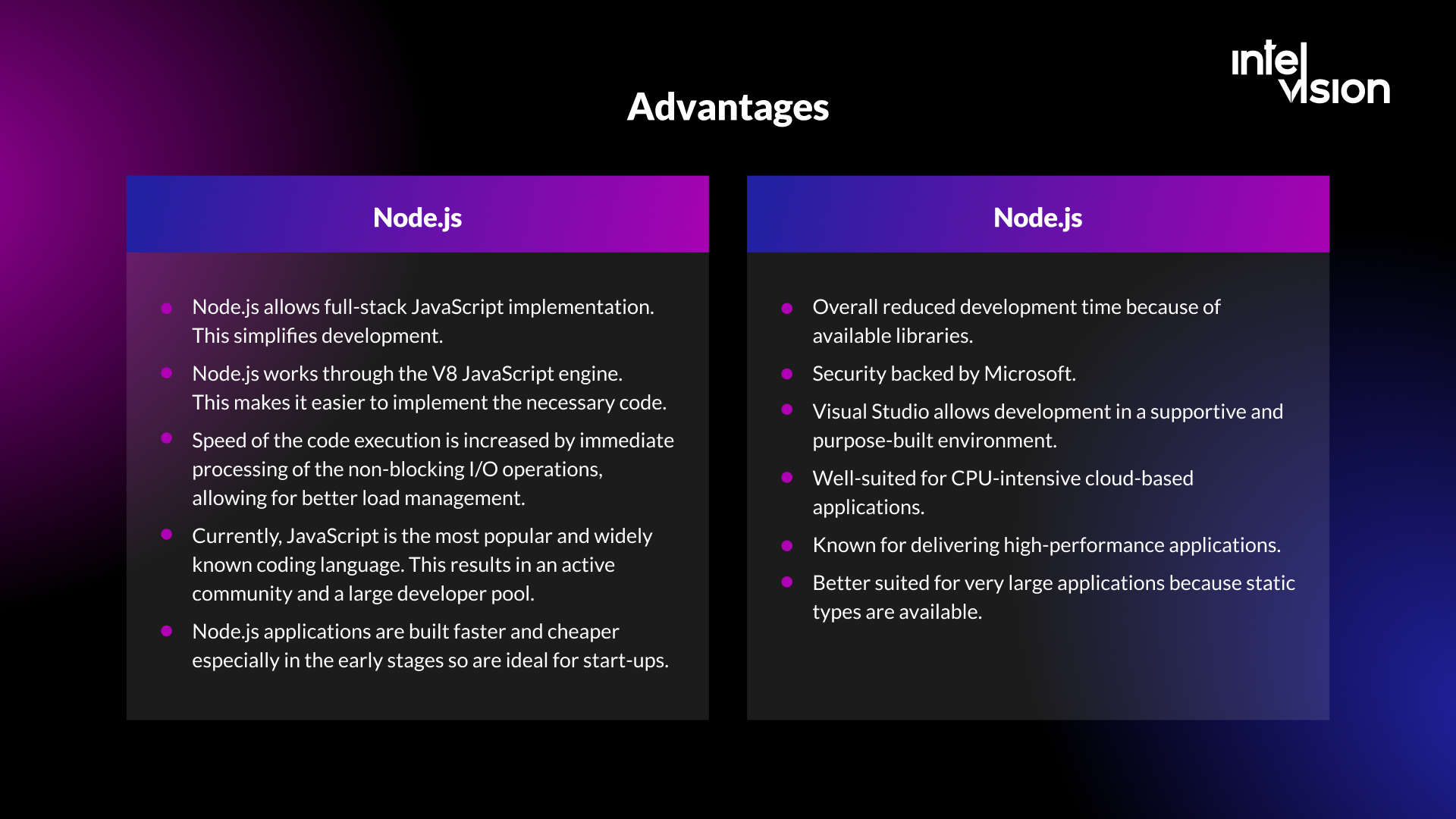
- One language, JavaScript or TypeScript, across front end and back end, which simplifies hiring, code sharing and context switching.
- Non-blocking I/O handles many concurrent connections with few resources, which suits APIs, real-time features and streaming.
- Very large ecosystem and community, with libraries for almost any integration.
- Fast startup, a good fit for serverless functions and backend-for-frontend layers next to React or Next.js.
- Products are often built faster and cheaper in the early stages, which makes Node.js popular with startups validating a product.
- Native TypeScript execution and a built-in test runner reduce the tooling needed for small services.
Advantages of using .NET
- Shorter development time for complex systems thanks to a large standard library, Entity Framework Core and ASP.NET Core built in.
- Security patches and long-term support backed by Microsoft, with three-year LTS releases.
- Strong static typing in C#, which pays off in very large applications and long-lived codebases maintained by several teams.
- Well suited for CPU-intensive cloud applications and high-performance services.
- Mature tooling in Visual Studio, Visual Studio Code and JetBrains Rider.
- One platform for web, cloud, Windows desktop and cross-platform mobile apps.
Who uses Node.js and .NET in 2026
The 2021 version of this article listed well-known companies using each platform. Company stacks change and such lists age badly, so here is what developers report instead. In the Stack Overflow Developer Survey 2026, among 10,281 respondents to the question on web frameworks and technologies:
- 46.4% use Node.js.
- 19.9% use ASP.NET Core, and 13.9% the older ASP.NET.
- ASP.NET Core is admired by 58.0% of those who use it, against 46.1% for Node.js.
Read that as two healthy platforms with different talent pools. JavaScript and TypeScript developers are easier to find in volume; experienced C# developers tend to come with enterprise and domain-heavy experience. The hiring market in your region and your team's current skills often matter more than any technical difference.
How AI-assisted development changes the choice
AI coding assistants are now part of daily work: in the 2026 Stack Overflow survey, 73% of respondents use coding assistants and agents daily, and 48% say they trust AI when they can easily validate its answers. That second number is the important one for a stack decision.
- Types make AI output checkable. Generated code in C# or strict TypeScript is caught by the compiler far more often than plain JavaScript. If you choose Node.js, use TypeScript with strict settings and type-check in CI.
- Both platforms are first-class for AI integration. The Model Context Protocol, used to connect AI agents to tools and data, has official Tier 1 SDKs for both TypeScript and C#. Neither choice locks you out of building AI features.
- Review discipline matters more than the language. AI-generated code increases the volume of changes. Code review, tests and dependency control decide whether that volume turns into speed or into incidents.
How to make the right decision
Both platforms have strengths and weaknesses, so the choice depends on your project requirements, your team and how long the system has to live. Use this as a starting point:
| Your situation | Usually the better fit |
|---|---|
| Real-time features: chat, live dashboards, notifications, collaborative editing | Node.js |
| Backend-for-frontend or server-side rendering for a React or Next.js app | Node.js |
| Startup MVP with a JavaScript team and an I/O-bound API | Node.js |
| Heavy business rules, calculations, reporting, document generation | .NET |
| Large, long-lived system maintained by several teams | .NET, or Node.js with strict TypeScript |
| Windows desktop apps, Active Directory or Microsoft 365 integration | .NET |
| Existing .NET Framework system to modernize | .NET, migrated step by step |
| Serverless functions and edge logic | Node.js, or .NET with Native AOT |
Before you commit, answer these questions:
- Is the hardest part of the system waiting on I/O or computing?
- What does your team know today, and who can you hire in your market within three months?
- How long must the system live, and who will maintain it in five years?
- Which integrations are non-negotiable, and is there a first-class SDK for them on each platform?
- What did a load test of your most demanding endpoint show on each platform?
Using both: what our projects show
The choice is not always either-or. Some of our published projects show where each platform fit:
- Both together. For Finsemble, a desktop application framework for fintech, our team built a library that supports both .NET Core and .NET Framework, with real-time updates over WebSockets from a Node.js back end, packaged for NuGet.
- Node.js for real-time data. For a digital payments company in the DACH region, a stream-based payments dashboard on Node.js, React, Kafka, Redis and TimescaleDB cut report generation from 2 days to minutes and made anomaly response 4x faster.
- .NET for a PropTech MVP. A property management platform built its MVP on .NET 7 with a senior full-stack developer from our team working under the client's tech lead.
- Platform lifecycles are real. For Vaillant we built an internal order management system with a cross-platform mobile app in Xamarin, then part of the .NET family. Microsoft ended Xamarin support on 1 May 2024 in favor of .NET MAUI. Whatever you choose, budget for upgrades as part of owning the product.
Common mistakes when choosing between Node.js and .NET
- Choosing by benchmark headlines. Your database and architecture decide performance far more than the runtime.
- Running CPU-heavy work on the Node.js event loop. Move it to worker threads or a separate service before it slows every request.
- Plain JavaScript in a large back end. Without strict TypeScript, refactoring and AI-assisted changes get risky as the codebase grows.
- Staying on an expiring version. .NET 8 and 9 reach end of support on 10 November 2026; Node.js 20 is already end-of-life.
- Ignoring the dependency supply chain. Unpinned packages and long-lived tokens are how ecosystem attacks reach you.
- Splitting stacks without a reason. Two platforms double the tooling, hiring and upgrade work. Use both only where each clearly earns its place.
We have a lot of in-house experience with both platforms. If you need engineers, we can add Node.js developers or .NET developers to your team. If you are deciding on the architecture of a new or struggling system, a software architecture review gives you a documented recommendation before you commit, and our guide to the technology stack for web applications covers the rest of the stack.
Sources
- Node.js: Previous releases
- Node.js release schedule (GitHub)
- Node.js documentation: Modules, TypeScript
- Node.js documentation: Permissions
- Microsoft: .NET and .NET Core support policy
- Microsoft Learn: What's new in .NET 10
- Microsoft .NET Blog: Bing.com runs on .NET Core 2.1
- Microsoft: Xamarin support policy
- CISA: Widespread supply chain compromise impacting npm ecosystem
- Stack Overflow Developer Survey 2026: Technology data
- Stack Overflow Developer Survey 2026: AI
- Model Context Protocol: SDKs
Read Intelvision often? Add us as a preferred source in Google Search.
Add to preferred sources